U.S. flag

An official website of the United States government

Here’s how you know

Dot gov

Official websites use .gov
A .gov website belongs to an official government organization in the United States.

HTTPS

Secure .gov websites use HTTPS
A lock (LockA locked padlock) or https:// means you have safely connected to the .gov website. Share sensitive information only on official, secure websites.

  • Environmental Topics
  • Laws & Regulations
  • Report a Violation
  • About EPA
Contact Us

Grantee Research Project Results

2011 Progress Report: Toxicity of Drinking Water Associated with Alternative Distribution System Rehabilitation Strategies

EPA Grant Number: R834867
Title: Toxicity of Drinking Water Associated with Alternative Distribution System Rehabilitation Strategies
Investigators: Mariñas, Benito J. , Plewa, Michael J.
Institution: University of Illinois Urbana-Champaign
EPA Project Officer: Page, Angela
Project Period: June 1, 2011 through May 31, 2015
Project Period Covered by this Report: June 1, 2011 through May 31,2012
Project Amount: $599,113
RFA: Advancing Public Health Protection through Water Infrastructure Sustainability (2009) RFA Text |  Recipients Lists
Research Category: Drinking Water , Water

Objective:

This project will investigate the potential impact on public health brought about by emerging alternatives for rehabilitating drinking water distribution systems. The central hypothesis is that there will be differences in the toxicity of tap water associated with different rehabilitation approaches. Specific objectives are to perform: (a) comparative studies of mammalian cell cyto/genotoxicity for simulated distribution system waters representative of conventional rehabilitation with centralized and decentralized treatment, and emerging dual and multiple networks (hypothesis: changes in hydraulic residence time, disinfectant addition and sequential treatment associated with different rehabilitation strategies will affect water cyto/genotoxicity); (b) comparative analysis of the roles of residual disinfectants, free and combined chlorine, and relevant water quality for distribution system rehabilitation alternatives (hypothesis: switching residual disinfection practice from free to combined chlorine will increase tap water cyto/genotoxicity, more so in source waters affected by water reuse).

Progress Summary:
(a) Water concentration methodology development
 
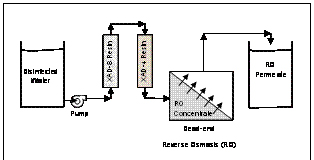
This year we focused mainly on methodology development. Our original idea was to concentrate disinfected source water samples using the apparatus, including non-ionic adsorption XAD-8 and XAD-4 resins connected in series, and reverse osmosis (RO) cell operated in dead-end mode in two-pass mode (Figure 1). 
 
Figure 1
Figure 1. Experimental apparatus used to concentrate
DBPs formed in disinfected water. 
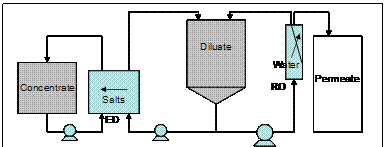
 
We expanded the idea of using RO membrane and included electrodialysis (ED) (Figure 2). Vetter, et al. [1] followed by Gurtler, et al. We expanded the idea of using RO membrane and included electrodialysis (ED) (Figure 2). Vetter, et al. [1] followed by Gurtler, et al. [2] demonstrated a promising water concentration method by coupling RO and ED. They successfully recovered natural organic matter (NOM) in seawater with high total organic carbon (TOC) recovery and low salt content. Recovery of organic carbon from seawater is extremely challenging due to highly diluted carbon content and extremely high inorganic solute in seawater, but still, they achieved recovery of 76% of marine dissolved organic matter with removal of 99.997% of sea salts.
 Figure 2
Figure 2. Hybrid RO/ED system
 
We have been developing methodology to apply RO/ED concentration method for tap water. Challenges of using electrodialysis for tap water originated from much lower solute concentration in tap water compared to sea water. Due to the ion exchange properties of ED membranes, negatively charged NOM molecules were adsorbed to anion exchange sites on the membranes. Sodium sulfate and sodium chloride were added at different time points and amounts in order to optimize the retention and concentration of NOM. It was found that a high concentration of inorganic salt displaced NOM that had adsorbed to anion exchange sites on the membranes, and was able to prevent loss of NOM.
 
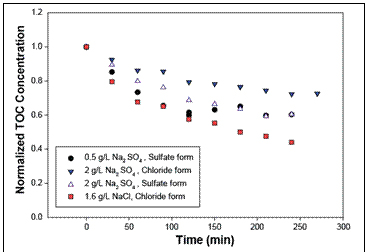
Sulfate addition was more effective than chloride for retaining NOM (represented as TOC concentration) (Figure 3). However, the presence of calcium in the tap water made it difficult to explore higher concentration sulfate addition. We installed zeolite, an inorganic ion exchanger, to solve the calcium sulfate precipitation problem. Work on this project continues to optimize the RO/ED concentration system. One journal article is expected on methodology development.
 
Figure 3
Figure 3. Changes in TOC concentrations after running 
electrodialysis with added amounts of solutes. 
 
 
(b) Preliminary cytotoxicity data for acceptable level of salt
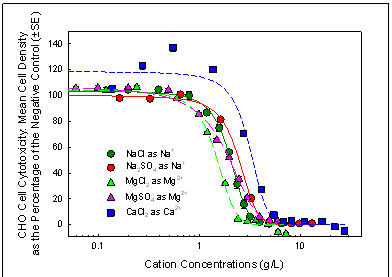
In order to concentrate water samples using combined RO/ED system, a certain level of conductivity needs to be maintained to have better recovery of organic carbon. Thus, target level of salt removal was needed. Since salt was assumed to exert cytotoxicity rather than genotoxicity, a mammalian Chinese hamster ovary (CHO) cell chronic cytotoxicity assay was conducted. A series of CHO cell chronic cytotoxicity concentration-response curves is presented in Figure 4. From this figure, concentrations of salt that induce 90% of salt-mediated killing in CHO cells were calculated and the lowest value of each ion (1.19 g/L as Na+, 0.842 g/L as Mg2+, 1.83 g/L as Cl−, 2.67 g/L as SO42−) can serve as the target level that combined RO/ED system should achieve.
 
Upon achieving more than 100-fold concentration using the RO/ED system, the concentrated sample will be used to prepare F12 medium, and the CHO cell chronic cytotoxicity assay will be conducted to see if the water concentrate itself will exert cytotoxicity on CHO cells.
 

Figure 4

Figure 4. CO cell chronic cytotoxicity concentration-response curve
for inorganic salts expressed as cation concentrations. 


(c) Comparative toxicity of haloacetaldehydes
The haloacetaldehydes (HALs) is a class of unregulated emerging DBPs that represent the third largest chemical class of DBPs in drinking water. According to the U.S. EPA Information Collection Rule (ICR) that involved 500 large drinking-water plants in the United States, HALs were detected at higher concentrations in water treatment systems using ozone rather than chlorine dioxide (up to 30.6 µg/L) [3]. We are conducting quantitative and comparative analyses of in vitro mammalian cell cytotoxicity and genotoxicity of HAL DBPs and related compounds. These data will aid in the further development of mechanism-based structure activity relationship techniques to evaluate the association between the DBP structures and the toxicological level.
 
(d) Preliminary results on the toxicity of HALs
We analyzed a number of HALs for their in vitro cytotoxicity and genotoxicity in CHO cells. The results for the chronic cytotoxicity analyses are presented in Table 1.
 
The LC50 values ranged from 3.58 µM for TBAL to 1.16 mM for TCAL. Based on the LC50 values, the descending order of the chronic cytotoxicity of the HALs analyzed was TBAL ≈ CAL > DBAL > BCAL > IAL > BAL > DCAL > BDCAL > FAL > TCAL.
 

Table 1. CHO cell chronic cytotoxicity of the HALs.

Compound
(LC50)* (M)
Tribromoacetaldehyde (TBAL)
3.58 X 10-6
Chloroacetaldehyde (CAL)
3.60 X 10-6
Dibromoacetaldehyde (DBAL)
4.70 X 10-6
Bromochloroacetaldehyde (BCAL)
5.34 X 10-6
Iodoacetaldehyde (IAL)
6.17 X 10-6
Bromoacetaldehyde (BAL)
1.62 X 10-5
Dichloroacetaldehyde (DCAL)
2.93 X 10-5
Bromodichloroacetaldehyde (BDCAL)
3.07 X 10-5
Formaldehyde (FAL)
7.29 X 10-5
Trichloroacetaldehyde (TCAL)
1.16 X 10-3
 
* LC50 (%C½ value) is the concentration of each chemical that reduced the CHO cell density by 50% as compared to the negative control
The results for the single cell gel electrophoresis (SCGE) genomic DNA damage analyses for the HALs are presented in Table 2.


Table 2. CHO cell acute genotoxic potency values of the HALs.

Compound
SCGE Genotoxic Potency (M)*
Dibromochloroacetaldehyde (DBCAL)
1.51 X 10-4
Chloroacetaldehyde (CAL)
1.59 X 10-4
Dibromoacetaldehyde (DBAL)
1.64 X 10-4
Tribromoacetaldehyde (TBAL)
3.55 X 10-4
Bromodichloroacetaldehyde (BDCAL)
4.38 X 10-4
Bromochloroacetaldehyde (BCAL)
5.71 X 10-4
Dichloroacetaldehyde (DCAL)
8.83 X 10-4
Bromoacetaldehyde (BAL)
9.61 X 10-4
Trichloroacetaldehyde (TCAL)
NS
 
*The SCGE genotoxic potency was determined as the HAL molar concentration at the midpoint of the concentration-response curve for the SCGE tail moment value.
The SCGE genotoxic potency value ranged from 151 µM for DBCAL to 961 µM for BAL (Table 2). Based on the genotoxic potency values, the descending rank order of the genotoxicity was DBCAL > CAL > DBAL > TBAL > BDCAL > BCAL > DCAL > BAL. TCAL was not genotoxic.

Future Activities:

(a) Water concentration and DBP production for toxicity evaluation
 
Upon optimization of RO/ED operation, we plan to acquire a water sample from the Bloomington treatment plant. The City of Bloomington obtains water from two man-made reservoirs, Lake Bloomington and Evergreen Lake. The Lake Bloomington reservoir is fed by runoff from 70 square miles of land while the drainage area for the Evergreen Lake reservoir is 41 square miles [4]. Water is treated conventionally, including lime softening and GAC-filtration. Filter effluent prior to chlorination will be obtained as a water sample for our comparative toxicological study. TOC level of the finished water in the distribution system ranged from 3 to 6.4 mg/L in one sampling point, and from 1.3 to 2.4 mg/L at a second sampling point, both sampling events performed in the year 2011[5]. Water quality report in 2009 gives a sodium level of 15 mg/L and sulfate level of 27 mg/L [6].
 
Even though the RO/ED process seems promising, the outcome needs to be validated. XAD extraction will serve as a standard since the majority of whole-mixture study is associated with XAD [7] and also RO/ED concentrate will require exchange to an organic solvent prior to analysis by gas chromatography [8]. Furthermore, the RO/ED process might not achieve a high enough concentration factor, and if that is the case, additional concentration with XAD will be necessary. For XAD concentration, compounds are adsorbed onto the resin of choice and eluted with an organic solvent that is then removed by evaporation. The remaining organics can then be eluted in an appropriate solvent for testing [9].
 
Our particular interest is comparison between chlorination and chloramination with different levels of bromide and iodide. The proposed test matrix is summarized in Table 3.
 

Table 3. Test matrix for toxicological evaluation of RO/ED and XAD concentrates.

 
Halide addition
Disinfection
Work flow
RO/ED control
−
−
RO/ED → toxicity test
RO/ED → XAD → toxicity test
RO/ED no halide, chlorination
−
Chlorination
RO/ED → disinfection → toxicity test
RO/ED → disinfection → XAD → toxicity test
RO/ED no halide, chloramination
−
Chloramination
RO/ED → disinfection → toxicity test
RO/ED → disinfection → XAD → toxicity test
RO/ED + halide, chlorination
+ Br−, I−
Chlorination
RO/ED → disinfection → toxicity test
RO/ED → disinfection → XAD → toxicity test
RO/ED + halide, chloramination
+ Br−, I−
Chloramination
RO/ED → disinfection → toxicity test
RO/ED → disinfection → XAD → toxicity test
XAD control
−
−
XAD → toxicity test
XAD no halide, chlorination
−
Chlorination
Disinfection → XAD → toxicity test
XAD no halide, chloramination
−
Chloramination
Disinfection → XAD → toxicity test
XAD + halide, chlorination
+ Br−, I−
Chlorination
Disinfection → XAD → toxicity test
XAD + halide, chloramination
+ Br−, I−
Chloramination
Disinfection → XAD → toxicity test
 
RO/ED concentrate and disinfected water samples will be analyzed for TOC, TOX, SUVA, and DBP profiles. Toxicological evaluation includes CHO cell chronic cytotoxicity and CHO cell acute genotoxicity.
 
(b) Comparative toxicity of HALs
For the HALs, future studies will include the completion of the full set of HALs toxicity bioassays to determine the cytotoxic and genotoxic rank order of the HALs and develop a comparative toxicity database, followed by a mechanism-based structure-activity relationship analysis for comparative toxicity study.

References:

[1]        T. A. Vetter, E. M. Perdue, E. Ingall, J. F. Koprivnjak, and P. H. Pfromm, "Combining reverse osmosis and electrodialysis for more complete recovery of dissolved organic matter from seawater," Separation and Purification Technology, vol. 56, pp. 383-387, 2007.
[2]        B. K. Gurtler, T. A. Vetter, E. M. Perdue, E. Ingall, J. F. Koprivnjak, and P. H. Pfromm, "Combining reverse osmosis and pulsed electrical current electrodialysis for improved recovery of dissolved organic matter from seawater," Journal of Membrane Science, vol. 323, pp. 328-336, 2008.
[3]        M. J. McGuire, J. L. McLain, and A. Obolensky, Information Collection Rute Data Analysis. Denver, CO: AwwaRF and AWWA, 2002.
[4]        Bloomington, "2010 Annual Consumer Report on the Quality of Tap Water," 2011.
[5]        Drinking water watch. Available: http://www.dnr.mo.gov/DWW/
[6]        Bloomington, "2009 Annual Consumer Report on the Quality of Tap Water," 2010.
[7]        J. E. Simmons, S. D. Richardson, T. F. Speth, R. J. Miltner, G. Rice, K. M. Schenck, E. S. Hunter, 3rd, and L. K. Teuschler, "Development of a research strategy for integrated technology-based toxicological and chemical evaluation of complex mixtures of drinking water disinfection byproducts," Environmental Health Perspectives, vol. 110 Suppl 6, pp. 1013-24, 2002.
[8]        S. D. Richardson, A. D. Thruston, Jr., S. W. Krasner, H. S. Weinberg, R. J. Miltner, K. M. Schenck, M. G. Narotsky, A. B. McKague, and J. E. Simmons, "Integrated disinfection by-products mixtures research: comprehensive characterization of water concentrates prepared from chlorinated and ozonated/postchlorinated drinking water," Journal of Toxicology and Environmental Health, Part A, vol. 71, pp. 1165-86, 2008.
[9]        S. D. Richardson, A. D. Thruston, T. V. Caughran, P. H. Chen, T. W. Collette, T. L. Floyd, K. M. Schenck, B. W. Lykins, G. R. Sun, and G. Majetich, "Identification of new ozone disinfection byproducts in drinking water," Environmental Science & Technology, vol. 33, pp. 3368-3377, 1999.

Journal Articles:

No journal articles submitted with this report: View all 9 publications for this project

Supplemental Keywords:

Sustainability, rehabilitation strategies, public health protection, safe drinking water

Progress and Final Reports:

Original Abstract
  • 2012 Progress Report
  • 2013 Progress Report
  • Final Report
  • Top of Page

    The perspectives, information and conclusions conveyed in research project abstracts, progress reports, final reports, journal abstracts and journal publications convey the viewpoints of the principal investigator and may not represent the views and policies of ORD and EPA. Conclusions drawn by the principal investigators have not been reviewed by the Agency.

    Project Research Results

    • Final Report
    • 2013 Progress Report
    • 2012 Progress Report
    • Original Abstract
    9 publications for this project
    6 journal articles for this project

    Site Navigation

    • Grantee Research Project Results Home
    • Grantee Research Project Results Basic Search
    • Grantee Research Project Results Advanced Search
    • Grantee Research Project Results Fielded Search
    • Publication search
    • EPA Regional Search

    Related Information

    • Search Help
    • About our data collection
    • Research Grants
    • P3: Student Design Competition
    • Research Fellowships
    • Small Business Innovation Research (SBIR)
    Contact Us to ask a question, provide feedback, or report a problem.
    Last updated April 28, 2023
    United States Environmental Protection Agency

    Discover.

    • Accessibility
    • Budget & Performance
    • Contracting
    • EPA www Web Snapshot
    • Grants
    • No FEAR Act Data
    • Plain Writing
    • Privacy
    • Privacy and Security Notice

    Connect.

    • Data.gov
    • Inspector General
    • Jobs
    • Newsroom
    • Open Government
    • Regulations.gov
    • Subscribe
    • USA.gov
    • White House

    Ask.

    • Contact EPA
    • EPA Disclaimers
    • Hotlines
    • FOIA Requests
    • Frequent Questions

    Follow.