U.S. flag

An official website of the United States government

Here’s how you know

Dot gov

Official websites use .gov
A .gov website belongs to an official government organization in the United States.

HTTPS

Secure .gov websites use HTTPS
A lock (LockA locked padlock) or https:// means you have safely connected to the .gov website. Share sensitive information only on official, secure websites.

  • Environmental Topics
  • Laws & Regulations
  • Report a Violation
  • About EPA
Contact Us

Grantee Research Project Results

2010 Progress Report: Nonlinear and Threshold Responses to Environmental Stressors in Land-river Networks at Regional to Continental Scales

EPA Grant Number: R833261
Title: Nonlinear and Threshold Responses to Environmental Stressors in Land-river Networks at Regional to Continental Scales
Investigators: Melillo, Jerry , Vörösmarty, Charles J. , Peterson, Bruce J. , Wollheim, Wil , Felzer, Benjamin S. , Kicklighter, David Wesley
Current Investigators: Melillo, Jerry , Peterson, Bruce J. , Vörösmarty, Charles J. , Felzer, Benjamin S. , Kicklighter, David Wesley , McClelland, James , Wollheim, Wil
Institution: Marine Biological Laboratory , University of New Hampshire
EPA Project Officer: Packard, Benjamin H
Project Period: September 1, 2007 through August 31, 2010 (Extended to August 31, 2011)
Project Period Covered by this Report: September 1, 2009 through August 31,2010
Project Amount: $899,191
RFA: Nonlinear Responses to Global Change in Linked Aquatic and Terrestrial Ecosystems and Effects of Multiple Factors on Terrestrial Ecosystems: A Joint Research Solicitation- EPA, DOE (2005) RFA Text |  Recipients Lists
Research Category: Aquatic Ecosystems , Climate Change

Objective:

Water is an essential building block of the Earth system and is critical to human prosperity. At the same time, humans are rapidly embedding themselves into the basic character of the water cycle without full knowledge of the consequences. Major sources of water system change constitute ultimately a question of multiple stressors and their impacts on these important water systems. The multiple stressors include resource mismanagement and overuse, river flow distortion, pollution, watershed disturbance, invasive species, and greenhouse warming. Defining the collective significance of such change remains in our view a grand challenge for the Earth and social sciences alike.
 
Our objective in this research was to explore the relationships among environmental stresses, the nonlinear and threshold behaviors they cause within freshwater ecosystems of large drainage basins, and the ecosystem services provided by the streams and rivers of the basins. To do this we refined our process-based aquatic model, the Aquatic Ecosystem Model (AEM) and tested its ability to simulate documented nonlinear and threshold responses to environmental stresses at a variety of spatial scales, from the river reach to the entire river network within a drainage basin. We are coupling the AEM with our improved terrestrial biogeochemistry model, the Terrestrial Ecosystem Model (TEM), thereby creating a new version of our Drainage Basin Model, which we use for regional and global analyses of nonlinear and threshold behaviors in freshwater systems at large scales.
 
Our research has five focus areas:
  1. Expand and refine our existing data archives with new high resolution data that are relevant for Aquatic Ecosystem analysis;
  2. Revise our Framework for Aquatic Modeling of the Earth Systems (FrAMES) to better serve the AEM both in terms of providing interfaces to our data archive and enable coupling of AEM components;
  3. Improve the representation of constituent processes in our coupled Aquatic Ecosystem Model;
  4. Improve the representation of the water and nitrogen cycles in TEM; and
  5. Apply coupled AEM-TEM to identify nonlinear threshold behaviors in freshwater ecosystems.
In this progress report, we focus on our work in Database Development (Focus 1), FrAMES (Focus 2), and AEM (Focus 3).

Progress Summary:

1  Aquatic Database Development

Considerable amount for efforts was dedicated to refine our data archive serving a variety of Earth System studies to incorporate various data from outside sources and to develop new data products on our own.

1.1  Near Real-time Climate Data Archive

A core element of our data archive is a series of climate products from different sources. The two most important climate variables for our AEM are air temperature and precipitation. While we find our model to be less sensitive to air temperature [Fekete et al. 2010], but the precipitation inputs are critical [Fekete et al. 2004, Biemans et al. 2009], therefore we put special emphasis on collecting a wide range of precipitation data products from different sources (based on in-situ and satellite observations).
 
Besides the precipitation data, we also mirror the full range of atmospheric variables from the NCEP reanalysis [Kalnay et al. 1996; Kistler et al. 2001] and the North American Regional Reanalysis are also incorporated into our data holdings.
 
The precipitation data sets at different spatial resolution in conjunction with the regridded river networks discussed in the next section allowed us to carry out a series of test assessing the impact of resolution on the riverine flow routing. Our test confirmed the intuitive findings of Fekete et al. [2001] that flow routing at daily or sub-daily temporal resolution requires high resolution river networks, but due to the averaging nature of the horizontal water transport processes the same temporal resolution for computing the vertical water balances is not needed. In other words, a land-surface water balance scheme operated at some coarser resolution could still provide bases for realistic discharge estimates, when the coarse resolution surface runoff input is routed over a finer resolution river network.

1.2  River Network and Corresponding Elevation

High resolution representation of the river systems play central role in our research. Originally, our intention was to use a 6 minute network derived from HYDRO1k [Verdin et al., 1999] modified with network regridding algorithm by Fekete et al. [2001] and applying same manual editing that we applied to our previous 30 minute resolution network [Vörösmarty et al., 2000]. HYDRO1k turned out to have too many significant errors and as a consequence the resulting 6-minute network needed too much manual editing.
 
The World Wildlife Fund started to develop a new high resolution gridded network derived from the Shuttle Radar Terrain Mapping mission elevation data combined with a variety of additional data sources representing linear features like river courses or lake and continent shore lines. The resulting ~500 m (15 arc second on longitude × latitude) gridded network (HydroSHEDS) [Lehner et al., 2008] is probably the best representation of the river systems globally (with the exception of higher latitudes that SRTM elevation did not cover). The ~500 m resolution is actually too high for carrying out flow routing over large watersheds so we applied the same regridding algorithm from Fekete et al. [2001] to aggregate HydroSHEDS to coarser resolutions (3 and 6 arc minutes). We choose 3 and 6 minutes because these resolutions yield exact numbers (0.05 and 0.1 degree respectively) in decimal degrees. We merged HydroSHEDS with our existing 6 minute network to expand its coverage beyond the SRTM domain.
 
Recently we revisited and revised our our regridding algorithm. In addition, we obtained a new high-resolution digital elevation data set with full global extent derived from stereographic processing of ASTER images from NASA’s Aqua and Terra satellites. The ASTER-DEM produced and 30 m spatial resolution has a 25 m vertical accuracy. While this dataset is less accurate than SRTM, its full coverage allowed us to complete our network at high latitudes.
 
Furthermore, we applied network defragmentation routine, which eliminates sporadic basin fragments (as a result of DEM errors) by identifying endorheic basins and searching for potential pour points on their watershed boundaries within a given elevation threshold. The algorithm reroutes the gridcells between the pour point and the endrorheic basin’s outlet to connect the 
basins to the adjacent basin with lower basin outlet. Originally, we applied from the GLOBE 1 km (30 arc second) data set from NOAA (which has full global coverage) for the network defragmentation, but we redid the same work using ASTER-DEM as soon as we got hold of the better elevation data. We applied DEM correction based on the gridded networks at aggregated resolution, which established the consistency between the DEM and the river network by lowered the elevation (cutting valleys) along all potential river courses from headwater to river mouth.


1.3  Wetland Database


Figure 1
Figure 1. Wetland distribution form a) the National Wetland Inventory, and b) the National Land Cover Data set. 
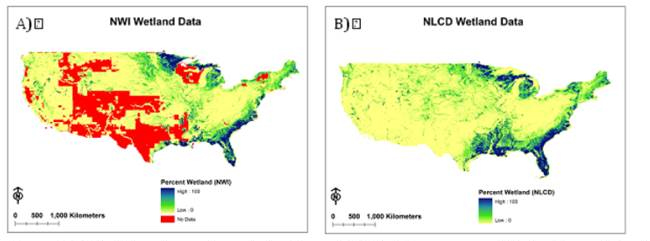


Wetland Data Sets. Wetlands can greatly influence both nitrogen and carbon loading to aquatic systems. We therefore developed a wetland data set for the US that is applicable to continental scale modeling (Figure 1). We aggregated existing high-resolution data sets to the 6 minute (~8 x 8 km) resolution. We obtained the entire National Wetlands Inventory digital archive from Tom Dahl at the United States Fish and Wildlife Service. This is a very high resolution (1:24000) digital data set that covers 58% of the conterminous U.S. and 25% of Alaska. We also extracted the wetland data in the National Land Cover Data (NLCD) set, which is at 30m resolution. Each of these data sets was aggregated to courser products that can interface with our gridded models. We are aggregating the data to 6 minute resolution, to provide a wetland layer of percent of grid cell as wetlands.

1.4  Developing Wastewater Treatment Plant Database

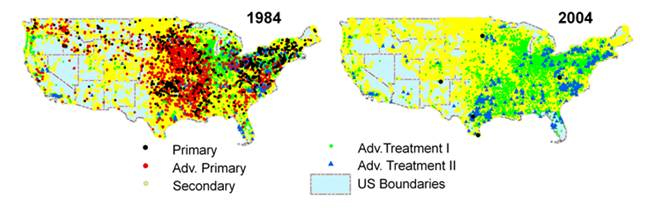
EPA is mandated by the Clear Water Act (adopted in 1972) to maintain an inventory of the operating wastewater treatment plants and oversee their operation. The Clean Water Need Surveys (CNWS) conducted in every four years since 1976 provide comprehensive information about the publicly funded wastewater treatment plants nation wide. We consolidated the differences between the 1984 and 2004 CWNS database (Figure 2), and we analyzed the improvement of the wastewater treatment in terms of total nitrogen release to freshwater. The majority of the treatment plants (12737 out of 15317 in 1984 and 14037 out of 16583 in 2004).
 

Figure 2
Figure 2. Distribution of wastewater treatment facilities from the Clean Water Needs Surveys, categorized by treatment level. 


2  Improved Representation of Aquatic Processes
 
2.1 AEM progress.
 
The current AEM takes advantage of hydrologic functionality provided by the WBMplus to route material through continental river systems. Besides representing the natural runoff generation processes, WBM/WTMplus incorporates water withdrawals (from surface diversions and groundwater) plus reservoir operation modules to treat direct human impacts on streamflow [Fekete et al., 2010; Wisser et al., 2008, 2010a, 2010b]. These models predict spatially distributed discharge, a key driver of aquatic processes. Other key drivers of aquatic processes include light and water temperature. We have developed submodels that predict these drivers, as described in our previous annual report. FrAMES now has the capacity to route water temperature, nitrogen and carbon.
 

Figure 3
 Figure 3. Predicted mean annual water temperature, aggregaed from daily
predicted temperatures, compared against observed mean annual water
temperature, derived from the GEMS Water data set (Stewart et.al., 2010)
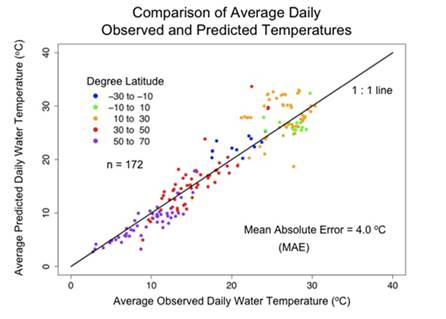


The water temperature model predicts average daily water temperatures at a 30-minute river grid network resolution (STN-30) based on mixing of terrestrial runoff and re-equilibration during discharge routing. The empirical re-equilibration model accounts for variable solar radiation, air temperature, and hydraulic dimensions [Dingman, 1974]. Average predicted water temperatures match global daily observations well with an average Index of Agreement (d) of 0.71 for 195 stations (1975 – 2001). Predictions are most accurate at high latitudes (30 to 70 degrees) and least accurate at low to mid latitudes (10 degrees to 30 degrees) highlighting the method’s bias towards temperate climates [Stewart et al., in prep]. In higher latitudes, the time series of mean daily temperatures compare well with observations. Mean annual temperatures correspond well with observations across all latitudes (Figure 3). Longitudinal profiles along large river transects are consistent with the expectation that re-equilibration with ambient air temperature is a dominant influence on water temperatures. The water temperature component offers the potential to understand how climate change will impact aquatic biogeochemical processes.
 

Figure 4
Figure 4. Predicted a) POC and b) DOC loadings into the entire river network of the Mississippi RIver network
assuming potential and contemporary land use. DOC is much more dependents on interannual variation in 
moisture conditions. Both show considerable reductions between potential and contemporary periods, suggesting
that heterotrophy has dec,ined considerably in aquatic systems. 
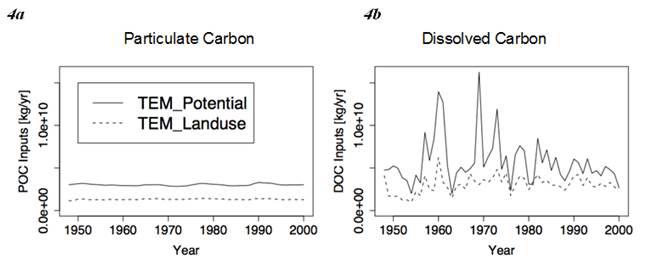


While temperature routing is embedded entirely within the hydrology model (i.e. it uses the same drivers that are used by the hydrology modules), routing of carbon and nitrogen requires estimates of spatially distributed loading from land, either using predictions from terrestrial ecosystem models, or specified as input fields from other sources. These are provided by existing data sets [Green et al., 2004], or from other models developed through this project (e.g. linkage to the TEM model). We linked carbon loading predictions from TEM to our river routing model to explore how riverine carbon fluxes changed between preindustrial and contemporary land use in the Mississippi basin. Dissolved organic carbon loading predictions were based directly on TEM results, while particulate organic carbon was estimated from litter fall estimates from EM coupled with river network geomorphological and hydraulic parameters (stream lengths, stream numbers, stream widths, riparian vegetation presence, riparian vegetation height). Our findings suggest particulate carbon loading in the contemporary era are <50% of what they were under preindustrial conditions (Figure 4a). Dissolved organic carbon is also reduced, though is more related to interannual climate variability (Figure 4b).
 
2.2  AEM Denitrification/Respiration Component.
 
Transformations of carbon and nitrogen currently emphasize dissimilatory processes (i.e. removal from the system through respiration of carbon or denitrification of nitrate). For nitrogen we use simple removal parameters that are based on empirical studies [Mulholland, 2008]. These removal parameters are a function of concentration and water temperature [Wollheim et al., 2008a; Wollheim et al., 2008b]. The empirical studies indicate that denitrification is a non-linear function of concentration [Mulholland, 2008]. We have explored the impact that this non-linearity has had on the flux of dissolved inorganic nitrogren (DIN) to the coastal zone between preindustrial and contemporary periods [Wollheim et al., in prep.]. The non-linearity leads to a weakened capacity of entire river systems to control nutrient exports.

References:

Biemans, H.; Hutjes, R. W. A.; Kabat, P.; Strengers, B. J.; Gerten, D. and Rost, S.: Effects of precipitation uncertainty on discharge calculations for main river basins, Journal of Hydromet., 10, 1011-1025 2009
 
Dingman, S. L.: Equilibrium temperatures of water surfaces as related to air temperature and solar radiation, Water Resources Research, 8, 42-49, 1974
 
Fekete, B. M.; Vörösmarty, C. J. and Lammers, R. B.: Scaling gridded river networks for macro-scale hydrology: Development and analysis and control of error, Water Resources Research, 37, 1955-1968, 2001
 
Fekete, B. M.; Vörösmarty, C. J.; Roads, J. and Willmott, C.: Uncertainties in Precipitation and their Impacts on Runoff Estimates, Journal of Climatology, 17, 294-303 2004
 
Fekete, B. M.; Wisser, D.; Kroeze, C.; Mayorga, E.; Bouwman, L.; Wollheim, W. M. and Vörösmarty, C. J.: (in press) Millennium Ecosystem Assessment scenario drivers (1970-2050): climate and hydrological alterations, Global Biochemical Cycles
 
Green, P. A.; Vörösmarty, C. J.; Meybeck, M.; Galloway, J. N.; Peterson, B. J. & Boyer, E. W.: Pre-industrial and contemporary fluxes of nitrogen through rivers: A global assessment based on typology, Biogeochemistry, 68, 71-105, 2004
 
Kalnay, E.; Kanamitsu, M.; Kistler, R.; Collins, W.; Deaven, D.; Gandin, L.; Iredell, M.; Saha, S.; White, G.and Woolen, J.; Zhu, Y.; Chelliah, M.; Ebisuzaki, W.; Higgis, W.; Janowiak, J.; Mo, K. C.; Ropelewski, C.; Wang, J.; Leetmaa, A.; Reynolds, R.; Jenne, R. and Joseph, D.: The NCEP/NCAR 40-year reanalysis project, Bulletin of the American Meteorological Society, 77, 437-472 1996
 
Kistler, R.; Kalnay, E.; Collins, W.; Saha, S.; White, G.; Woolen, J.; Chelliah, M.; Ebisuzaki, W.; Kanamitsu, M.; Kousky, V.; van den Dool, H.; Jenne, R. and Fiorino, M.: The NCEP/NCAR 50-year reanalysis: Monthly means CD-ROM and Documentation, Bull. Amer. Meteorol. Soc., 82, 247-267 2001
 
Lehner, B.; Verdin, K. & Jarvis, A.: New global hydrography derived from spaceborne elevation data, AGU EOS Transactions, 89, 93-94, 2008
 
M. Rychtecka, C. J. Vörösmarty, P. Green. B. M. Fekete and A. Neale: Spatio-Temporal Impact of Wastewater Point Sources on Nitrogen Pollution in U.S. Watersheds, in prep, 2011
 
McMahon, G.; Tervelt, L.; Donehoo, W. :Methods for estimating annual wastewater nutrient loads in the southeastern United States, Open-File Report 2007–1040, U.S. Geologi­cal Survey, Reston, 2007
 
Mulholland, P. J.; Helton, A. M.; Poole, G. C.; Hall, R. O.; Hamilton, S. K.; Peterson, B. J.; Tank, J. L.; Ashkenas, R. L.; Cooper, L. W.; Dahm, C. N.; Dodds, W. K.; Findlay, S. E. G.; Gregory, S. V.; Grimm, N. B.; Johnson, S. L.; McDowell, W. H.; Meyer, J. L.; Valett, H. M.; Webster, J. R.; Arango, C. P.; Beaulieu, J. J.; Bernot, M. J.; Burgin, A. J.; Crenshaw, C. L.; Johnson, L. T.; Niederlehner, B. R.; O'Brien, J. M.; Potter, J. D.; Sheibley, R. W.; Sobota, D. J. & Thomas, S. M.: Stream denitrification across biomes and its response to anthropogenic nitrate loading, Nature, 452, 202-205, 2008
 
Syvitski, J. P. M. & Milliman, J. D.: Geology, geography, and humans battle for dominance over the delivery of fluvial sediment to the coastal ocean, J. Geology, 115, 1-19, 2007
 
Verdin, K. L. and Verdin, J. P.: A Topological System for Delineation and Codification of the Earth's River Basins, Journal of Hydrology, 218, 1-12, 1999
 
Vörösmarty, C. J.; Fekete, B. M.; Meybeck, M. & Lammers, R. B.: Global System of Rivers: Its role in organizing continental land mass and defining land-to-ocean linkages, Global Biochemical Cycles, 14, 599-621, 2000
 
Wisser, D.; Frolking, S.; Douglas, E. M.; Fekete, B. M.; Vörösmarty, C. J. and Schumann, A. H.: Global irrigation water demand: Variability and uncertainties arising from agricultural and climate data sets: Geophysical Research Letters, 35, doi:10.1029/2008GL035296, 2008
 
Wisser, D.; Fekete, B. M.; Vörösmarty, C. J. and Schumann, A. H.: Reconstructing 20th century global hydrography: A contribution to the Global Terrestrial Network- Hydrology (GTN-H), Hydrology and Earth System Sciences, 14, 1-24, 2010a
 
Wisser, D.; Frolking, S.; Douglas, E.; Fekete, B. M.; Schuman, A. H. and Vörösmarty, C. J.: The significance of local water resources captured in small reservoirs for crop production - a global-scale analysis: Journal of Hydrology, 384, 264-275, 2010b
 
Wollheim, W. M.; Peterson, B. J.; Vörösmarty, C. J.; Hopkinson, C. S. and Thomas, S. A.: Dynamics of N removal over annual time scales in a suburban river network, Biogeosciences, G03038, doi:10.1029/2007JG000660, 2008a
 
Wollheim, W. M.; Vörösmarty, C. J.; Bouwman, A. F.; Green, P. A.; Harrison, J.; Linder, E.; Peterson, B. J.; Seitzinger, S. and Syvitski, J. P. M.: Global N removal by freshwater aquatic systems: a spatially distributed, within-basin approach, Global Biochemical Cycles, GB2026, doi:10.1029/2007GB002963, 2008b


Journal Articles on this Report : 8 Displayed | Download in RIS Format

Publications Views
Other project views: All 28 publications 13 publications in selected types All 13 journal articles
Publications
Type Citation Project Document Sources
Journal Article Alexander RB, Bohlke JK, Boyer EW, David MB, Harvey JW, Mulholland PJ, Seitzinger SP, Tobias CR, Tonitto C, Wollheim WM. Dynamic modeling of nitrogen losses in river networks unravels the coupled effects of hydrological and biogeochemical processes. Biogeochemistry 2009;93(1-2):91-116. R833261 (2008)
R833261 (2009)
R833261 (2010)
R833261 (Final)
R834187 (2010)
R834187 (2011)
R834187 (2012)
R834187 (2013)
R834187 (Final)
  • Full-text: Springer-Full Text HTML
    Exit
  • Abstract: Springer-Abstract
    Exit
  • Other: Springer-Full Text PDF
    Exit
  • Journal Article Beaulieu JJ, Tank JL, Hamilton SK, Wollheim WM, Hall Jr. RO, Mulholland PJ, Peterson BJ, Ashkenas LR, Cooper LW, Dahm CN, Dodds WK, Grimm NB, Johnson SL, McDowell WH, Poole GC, Valett HM, Arango CP, Bernot MJ, Burgin AJ, Crenshaw CL, Helton AM, Johnson LT, O'Brien JM, Potter JD, Sheibley RW, Sobota DJ, Thomas SM. Nitrous oxide emission from denitrification in stream and river networks. Proceedings of the National Academy of Sciences of the United States of America 2011;108(1):214-219. R833261 (2010)
    R833261 (Final)
    R834187 (2010)
    R834187 (2011)
    R834187 (2012)
    R834187 (2013)
    R834187 (Final)
  • Full-text from PubMed
  • Abstract from PubMed
  • Associated PubMed link
  • Full-text: PNAS-Full Text HTML
    Exit
  • Abstract: PNAS-Abstract
    Exit
  • Other: PNAS-Full Text PDF
    Exit
  • Journal Article Felzer BS, Cronin TW, Melillo JM, Kicklighter DW, Schlosser CA. Importance of carbon-nitrogen interactions and ozone on ecosystem hydrology during the 21st century. Journal of Geophysical Research-Biogeosciences 2009;114(G1):G01020 (10 pp.). R833261 (2008)
    R833261 (2009)
    R833261 (2010)
    R833261 (Final)
  • Full-text: Wiley-Full-text PDF
    Exit
  • Abstract: Wiley-Abstract & Full-text HTML
    Exit
  • Journal Article Green MB, Wollheim WM, Basu NB, Gettel G, Rao PS, Morse N, Stewart R. Effective denitrification scales predictably with water residence time across diverse systems. Nature Precedings 2009;3520.1. R833261 (2009)
    R833261 (2010)
    R833261 (Final)
    R834187 (2010)
    R834187 (2011)
    R834187 (2012)
    R834187 (2013)
    R834187 (Final)
  • Full-text: Nature Precedings-Full Text HTML
    Exit
  • Abstract: Nature Precedings-Abstract
    Exit
  • Other: Research Gate-Abstract & Full Text PDF
    Exit
  • Journal Article Harrison JA, Maranger RJ, Alexander RB, Giblin AE, Jacinthe P-A, Mayorga E, Seitzinger SP, Sobota DJ, Wollheim WM. The regional and global significance of nitrogen removal in lakes and reservoirs. Biogeochemistry 2009;93(1-2):143-157. R833261 (2008)
    R833261 (2009)
    R833261 (2010)
    R833261 (Final)
    R834187 (2010)
    R834187 (2011)
    R834187 (2012)
    R834187 (2013)
    R834187 (Final)
  • Abstract: Springer-Abstract
    Exit
  • Other: USGS-Abstract
  • Journal Article Helton AM, Poole GC, Meyer JL, Wollheim WM, Peterson BJ, Mulholland PJ, Bernhardt ES, Stanford JA, Arango C, Ashkenas LR, Cooper LW, Dodds WK, Gregory SV, Hall Jr. RO, Hamilton SK, Johnson SL, McDowell WH, Potter JD, Tank JL, Thomas SM, Valett HM, Webster JR, Zeglin L. Thinking outside the channel: modeling nitrogen cycling in networked river ecosystems. Frontiers in Ecology and the Environment 2011;9(4):229-238. R833261 (2010)
    R833261 (Final)
    R834187 (2010)
    R834187 (2011)
    R834187 (2012)
    R834187 (2013)
    R834187 (Final)
  • Full-text: ResearchGate-Full Text PDF
    Exit
  • Abstract: ESA-Abstract
    Exit
  • Other: U.S. Forest Service-Full Text PDF
    Exit
  • Journal Article Wollheim WM, Vorosmarty CJ, Bouwman AF, Green P, Harrison J, Linder E, Peterson BJ, Seitzinger SP, Syvitski JPM. Global N removal by freshwater aquatic systems using a spatially distributed, within-basin approach. Global Biogeochemical Cycles 2008;22(2):GB2026. R833261 (2008)
    R833261 (2010)
    R833261 (Final)
  • Full-text: Wiley-Full-text PDF
    Exit
  • Abstract: Wiley-Abstract & Full-text HTML
    Exit
  • Journal Article Wollheim WM, Peterson BJ, Thomas SM, Hopkinson CH, Vorosmarty CJ. Dynamics of N removal over annual time periods in a suburban river network. Journal of Geophysical Research-Biogeosciences 2008;113(G3):G03038. R833261 (2008)
    R833261 (2010)
    R833261 (Final)
  • Full-text: Wiley-Full-text PDF
    Exit
  • Abstract: Wiley-Abstract & Full-text HTML
    Exit
  • Supplemental Keywords:

    Global change, multiple stressors, nonlinear ecosystem response, threshold response, river network, drainage basin, land cover change, ecosystem services, water quality, hydrologic regime, hydrological modeling, multiple scales

    Progress and Final Reports:

    Original Abstract
  • 2008 Progress Report
  • 2009 Progress Report
  • Final Report
  • Top of Page

    The perspectives, information and conclusions conveyed in research project abstracts, progress reports, final reports, journal abstracts and journal publications convey the viewpoints of the principal investigator and may not represent the views and policies of ORD and EPA. Conclusions drawn by the principal investigators have not been reviewed by the Agency.

    Project Research Results

    • Final Report
    • 2009 Progress Report
    • 2008 Progress Report
    • Original Abstract
    28 publications for this project
    13 journal articles for this project

    Site Navigation

    • Grantee Research Project Results Home
    • Grantee Research Project Results Basic Search
    • Grantee Research Project Results Advanced Search
    • Grantee Research Project Results Fielded Search
    • Publication search
    • EPA Regional Search

    Related Information

    • Search Help
    • About our data collection
    • Research Grants
    • P3: Student Design Competition
    • Research Fellowships
    • Small Business Innovation Research (SBIR)
    Contact Us to ask a question, provide feedback, or report a problem.
    Last updated April 28, 2023
    United States Environmental Protection Agency

    Discover.

    • Accessibility
    • Budget & Performance
    • Contracting
    • EPA www Web Snapshot
    • Grants
    • No FEAR Act Data
    • Plain Writing
    • Privacy
    • Privacy and Security Notice

    Connect.

    • Data.gov
    • Inspector General
    • Jobs
    • Newsroom
    • Open Government
    • Regulations.gov
    • Subscribe
    • USA.gov
    • White House

    Ask.

    • Contact EPA
    • EPA Disclaimers
    • Hotlines
    • FOIA Requests
    • Frequent Questions

    Follow.