U.S. flag

An official website of the United States government

Here’s how you know

Dot gov

Official websites use .gov
A .gov website belongs to an official government organization in the United States.

HTTPS

Secure .gov websites use HTTPS
A lock (LockA locked padlock) or https:// means you have safely connected to the .gov website. Share sensitive information only on official, secure websites.

  • Environmental Topics
  • Laws & Regulations
  • Report a Violation
  • About EPA
Contact Us

Grantee Research Project Results

Final Report: Applying Data Assimilation and Adjoint Sensitivity to Epidemiological and Policy Studies of Airborne Particulate Matter

EPA Grant Number: R833865
Title: Applying Data Assimilation and Adjoint Sensitivity to Epidemiological and Policy Studies of Airborne Particulate Matter
Investigators: Stanier, Charles , Krewski, Daniel , Carmichael, Gregory R. , Kumar, Naresh , Field, R. William , Oleson, Jacob J.
Institution: University of Iowa , University of Ottawa
EPA Project Officer: Chung, Serena
Project Period: February 1, 2009 through January 31, 2013 (Extended to January 31, 2014)
Project Amount: $899,401
RFA: Innovative Approaches to Particulate Matter Health, Composition, and Source Questions (2007) RFA Text |  Recipients Lists
Research Category: Particulate Matter , Air

Objective:

Broadly stated, the objectives of the grant were to explore novel combinations of model-simulated fine particulate matter and its components together with observations to make more accurate and finer spatial resolution estimates of air pollution. Furthermore, these model-simulated and hybrid concentration values are linked with available epidemiological datasets to (a) determine and communicate best practices for working with modeled exposure data in epidemiological studies, as well as (b) to learn new insights about the health effects of fine particulate matter, source-resolved fine particulate matter, and speciated particulate matter. Finally, the project proposed to demonstrate the potential for target-oriented modeling using adjoints of 3D chemical transport models such as CMAQ.

Summary/Accomplishments (Outputs/Outcomes):
Large-scale multi-year CMAQ simulations:
 
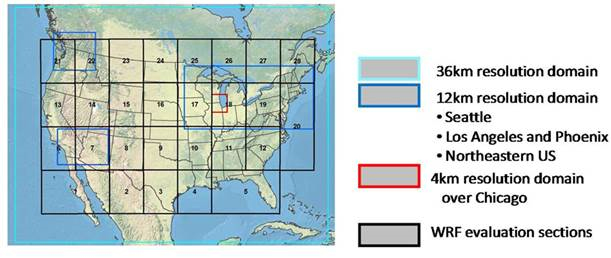
All of the project objectives rely on large-scale air quality modeling over North America for the period 2002-2006. The modeling domains for this project are shown in Figure 1. To enable the air quality modeling, 5 years of meteorology simulations were completed using the Weather Research Forecasting (WRF) model and MCIP for the CONUS 36 km parent domain and four subdomains. In addition to showing the model domains, Figure 1 also shows evaluation areas (black numbers 1-28) used for evaluation of meteorological model skill. An optimized WRF setup was identified for the project and is discussed in section 2.1. Meteorology outputs were evaluated for the year 2002 to establish that meteorological model skill was similar to other state-of- science models for the U.S. The WRF configuration and its evaluation are discussed in section 2.1 and in an appendix (A1).
 
Figure 1
Figure 1. Nested model domains (36, 12, and 4 km domains) overlaid by 28 evaluation blocks for 
characterization of meteorological error. 
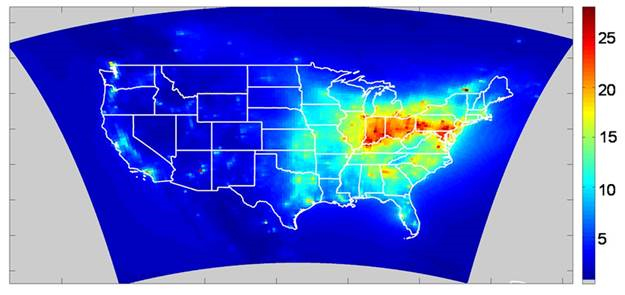
 
Jaemeen Baek (postdoctoral researcher) performed emissions preprocessing (using the SMOKE emissions model) for the domains shown in Figure 1. CMAQ PM2.5 results are available at 3-h temporal resolution for the modeling period and domains. As an example, the annual average 36 km PM2.5 simulation result for 2002 is shown in Figure 2.
 
Figure 2
Figure 2. PM2.5 simulation result, annual average PM2.5 for 2002. Coor scale is PM2.5 in µg m-3.
 
The model result was evaluated to establish similar model-observation skill relative to other contemporaneous CONUS implementations of CMAQ. The model exhibited negative bias in summer and positive bias in winter, a characteristic of many contemporary air quality models. Model evaluation summary is shown in Table 1.
 
Table 1. Model performance evaluation, with color coding using classifications of Morris et . al. (2005). Classifications are excellent (green), good (yellow), average (orange), and problematic (red). Rows 2-5 are for the CONUS 36 km domain. Rows 7.10 are for the 23 km Northeastern U.S. subdomain. Evaluation is relative to STN network PM2.5 concentrations.
Season Number Pairs Model Mean PM2.5 (µg/m3) OBS Mean PM2.5 (µg/m3) Mean Bias (µg/m3) Mean Error (µg/m3) Mean Fractional Bias Mean Franctional Error Correlation Coefficient (r)
CONUS 36 km parent domain
Spring 14374 12.3 11.0 1.3 6.0 -4 53 0.47
Summer 16860 11.2 16.1 -4.8 7.7 -4.5 62 0.50
Fall 15393 15.3 11.7 3.5 7.7 12 57 0.54
Winter 13332 14.3 11.6 5.7 8.6 30 58 0.56
Northeaster U.S. 12 km subdomain
Spring 6757 15.4 11.3 4.2 5.9 21 43 0.69
Summer 7040 16.0 18.4 -2.4 7.2 -16 45 0.56
Fall 7476 18.9 11.8 7.1 8.3 39 52 0.69
Winter 6317 23.8 12.8 11.0 11.7 57 63 0.68


Links to the American Cancer Society Cohort Study
 
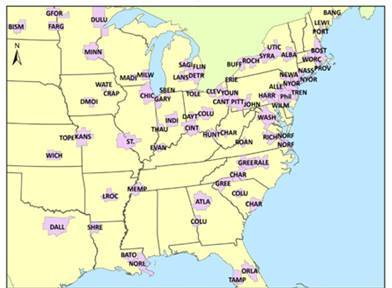
Air pollution concentrations predicted by CMAQ were linked to the American Cancer Society (ACS) study—specifically the concentrations and health data used in the ACS Extended Reanalysis Study by Krewski et al. (2007). The linkage was performed at the Metropolitan Statistical Area (MSA) level and at the individual participant level. An example of MSA areas used in the ACS analysis is shown in Figure 3.
 
Figure 3
Figure 3. Geographical boundaries (MSAs and other) used in earlier
analysis of PM2.5 vs. the American Cancer Society (ACS) cohort. 
Western MSA boundaries are not shown in this figure. 
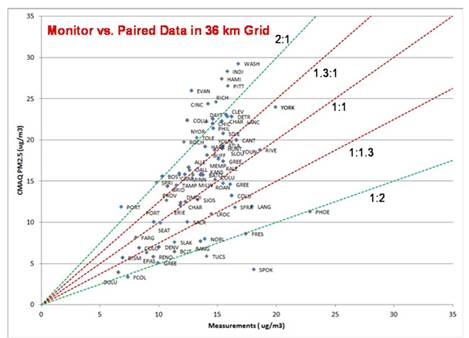
 
Model skill, after aggregation to the MSA level, is consistent with the levels of bias and error shown in Table 1. A scatterplot of observed PM2.5 concentrations (x-axis) vs. modeled PM2.5 (y-axis) is shown in Figure 4.
 
Figure 4
Figure 4. Measured PM2.5 and modeled PM2.5 restricted to ACS MSAs. 
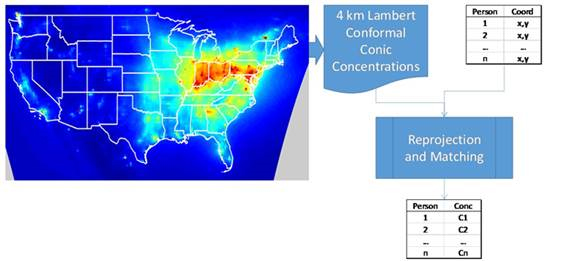
 
A flowchart demonstrating the linkage process is found in Figure 5. We have successfully matched concentrations to 669,253 subjects with during the ACS followup period 1982-2004. This includes 237,253 mortality cases and 84,161 cardiovascular mortality cases. Preliminary hazard ratios for PM2.5 for selected causes of death have been calculated adjusting for individual level covariates and stratifying the baseline hazard function by age, gender, and race using the standard Cox survival model. Analysis is ongoing examining the influence of source of exposure estimate (measurements averaged at the MSA level, model averaged at the MSA level, model value at 36 km, model value at highest available resolution, etc.) and at varying levels of aggregation in the cohort. Analysis will be completed using total PM2.5 and source-resolved PM2.5 aggregated into simplified groupings of 9, 7, 6, or 4 source categories. For example, the 4 source analysis will be categorized as (a) organic primary PM2.5 (mobile + biomass/open burning); (ii) dust / crustal; (iii) mainly inorganic/crustal/metal primary PM2.5 (stationary combustion + industrial point sources); and (iv) total secondary PM2.5.
 
Figure 5
Figure 5. Flowchart showing the matching of concentrations to the individuals in the epidemiological cohort. 
Based on coordinates of the individuals (count n) in the cohort, each person is assigned a consternation C1 through Cn.
 
Data assimilation
 
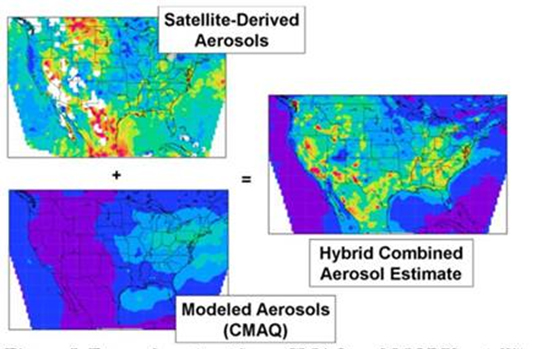
Two types of data assimilation have been developed as part of the project. The first combines satellite data from the MODIS sensor and combines it with CMAQ using optimal interpolation. An example of the model-data fusion is shown in Figure 5.
 
Figure 6
Figure 6. Example output from CMAQ and MODIS sattellite (regridded to CMAQ domain) for 
January 2002. Combinationof these using optical interpolation leads to the hybrid values shown
on the right. 
 
By using optimized settings for data assimilation of CMAQ PM2.5 and MODIS aerosol optical depth (AOD), a domain-wide average improvement in fractional error from 1.2 to 0.97 at IMPROVE monitoring sites was demonstrated, and from 0.99 to 0.89 at STN monitoring sites. Somewhat larger improvements to fractional bias were observed. However, for 38% of the month-region combinations, MODIS OI degraded the forward model skill, due to biases and outliers in MODIS AOD. Negative bias in CMAQ for coarse aerosols (i.e., wind-blown dust) was found to have a much smaller influence than positive bias in MODIS AOD. Use of newer Level 3 MODIS products with reduced bias through post-processing to remove/reduce and screen out known bias and errors gave somewhat better results.
 
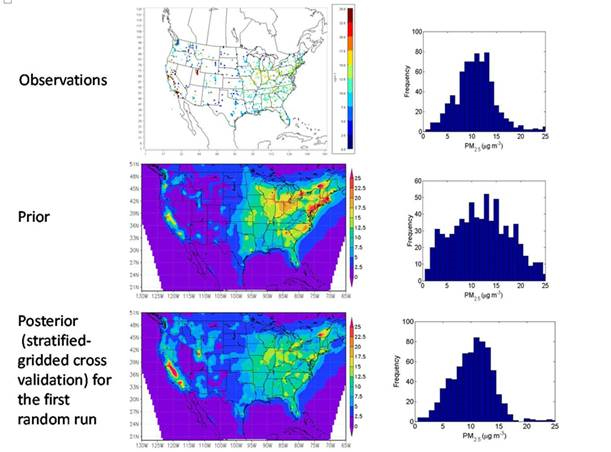
The second type of data assimilation was to combine surface PM2.5 measurements with CMAQ model product using optimal interpolation. This yields superior results when evaluated with PM2.5 measurements withheld from the data assimilation. An example of this interpolation process is shown in Figure 6. This type of assimilation was able to (relative to data randomly withheld from the model-data fusion) to improve r2 from 0.36 to 0.76, reduce fractional error from 0.43 to 0.15, reduce normalized meal error from 36% to 13%, and reduce RMSE from 5.4 to 2.3 μg m-3.
 
Figure 7
Figure 7. Example of surface measurement data assimilation for January 2002. Top row are measurement
values for PM2.5, assigned to the CMAQ grid as a map (left) and histogram (right). Middle row are 
CMAQ model values before assimilation as a map (left) and as a histogram (right). Bottom row is the
posterior PM2.5 using optimal interpolation to sombine the first two rows. 
 
Understanding the information content of MODIS satellite aerosol measurements
 
Results on the statistical properties of MODIS aerosol optical depth (AOD) relative to surface PM2.5 measurements were examined and described in the in press article entitled “"On the Spatio-Temporal Relationship Between MODIS AOD and PM2.5 Particulate Matter Measurements."” The paper demonstrates that (using Chicago air quality measurements taken between 2007 and 2008) AOD and PM2.5 can be efficiently linked statistically using a weekly hierarchical model. We determined an optimal space-time window in the small-scale correlation study for imputing PM2.5 values around AOD measurements. We also demonstrated that AOD measurements aggregated weekly can be used to predict PM2.5 measurements. A 5,000 to 6,000 meter radius with an 8- to 12-hour timeframe was determined suitable for collecting AOD measurements around a given PM2.5 value when attempting to perform localized predictions. Spatio-temporal structure within the dataset was not significant enough to be exploited by the statistical model. Even a very flexible latent spatio-temporal process (exponential spatial decay with a separable autoregressive temporal process) did not detect any systematic spatiotemporal variability of PM2.5 around a mean structure containing only AOD.
 
Working with source-resolved PM2.5
 
The University of Iowa project includes ongoing work to simulate source-resolved PM2.5 and link the results to the ACS cohort to identify more and less hazardous types of aerosols. This is being done by adding tracers for primary aerosols categorized into 20 sources, such as wild fires, fireplaces, natural gas combustion, etc. The list of source categories can be found in Table 2. Primary PM2.5 - EC, primary OC and unspecified PM2.5 - from specific sources are added as tracers in CMAQ. Progress as of the grant ending period is that the emissions files have been processed, but that the source resolved simulations are incomplete.
 
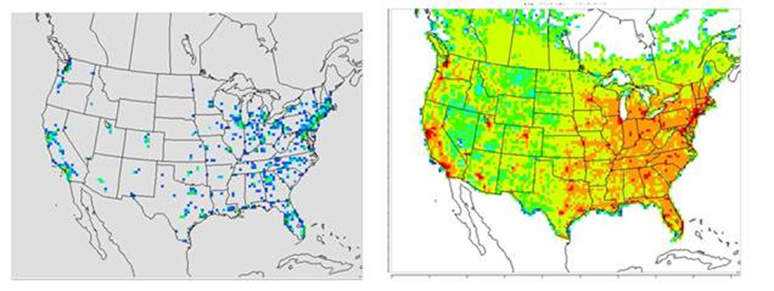
Figure 8 shows the emissions for the L2 source category (non road diesel).
 
Table 2. Source categories for the University of Iowa source-resolved simulations
Grouping Sources
Liquid Fuels Combustion Onroad diesel vehicles (L1)
Nonroad diesel engines (L2) Onroad gasoline vehicels (L3) Nonroad
Gasoline engines (L4) Oil cumbustion (L5-LEGU, L5-nLEGU)
Gaseous Fuels Combustion Natural gas (G-EGU, C1-nEGU)
Coal combustion Coal combustion (C1 -EGU, C1-nEGU)
Biomass Burning Agricultural burning (B1) fireplace/woodstove (B2)
Residential yard and solid waste burning (B3) Wildfires (B4) Prescribed burning (B5)
Dust Road dust (D1)
Unpaved road dust (D2) Other fugitive dust (D3)
Industrial sources Pulp, paper and wood process i ng (P1)
Primary metal processes (P2  
Mineral industrial processes (P3) Other industrial processes (P4)
Other Other fuel combustion (O1) other (02)

Figure 8
Figure 8. Example of source-resolved emissions input to CMAQ. Nonroad diesel engines PM2.5 emissions. Left shows linear scale, 
emphasizing major metropolitan areas. RIght shows log scale, demonstrating that emissions are included in the model for all of the
U.S. and Canada. 
 
Efforts towards development of the adjoint model of CMAQ
 
Target-oriented modeling has significant potential for recovery and visualization of the influence of spatially resolved emissions on user-defined targets (giving the name to target-oriented modeling). The power of the target-oriented approach is (a) the flexibility to define the target; and (b) the ability to calculate the influence of sources in all model grid cells to the target. Example targets can be simple (average concentration over the domain) or complicated (number of NAAQS ozone violations in a specific state). Relevant to the air pollution PM-health questions are population weighted aerosol exposures, possibly weighted according to source-specific health risks.
 
An example of a target-oriented calculation is the spatially resolved influence of NOx emissions on an ozone violation index. Such a map is possible using the computational machinery (called the adjoint model) associated with variational data assimilation. It is much more difficult to construct a similar target-oriented sensitivity map using traditional forward sensitivity methods. The adjoint allows efficient calculation of the grid cells that have (at a previous time step) influence on the current concentration at a receptor point. With forward sensitivity calculations, the influences are instead propagated from source to receptor.
 
As the particle component toxicity question is unraveled, the target-oriented approach will be invaluable for the evaluation and implementation of effective air quality regulations. If a target function could be identified connecting excess mortality with aerosol concentrations (or an ensemble of targets to account for uncertainty in the health effects), then maps can be generated relating emission reductions in specific sectors and locations to associated decreases in the burden of morbidity and mortality caused by air pollution. The targets can be customized to focus on specific locations and/or on sensitive subpopulations, and could target gas phase precursors of secondary aerosols. By combining health and climate endpoints in one target, climate-health co-benefits could be optimized.
 
The proposal called for application of a 3D chemical transport model with an adjoint model (including gas, transport, and aerosol processes). This was a necessary component to the demonstration of target-oriented sensitivity calculations. We chose to join a CMAQ adjoint development group, led by Amir Hakami and Daven Henze, in 2010. The initial thinking was that a community adjoint model could be completed in about 2 years. Dr. Baek took on the task of building an adjoint model of aqueous chemistry (AQCHEM). Dr. Baek’s approaches to the aqueous chemistry adjoint were promising (and are described herein) but to date have neither yielded a suitable match to the native forward CMAQ model, nor a sufficiently accurate and robust tangent linear or adjoint model.
 
CMAQ solves the aqueous chemistry as a series of equilibrium equations, removal, SOA formation, and kinetic reactions. The default CMAQ version solves the aqueous chemistry via the bisection method (for pH) and the Euler method (for aqueous chemical kinetics). There are other solvers that give more accurate solutions than the Euler method but they are not used in CMAQ since they are resource demanding.
 
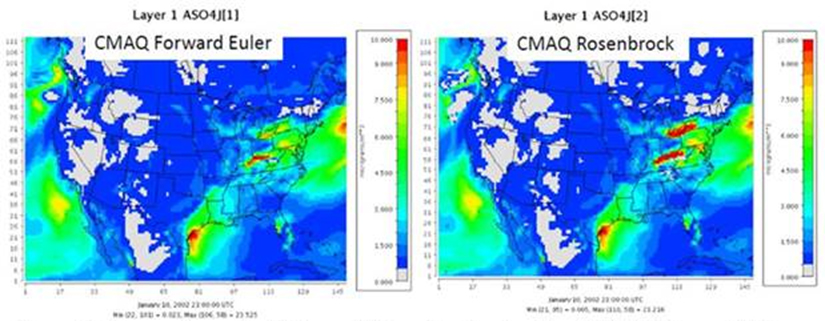
Our approach for developing the CMAQ adjoint model was to replace the default CMAQ solver with the Rosenbrock solver that is based on Kinetic PreProcessor (KPP) generated codes. KPP generates FORTRAN codes that solve the set of chemical reactions using the Rosenbrock solver. The use of KPP was anticipated to lead to higher accuracy and to the efficient generation of an automated adjoint from KPP. Forward, tangent linear, and adjoint models were developed as part of the project. Output for sulfate from the University of Iowa KPP/Rosenbrock solver is compared to the bisection/Euler solver of CMAQ in Figure 9.
 
Figure 9
Figure 9. Comparison of sulfate predictions for the standard CMAQ forward Euler method (left) and the University of Iowa CMAQ/Rosenbrock solver (right)
 
Although qualitatively and quantitatively very similar (see Figure 9), very precise agreement in the forward models is a requirement (see for example the differences over Lake Erie), and we were not able to achieve sufficient agreement in the 3D forward model. Furthermore, when running the 3D adjoint model (as opposed to the forward model shown in Figure 9), unresolved runtime errors, infeasible small integrator step sizes, and nonphysical values were encountered.
 
Additional discussion of the AQCHEM KPP model can be found in Appendix 4.
 
Effects of resolution
 
Because both meteorological and PM2.5 models were available for this project at 36-km, 12-km, and 4-km resolution, it was natural to study the effect of resolution on (i) meteorology skill, (ii) total and source-resolved PM2.5, and (iii) epidemiological results. The first two of these three were completed. As discussed in the Appendix A1, increased meteorology resolution usually (but not always) increases meteorology skill using the WRF configuration adopted in this work.
 
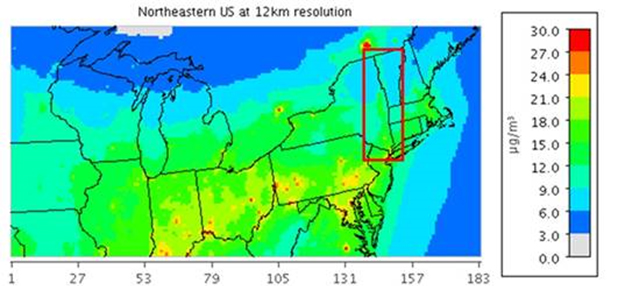
The effect of resolution on PM2.5 concentrations is shown by example in Figures 9 and 10. High emission areas become resolved as resolution increases to 12 km (Figure 10) and to 4 km (Figure 11).
 
Figure 10
Figure 10. PM2.5 in the Northeastern U.S. 12 km domain. Red box shows the Hudson RIver valley, 
which has an increment over the surrounding rural areas when simulated at 12 km, but not at 36 km. 
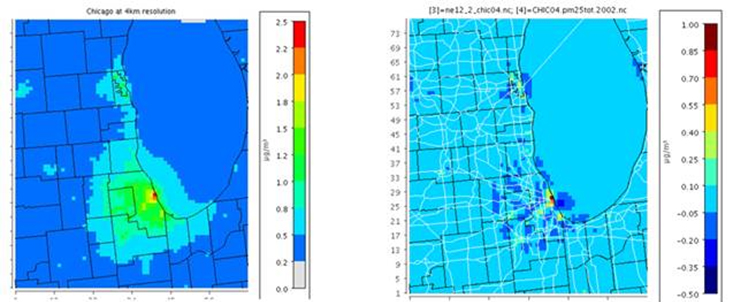
 
Figure 11
Figure 11. 4-km Elemental Carbon (EC) in the Chicago 4-km domain. Left panel shows annual average 4-km EC. Right panel
shows difference between the 12-lm simulation and 4-km simulation. Concentrations in the city center are increased at high 
resolution, and decreased in the margins within ~12 km of the high emission grid cells. 
 
The impact of the increased resolution is shown in Table 3. Mean modeled concentrations at all of the receptors increase with the higher resolution. Since the model is already biased high in 3 of 4 seasons this causes a small decrease in performance. The project team is continuing to examine whether similar results are shown for primary emission species and in the various 36 km vs. 12 km comparisons. Note that while Table 3 is an “apples-to-apples” comparison, Table 1 is not – the 12 km and 36 km simulations described in Table 1 are not for the same domain boundaries.
 
Table 3. Model performance for Chicago - comparing the 12 km and 4 km results. Classifications are excellent (green), good (yellow), average (orange), and problematic (red). Rows 2.5 are for the 12 km simulation. Row 7-10 are for the 4 km simulations. Evaluation is relative to STN network PM2.5 concentrations
Season Number Pairs Model Mean PM2.5 (µg/m3) OBS Mean PM2.5 (µg/m3) Mean Bias (µg/m3) Mean Error (µg/m3) Mean Fractional Bias Mean Franctional Error Correlation Coefficient (r)
Chicago model vs. obervation at 12-km
Spring 446

13.5

11.1 2.4 4.0 15 32 0.73
Summer 388 13.9 15.3 -1.5 4.1 -10 30 0.75
Fall 412 19.2 13.5 5.7 6.9 33 41 0.80
Winter 424 19.0 13.6 5.5 6.8 37 45 0.47
4 km
Spring 445 14.8 11.1 3.6 5.1 21 37 0.66
Summer 388 14.6 15.3 -0.7 4.6 -7 32 0.66
Fall 412 19.8 13.5 6.2 7.4 34 43 0.80
Winter 424 19.8 13.6 6.02 7.6 40 47 0.38
 
 
Table 4 summarizes key project outcomes and results.
 
Table 4./ Summary of a list of project results as of June 1, 2014
Quesstions of Objective Result
To create a database of PM2.5 concentratins for studying data assimilation techniques, best modeling practices (for health studies), and links to epidemiology.  We have completed continual CMAQ modeling for 2001 and 2002 using a combination of 36, 12, and 4 km domains. Other years and sorce-resolved model results (target year for them is 2002) are incomplete as of 6/1/2014
Feasibility of linking to a large epidemiology cohort. Our domains have been linked to the ACS cohort (200,000 + mortality cases) and preliminary calculations of relative risk to modeled PM2.5 were calculated. 
How good is modeled PM2.5 for use in long-term epidemiologial studies such as with the ACS corhort? High PM2.5 model error and spatial structure in bias are problematic for their use in an epidemiological study - improvements via data assimiliation or regression calibration are needed; Comparing PM2.5 concentrations in the model versus measured values in teh ACS cohort shows that a majority of the areas are predicted to within a 2:1 envelope, but model overprediction is somewhat severe in locaitons (mostly in the Midwestern U.S. 
What are some of the promising data assimilation techniques? Optimal interpolation of surface observations has been shown to substantially reduce bias and error relative to witheld data. 
What about data assimilation of satellite data? Methods explored in this project are not as successful as optimal interpolation of the surface measurements, although more effective alternate methodologies cannot be ruled out. 
What are some of the issues with using MODIS aerosol optical depth? MODIS bias and error combined with variable model bias make the problem difficult. 
What degree of improvement can be achieved using the MODIS aeorsol optical depth and method of this work?  The best combinations of setting/schemes led to a domain average improvement in franctional error from 0.72 to 0.58 at IMPROVE monitoring sites, and from 0.59 to 0.53 at STN monitoring sites; somewhat larger improvements to fractional bias were observed; for 39% of the month-region combinations, no settings lead to improvement via OL.
Which is more important, positive bias of MODIS in teh Western U.S., or negative bias of CMAQ in the Western U.S. for windblown dust? MODIS AOD positive bias (in the west) were more important than negative bias in CMAQ for coarse aerosols (i.e., wind-blown dust)
What are some recommendations for improving results from assimilation of satellite AOD? REcommendations: use of improved MODIS retrievals are proposed in collection 6, and the integratin of AOD from both MISR and MODIS. 
How does model preformance for total PM2.5 change between 12 km and 4 km resolution? For our WRF3.3.1 configuration performance somtimes inproved with finer resolution, but not always. 
What is the progress toward development of the adjoint of CMAQ and target-oriented sensitivities.  Progress of the adjoint of CMAQ continues within multiple research groups; efforts within project to replace the default CMAQ 4.7.1 aqueous chemistry routine with a version based on the Kinetic PreProcessor (KPP) that would promote efficient calculation of the model adjoint were initially promising, but numerical issues have not yet been fully addressed. 


The proposal called for application of a 3D chemical transport model with an adjoint model (including gas, transport, and aerosol processes). This was a necessary component to the demonstration of target oriented sensitivity calculations. We chose to join a CMAQ adjoint development group, led by Amir Hakami and Daven Henze, in 2010. The initial thinking was that a community adjoint model could be completed in about two years; however, four years into the project, a CMAQ adjoint modeling system suitable for the project goals is not yet available.

 
Large-scale multi-year CMAQ simulations:
 
Table 5 includes detailed settings for the WRF v 3.1.1 model run for this project (see also Appendix 1).
 
Table 5. Settings for WRF v3.1.1
Vriable Setting (wrf namelist settings in parenthesis)
Nesting one way nesting
Vertical Resolution 30 levels
First layer depth -20m
Model top 100 mbar
Spinup period 24 h
Run time before initialization (excluding spinup) 150 hrs
Land cover USGS 24-category Land Use Categories
Treatment of Snow (albedo, incluence on surface engery and moisture balance) 1
Initial and Boundary Conditions NARR
isffix & icloud 1
Data assimiliation to improve initial boundary conditions via objective analysis (OBSGRID), e.g. making metos_em* files instead of met_em* yes
Data souce for Objective Analysis ADP surface and upper measurements
Obervation nudging - is it used (i.e. obs_msdge_opt NO - analysis and surface nudging used, but not observational nudging
Grid (analysis) nudging via FDDA. Settings above surface layer (grid_fdda) Nudge temperature and humidity and winds through entire depth
u.v: 5x10⁻⁴ (36 km), 3x10⁻⁴ (12 and 4 km)
T: 5x10⁻⁴ (36 km), 3x10⁻⁴ (12 and 4 km)
q: 1x10⁻⁵ (36, 12 & 4 km)
nudging at 3 hr intervals
Grid (surface) nudging in the surface layer (grid_sfdda) [Yes/No + data source) Yes on 12 km and 4 km - OBSGRID run on METAR files to generate ndtedf files for surface
Settings for SFDDA settinss at surface (grid_sfdda settings) Nudge winds at surface 5x10⁻⁴ nudging at 3 hr intervals
PBL Scheme (bl_pbd_physics) ACM2(7)
Microphysics scheme (mp_physics) Morrison (10)
Radiation scheme (ra_lw_phusics, ra_sw_physics) RRTMG(4), SQ and LW time steps 12 min, 4 min and 1 min
Land surface scheme (sf_sfclay_physics and sf_surface_physics) Pleim-Xiu(7)
Cumulus scheme (cu_physics) Kain-Fritsch(1)
Soil moisture treatment/soil layers default 2 layers
Tiime step 120 sec at 35 km; 40 sec at 12 km & 10 sec at 4 km
Dynamics damping (w_dumping, damp_opt) w_damping = 1
damp_opt = 3


Emissions were processed using the Sparse Matrix Operator Kernel (SMOKE) model version 2.5. Additional detail on emission modeling choices is found in Table 6.
 
Table 6. Emission modeling information
Modeling
Year
NEI
Year
On-road source Non road 
source
Point source CEM Area
source
Canada
2000 2001 Projected using EGAS 4.0 VMT 2001 Projected using EGAS 4.0 2000 2001 *
2001 2001 2001 2001 2001 2001 2001 *
2002 2002 2002 2002 2002 2002 2002 *
2003 2002 Projectied using EGAS 4.0 VMT 2002 Projectied using EGAS 4.0 VMT 2003 2002 *
2004 2005 Projectied using EGAS 4.0 VMT 2005 Projectied using EGAS 4.0 VMT 2004 2005 *
* Area, nonroad and mobile emission rates are linearly interpolated using 2000 and 2010 data. 2006 Point source data was projected back to the simulation year using Canada emission trends. Overall pollutant scaling factors are applied. 


The photochemical model version was CMAQ version 4.7.1. The computing environment used for the modeling was primarily the Helium cluster at University of Iowa. It has a total of 1,600 cores, of which 16-48 were used for the model runs. The processors are Intel(R) Xeon(R) CPU X5550 @ 2.67GHz with 8MB cash (4 cores, 48 GB Memory). Helium was running Linux version 2.6.18 / Intel Fortran version 11.1. Parallelization was done with Open MPI/MPICH.
 
Data assimilation of satellite AOD and surface PM2.5 measurements using Optimal Interpolation

Details of methods selection and results for satellite data assimilation are attached as Appendix 2. Appendix 3 contains methodological details and results for data assimilation of surface PM2.5 measurements.

Efforts towards development of the adjoint model of CMAQ

Details of methods and results for our development work regarding a new version of the CMAQ module AQCHEM using the Kinetics Preprocessor (KPP) tool with automatic generation of adjoint code can be found in Appendix 4.


Conclusions:

Progress has been made in all of these goals, but progress to date unfortunately remains short of our proposed outcomes. As the formal grant period is over, we are summarizing progress and outcomes to date in this report; however, we continue to work to achieve a greater fraction of the proposed goals and publish more manuscripts on the work related to our EPA grant. We will notify EPA of additional publications resulting from this project as they are accepted. Reasons for the incomplete objectives are discussed in the report.

This research demonstrates that computer models of atmospheric particulate matter, such as the CMAQ model, have a role to play in studies of the health effects of air pollution. However, biases in concentrations and composition of particulate matter need to be considered and addressed, if possible, using assimilation of measured data (the method studied in this work) or by other means such as improvement of models and model inputs.
 
One of the potential advantages demonstrated in this work of using modeled concentrations rather than measured concentrations is the ability to extend epidemiological studies to a wider population. In our work, we were able to estimate concentrations for 37% more subjects than in the original work that was restricted to locations close to monitors; furthermore, the added subjects are a relatively less studied group (since they live in lower population density areas and often do not have nearby monitors).
 
Of the data assimilation techniques studied in our project, the assimilation of surface PM2.5 measurements is quite feasible and optimal interpolation, although a simple method, is straightforward to implement, fast, and yields significant improvement in PM2.5 model-observation skill. The alternate method, assimilation of aerosol optical depth measured from the orbiting MODIS sensor, showed less improvement of model skill. Satellite aerosol measurements will continue to be an important part of health and climate studies – however, their incremental information content to inform outdoor surface concentrations is limited, especially in areas with dense surface observation networks and well- developed emissions inventories and meteorology networks for assimilation into transport or weather models.


References:

Krewski D, Jerrett M, Burnett RT, Ma R, Hughes E, Shi Y, Turner MC, Pope CA, Thurston G, Calle EE, Thun MJ, Beckerman B, DeLuca P, Finkelstein N, Ito K, Moore DK, Newbold KB, Ramsay T, Ross Z, Shin H, Tempalski B. 2007. Extended Follow-up and Spatial Analyses of the American Cancer Society Study Linking Particulate Air Pollution and Mortality. Cambridge MA, Health Effects Institute.
 
Morris RE, McNally DE, Tesche TW, Tonnesen G, Boylan JW, Brewer P. 2005. Preliminary evaluation of the community multiscale air, quality model for 2002 over the southeastern United States. Journal of The Air & Waste Management Association 55(11):1694-1708.


Journal Articles on this Report : 9 Displayed | Download in RIS Format

Publications Views
Other project views: All 26 publications 9 publications in selected types All 9 journal articles
Publications
Type Citation Project Document Sources
Journal Article Baxter LK, Dionisio KL, Burke J, Sarnat SE, Sarnat JA, Hodas N, Rich DQ, Turpin BJ, Jones RR, Mannshardt E, Kumar N, Beevers SD, Ozkaynak H. Exposure prediction approaches used in air pollution epidemiology studies: key findings and future recommendations. Journal of Exposure Science & Environmental Epidemiology 2013;23(6):654-659. R833865 (Final)
R834799 (2014)
R834799 (2015)
R834799 (2016)
R834799 (Final)
R834799C004 (2013)
R834799C004 (2014)
R834799C004 (2015)
R834799C004 (Final)
  • Full-text from PubMed
  • Abstract from PubMed
  • Associated PubMed link
  • Full-text: ResearchGate-Full Text HTML
    Exit
  • Abstract: Nature Publishing-Abstract
    Exit
  • Other: ResearchGate-Full Text PDF
    Exit
  • Journal Article Fahey KM, Carlton AG, Pye HOT, Baek J, Hutzell WT, Stanier CO, Baker KR, Appel KW, Jaoui M, Offenberg JH. A framework for expanding aqueous chemistry in the Community Multiscale Air Quality (CMAQ) model version 5.1. Geoscientific Model Development 2017;10(4):1587-1605. R833865 (Final)
    R835041 (Final)
  • Full-text from PubMed
  • Abstract from PubMed
  • Full-text: GMD-Full Text PDF
    Exit
  • Abstract: GMD-Abstract
    Exit
  • Journal Article Kumar N, Chu AD, Foster AD, Peters T, Willis R. Satellite remote sensing for developing time and space resolved estimates of ambient particulate in Cleveland, OH. Aerosol Science and Technology 2011;45(9):1090-1108. R833865 (Final)
    R835193 (Final)
  • Full-text from PubMed
  • Abstract from PubMed
  • Associated PubMed link
  • Full-text: AST-Full Text PDF
    Exit
  • Abstract: AST-Abstract HTML
    Exit
  • Journal Article Liang D, Kumar N. Time-space Kriging to address the spatiotemporal misalignment in the large datasets. Atmospheric Environment 2013;72:60-69. R833865 (Final)
  • Full-text from PubMed
  • Abstract from PubMed
  • Associated PubMed link
  • Full-text: ScienceDirect-Full Text HTML
    Exit
  • Abstract: ScienceDirect-Abstract
    Exit
  • Other: ScienceDirect-Full Text PDF
    Exit
  • Journal Article Porter AT, Oleson JJ, Stanier CO. On the spatio-temporal relationship between MODIS AOD and PM2.5 particulate matter measurements. Journal of Data Science 2014;12(2):255-275. R833865 (2012)
    R833865 (Final)
  • Full-text: Journal of Data Science-Full Text PDF
    Exit
  • Abstract: Journal of Data Science-Citation
    Exit
  • Journal Article Zhang HL, Ying Q. Secondary organic aerosol from polycyclic aromatic hydrocarbons in Southeast Texas. Atmospheric Environment 2012;55:279-287. R833865 (Final)
  • Full-text: ScienceDirect-Full Text HTML
    Exit
  • Abstract: ScienceDirect-Abstract
    Exit
  • Other: ScienceDirect-Full Text PDF
    Exit
  • Journal Article Zhang HL, Zhang HL, Li JY, Ying Q, Guven BB, Olaguer EP. Source apportionment of formaldehyde during TexAQS 2006 using a source-oriented chemical transport model. Journal of Geophysical Research-Atmospheres 2013;118(3):1525-1535. R833865 (Final)
  • Full-text: Wiley-Full Text PDF
    Exit
  • Abstract: Wiley-Abstract & Full Text HTML
    Exit
  • Journal Article Zhang H, Li J, Ying Q, Yu JZ, Wu D, Chen Y, He K, Jiang J. Source apportionment of PM2.5 nitrate and sulfate in China using a source-oriented chemical transport model. Atmospheric Environment 2012;62:228-242. R833865 (Final)
    R833864 (2011)
    R833864 (2012)
    R833864 (2013)
    R833864 (Final)
  • Full-text: ScienceDirect-Full Text HTML
    Exit
  • Abstract: ScienceDirect-Abstract
    Exit
  • Other: ScienceDirect-Full Text PDF
    Exit
  • Journal Article Zhang H, Chen G, Hu J, Chen S-H, Wiedinmyer C, Kleeman M, Ying Q. Evaluation of a seven-year air quality simulation using the Weather Research and Forecasting (WRF)/Community Multiscale Air Quality (CMAQ) models in the eastern United States. Science of the Total Environment 2014;473-474:275-285. R833865 (Final)
    R833864 (2013)
    R833864 (Final)
  • Abstract from PubMed
  • Full-text: ScienceDirect-Full Text HTML
    Exit
  • Abstract: ScienceDirect-Abstract
    Exit
  • Other: ScienceDirect-Full Text PDF
    Exit
  • Supplemental Keywords:

    Air, health effects, human health, modeling

    Progress and Final Reports:

    Original Abstract
  • 2009 Progress Report
  • 2010 Progress Report
  • 2011 Progress Report
  • 2012 Progress Report
  • Top of Page

    The perspectives, information and conclusions conveyed in research project abstracts, progress reports, final reports, journal abstracts and journal publications convey the viewpoints of the principal investigator and may not represent the views and policies of ORD and EPA. Conclusions drawn by the principal investigators have not been reviewed by the Agency.

    Project Research Results

    • 2012 Progress Report
    • 2011 Progress Report
    • 2010 Progress Report
    • 2009 Progress Report
    • Original Abstract
    26 publications for this project
    9 journal articles for this project

    Site Navigation

    • Grantee Research Project Results Home
    • Grantee Research Project Results Basic Search
    • Grantee Research Project Results Advanced Search
    • Grantee Research Project Results Fielded Search
    • Publication search
    • EPA Regional Search

    Related Information

    • Search Help
    • About our data collection
    • Research Grants
    • P3: Student Design Competition
    • Research Fellowships
    • Small Business Innovation Research (SBIR)
    Contact Us to ask a question, provide feedback, or report a problem.
    Last updated April 28, 2023
    United States Environmental Protection Agency

    Discover.

    • Accessibility
    • Budget & Performance
    • Contracting
    • EPA www Web Snapshot
    • Grants
    • No FEAR Act Data
    • Plain Writing
    • Privacy
    • Privacy and Security Notice

    Connect.

    • Data.gov
    • Inspector General
    • Jobs
    • Newsroom
    • Open Government
    • Regulations.gov
    • Subscribe
    • USA.gov
    • White House

    Ask.

    • Contact EPA
    • EPA Disclaimers
    • Hotlines
    • FOIA Requests
    • Frequent Questions

    Follow.