U.S. flag

An official website of the United States government

Here’s how you know

Dot gov

Official websites use .gov
A .gov website belongs to an official government organization in the United States.

HTTPS

Secure .gov websites use HTTPS
A lock (LockA locked padlock) or https:// means you have safely connected to the .gov website. Share sensitive information only on official, secure websites.

  • Environmental Topics
  • Laws & Regulations
  • Report a Violation
  • About EPA
Contact Us

Grantee Research Project Results

2006 Progress Report: Effects of Nanomaterials on Human Blood Coagulation

EPA Grant Number: R832843
Title: Effects of Nanomaterials on Human Blood Coagulation
Investigators: Perrotta, Peter L. , Gouma, Pelagia-Irene
Institution: West Virginia University , The State University of New York at Stony Brook
EPA Project Officer: Hahn, Intaek
Project Period: February 1, 2006 through January 31, 2009
Project Period Covered by this Report: February 1, 2006 through January 31,2007
Project Amount: $375,000
RFA: Exploratory Research: Nanotechnology Research Grants Investigating Environmental and Human Health Effects of Manufactured Nanomaterials: A Joint Research Solicitation - EPA, NSF, NIOSH (2005) RFA Text |  Recipients Lists
Research Category: Nanotechnology , Safer Chemicals

Objective:

The goal of this project is to determine the effects of commercially available nanomaterials on the human blood coagulation system. The rationale is based on the fact that common human diseases, such as myocardial infarction, are caused by abnormalities of blood coagulation that predispose to thrombosis (clots) and these diseases are clearly influenced by environmental factors. Because of their large surface area and reactivity, nanomaterials that enter the workplace or home have the potential to adversely affect blood coagulation, which could result in clotting abnormalities.

Approach:

A comprehensive approach will be used to study how a wide-range of commercially prepared nanomaterials affects human blood coagulation. Techniques will focus on the two major components of the clotting system: blood coagulation proteins and platelets. First, the toxic effects of nanomaterials on blood clotting proteins will be studied using coagulation-specific laboratory assays. We will focus on the ability of nanomaterials to promote and/or retard the catalytic activity of coagulation enzymes. This is because adsorption of enzymes on the extensive available surface of nanomaterials may alter the functional groups of the enzymes and, hence, their enzymatic activity. Surface interactions between blood coagulation proteins and nanomaterials will be further detailed at the molecular level using surface plasmon resonance and atomic force microscopy. Finally, classes of nanomaterials will be identified that have the ability to “activate” human platelets because platelet activation plays a role in many thrombotic diseases.

Progress Summary:

1.         Modified coagulation assays for micro-titer plate format
A modified micro-titer plate method was developed because this format requires much smaller sample sizes (20-50 µL) than standard coagulation instruments (200-500 µL). The assays were customized for specific purposes, namely, to examine the effects of nanomaterials on the clotting system. A kinetic micro-plate reader (DTX 880, Beckman) was used to detect changes in absorbance following clot formation. Clot “signature curves” provides a means for tracking the kinetics of clot formation. The 2 major assays modified for this format were selected based on their ability to detect changes in global hemostatic function; these included a measure of surface activation (activated partial thromboplastin time, aPTT) and a measure of thrombin generation (endogenous thrombin potential, ETP). This format is useful for efficiently screening different types and concentrations of nanoparticles. These tests have a coefficient of variation of less than 5%, which is excellent for clotting assays.
 
2.         Studied in vitro effects of nanomaterials on global hemostatic function
 
Inherent properties of nanomaterials, including their catalytic and adsorption properties, could enhance coagulation cascade leading to thrombosis or alternatively, interfere with the clotting process leading to hemorrhage. The first test used to assess function was the aPTT, performed using normal human citrated platelet poor plasma (PPP) obtained from commercial suppliers (George King Biomedical). Plasma was stored at -80º C to maintain the activity of coagulation proteins.
 
First, the following assay characteristics were confirmed to ensure that spurious results were not obtained when nanomaterials were added to the system:
  • Positive & negative controls were used in all runs to ensure test validity and reproducibility
  • Dose-response effects were studied by varying number of nanoparticles
  • Different anticoagulants were studied (citrate and EDTA) to the nanoparticles had no direct effect on the anticoagulant itself.

 Initial experiments performed exposing blood clotting proteins to single walled carbon nanotubes (SWCNT) suggest that this type of nanomaterial may interfere with blood coagulation. However, SWCNTs appear to remain poorly dispersed when placed into our biological system. The SWCNTs used in the clotting experiments were prepared at the National Institute of Occupational Safety & Health (NIOSH) in Morgantown. NIOSH has performed a large number of toxicological studies on animals using these preparations. 

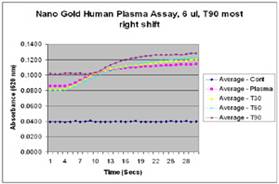
Thus, we then focused on well-characterized spherical gold nanoparticles (Nanoparts Inc.). Sizes tested include 30, 60 and 90 nm particles. Particle number was varied for each size particle so that the “lag phase” seen prior to clot-formation could be compared (Figures 1 & 2). These studies suggest a shortening of clot times when nanoparticles are added to the experimental system.


                                Figure 1
                           Figure 2


 3.         Prepared bio-composite mats as biosensor substrates
 
The successful incorporation of biological reagents into electrospun nanofibers, and sustained activity through the harsh environment of the electrospinning process has recently been reported by a few groups. Thus, our group has employed the electrospinning process to create enzymatic biocomposite nanofibers. This experiment connected the fields of electrospinning and biosensing for the first time by employing urease nanofiber mats as novel urea biosensing material.  The mechanism used in enzyme-based urea biosensors concentrates on irreversible hydrolysis of urea into ammonia and carbon dioxide in the presence of urease.  Blends of polyvinylpyrrolidone (PVP) and urease were electrospun, and formed beaded nanofibers with diameters of 7 to 100 nm.  The encapsulated enzyme activity was comparable to its pure form.  Further studies showed that solvent substitution and increased polymer concentration allowed for a larger amount of enzyme to be electrospun to form smoother fibers without beads. In later portions of this project, novel biosensors will be developed by encapsulating proteins and peptides in polymer systems.
 
Incorporation of small protein molecules into a polymer matrix: Nanogold labeled streptavidin (Nanoprobes Inc., catalogue No.:2016. See http://www.nanoprobes.com/pdf/Inf2016.pdf for detailed information) and  Polyvinylpyrrolidone (PVP) dissolved in ethanol mixtures were prepared by magnetic stirring. Streptavidin incorporated nanofibers were then deposited on aluminum substrates using the electrospinning method. Several parameters, including the concentration of streptavidin and PVP in the solution, the electrospinning speed and voltage, were changed respectively to determine the optimal conditions for the bio-incorporation.
 
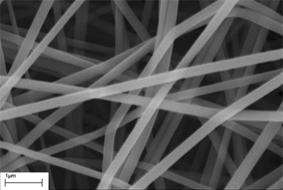
Scanning electron microscopy was employed to assess the morphological characteristics of the bio-composite mats. The SEM images (Figure 3) shown below illustrate the morphology of the nanofiber mats processed under optimal conditions, that is:
 
  • m(PVP)=0.1 g; m(streptavidin)=0.1 g; V(ethanol)=1 mL;
  • electrospinning speed=2 μL/min;   electrospinning voltage=15 kV.
  • The sol-gel was magnetically stirred for 2 h prior to processing
 
 
Figure 3: Streptabidin/PVP nanofibers
                        Low-power magnification                             High power magnification


From these images, one can see that the nanofibers are evenly and densely distributed in a large area without the presence of any residual particles on the substrate. The fibers have similar diameters, on average 200 nm. In addition, no obvious beads are observed in any single fiber, indicating that the fibers are uniformly synthesized during the electrospinning process. Such result suggests that successful incorporate of the biological into the polymer system. A problem is that although the streptavidin molecules have been nanogold labeled, the nanogold particles have a size of 1.4 nm, thus are below the resolution limit of any field emission gun SEM (2 nm). Hence, we are unable to determine if the incorporation of streptavidin is uniform along the fibers through SEM. A promising method during the future research is to use fluorescent tags on the proteins or peptides instead and to observe the biocomposites using confocal microscopy.
 
4.         Conductimetric measurement of cation concentration in solutions using electrospun PANI composites as sensing matrices
 
The principle of operation of the thrombin biosensor that was proposed in this project involves the conductimetric measurement of NH2+ cations in analyte solutions by electroactive polymers, such as polyaniline (PANI) composites. The first step towards achieving this goal is to demonstrate that H+ concentration (i.e., pH changes) may be monitored accurately and reproducibly by using electrospun cellulose acetate and E.S. (emeraldine salt) polyaniline composites.
 
The PANI concentration used was 20% and 50% in the electrospun matrix.  The films were bonded using silver paste to gold wires.  The distance between the gold electrodes was 2-3 mm.  The films were immersed in a solution of 100 mL water with 5 µL of pH ISA solution to increase and stabilize the pH of the solution to ~10.  A Ross pH reference electrode was also immersed in the solution to monitor changes in pH.  The resistance of the electrospun composite was measured using a Keithley high resistance multimeter. The pH of the solution was varied by adding 0.1-0.2 mL of acetic acid solutions 0.025%, 0.05%, 0.1%, and 0.2%. It was shown in our work that the 80-20 CA/PANI hybrid is more sensitive to the change in [H+] in the solution than the 50-50 composition. 
 
When acetic acid reacts with water the following reaction occurs:
 
CH3COOH  + H2O                          H+ (H2O) + CH3COO-
 
Since acetic acid is monoprotic, for every unit of acetic acid, only one H+ is liberated.  Water arranges itself around this proton forming an acidic molecule.  As the pH of the solution decreases, the concentration of H+ increases in the solution. Above pH 9, polyaniline is deprotonated by the basic solution (considered a proton acceptor) due to the excess CH3COO-, resulting in an increase in the film’s resistance.  As the pH of the solution decreases the solution becomes a proton donor and the resistance of the film begins to slowly decrease.  Related literature suggests that transitions between emeraldine salt (conducting) and emeraldine base (non-conducting) may occur.  In the literature these changes are popularly measured potentiometrically or optically.  Our experiments present the first ever attempt to measure cation concentration conductimetrically. 

Expected Results:

Studies outlined in this proposal will identify nanomaterials that can harm the human blood coagulation system. Furthermore, thresholds of toxicity and dose-response effects of coagulation proteins to nanomaterials will be quantified. The advanced techniques utilized will help to understand the complex interactions between nanomaterials, coagulation enzymes, and platelets. Through our findings a system for classifying engineered nanomaterials based on their physiologic effects on blood coagulation will be developed. This will help to predict whether novel classes of nanomaterials and/or functionalized nanomaterials can potentially harm human blood coagulation.

Future Activities:

1.         Dispersion of nanoparticles in biological systems
 
Studying the potential toxic effects of manufactured nanomaterials is complicated by the fact that most nanoparticles aggregate when placed in biological media. Many toxicology studies reported to date have not adequately documented nanoparticle dispersion prior to in vitro or in vivo nanoparticle exposure. Thus, we will continue to spend time preparing nanoparticle dispersions that are suitable for biological experiments, and more importantly, characterize these dispersions within biological buffers, as well as plasma containing solutions.
 
2.         Thrombin nanosensor
 
A nanosensor will be designed that detects low levels of thrombin, an enzyme that plays several key roles in blood coagulation. This sensor detects the thrombin-catalyzed hydrolysis of a specific thrombin substrate (Benzoyl-Phe-Val-Arg-AMC, HCl) by using a conducting polymer that measures changes in electrical resisance in the presence of ions. Such a sensor would be useful in measuring small changes in thrombin that occur in a variety of human diseases, both in the blood, and at the surface of cells and blood vessels.
 
3.         Determine effects of nanomaterials on thrombin generation
 
We are developing cellular and non-cell based assays to determine the effects of nanomaterials on the generation of thrombin. This is the key enzyme responsible for the conversion of soluble fibrinogen to a fibrin clot. We are modifying a fluorogenic assay for thrombin measurement that can be used in both human and rat plasma. Like the coagulation assays, these assays will require small sample volumes and be suitable for higher throughput studies. Although our focus will be on thrombin generation in human plasma and platelets, we will explore the generation of thrombin in a rat model of nanoparticle exposure in collaboration with Dr. Dale Porter of NIOSH. He is storing rat plasma under suitable conditions for thrombin measurement following exposure to nanomaterials.
 
4.         Interactions between cells and nanostructured particles formed by electrospinning
 
We will continue to study the interactions between cells and nanomaterials. Different nanoparticles will be incorporated into electrospun fibers. The interactions will then be studied using a variety of assays meant to measure cell viability (e.g. MTS assay). Detailed morphologic examination will also be undertaken using SEM.


Journal Articles on this Report : 2 Displayed | Download in RIS Format

Publications Views
Other project views: All 22 publications 5 publications in selected types All 4 journal articles
Publications
Type Citation Project Document Sources
Journal Article Bishop A, Balaszi CS, Yang JC, Gouma P. Biopolymer-hydroxyapatite composite coatings prepared by electrospinning. Polymers for Advanced Technologies 2006;17(11-12):902-906. R832843 (2006)
  • Abstract: Polymers for Advanced Technologies
    Exit
  • Journal Article Sawicka K, Gouma P. Electrospun composite nanofibers for functional applications. Journal of Nanoparticle Research 2006;8(6):769-781. R832843 (2006)
  • Abstract: Journal of Nanoparticle Research
    Exit
  • Supplemental Keywords:

    nanotechnology, environmental factors, thrombosis, biology, engineering, pathology, adsorption, chemical transport, risk assessment, health effects, human health, dose response, enzymes, cumulative effects, chemicals, toxics, particulates, analytical, nanotoxicology, coagulation, proteins, nanomaterials, biosensors, Health, Scientific Discipline, ENVIRONMENTAL MANAGEMENT, Health Risk Assessment, Risk Assessments, Environmental Microbiology, Biochemistry, Risk Assessment, bioavailability, nanomaterials, blood coagulation enzymes, nanotechnology, nanoparticle toxicity, analysis of chemical exposure, blood clotting

    Progress and Final Reports:

    Original Abstract
  • 2007 Progress Report
  • Final Report
  • Top of Page

    The perspectives, information and conclusions conveyed in research project abstracts, progress reports, final reports, journal abstracts and journal publications convey the viewpoints of the principal investigator and may not represent the views and policies of ORD and EPA. Conclusions drawn by the principal investigators have not been reviewed by the Agency.

    Project Research Results

    • Final Report
    • 2007 Progress Report
    • Original Abstract
    22 publications for this project
    4 journal articles for this project

    Site Navigation

    • Grantee Research Project Results Home
    • Grantee Research Project Results Basic Search
    • Grantee Research Project Results Advanced Search
    • Grantee Research Project Results Fielded Search
    • Publication search
    • EPA Regional Search

    Related Information

    • Search Help
    • About our data collection
    • Research Grants
    • P3: Student Design Competition
    • Research Fellowships
    • Small Business Innovation Research (SBIR)
    Contact Us to ask a question, provide feedback, or report a problem.
    Last updated April 28, 2023
    United States Environmental Protection Agency

    Discover.

    • Accessibility
    • Budget & Performance
    • Contracting
    • EPA www Web Snapshot
    • Grants
    • No FEAR Act Data
    • Plain Writing
    • Privacy
    • Privacy and Security Notice

    Connect.

    • Data.gov
    • Inspector General
    • Jobs
    • Newsroom
    • Open Government
    • Regulations.gov
    • Subscribe
    • USA.gov
    • White House

    Ask.

    • Contact EPA
    • EPA Disclaimers
    • Hotlines
    • FOIA Requests
    • Frequent Questions

    Follow.