U.S. flag

An official website of the United States government

Here’s how you know

Dot gov

Official websites use .gov
A .gov website belongs to an official government organization in the United States.

HTTPS

Secure .gov websites use HTTPS
A lock (LockA locked padlock) or https:// means you have safely connected to the .gov website. Share sensitive information only on official, secure websites.

  • Environmental Topics
  • Laws & Regulations
  • Report a Violation
  • About EPA
Contact Us

Grantee Research Project Results

2009 Progress Report: Toxicological Evaluation of Realistic Emission Source Aerosol (TERESA): Investigation of Vehicular Emissions

EPA Grant Number: R832416C005
Subproject: this is subproject number 005 , established and managed by the Center Director under grant R832416
(EPA does not fund or establish subprojects; EPA awards and manages the overall grant for this center).

Center: Health Effects Institute (2015 - 2020)
Center Director: Greenbaum, Daniel S.
Title: Toxicological Evaluation of Realistic Emission Source Aerosol (TERESA): Investigation of Vehicular Emissions
Investigators: Koutrakis, Petros , Godleski, John J.
Institution: Harvard University
EPA Project Officer: Chung, Serena
Project Period: October 1, 2005 through September 30, 2010 (Extended to September 30, 2011)
Project Period Covered by this Report: August 1, 2008 through July 31,2009
RFA: Particulate Matter Research Centers (2004) RFA Text |  Recipients Lists
Research Category: Human Health , Air

Objective:

Because particulate and gaseous source emissions undergo many transformations once released into the atmosphere, it is likely that secondary and primary pollutants exhibit different toxicities. Since most of the source-specific toxicity studies to date have focused on primary pollutants, there remains a great need to investigate the relative toxicity of source-specific primary and secondary particles. We recently have probed directly into this question with the Toxicological Evaluation of Realistic Emission Source Aerosol (TERESA) Power Plant study, a research project funded by the Electric Power Research Institute (EPRI) and the previous Harvard EPA PM Center. This study was designed to investigate the relative toxicity of primary and secondary particulate emissions from coal-fired power plants, in situ, and to explore the relationship between secondary particle formation processes and particle toxicity. As part of the TERESA study we have developed techniques and facilities to sample source emissions, form secondary particles inside a photochemical chamber, and expose animals to both primary and secondary particles. The TERESA approach forms an excellent foundation for future research, as it can readily be adapted to investigate other combustion sources. Using the developed technologies, this project extends this research to the toxicological investigation of primary and secondary pollutants from vehicular (mobile source) emissions released from the ventilation stack of a large roadway tunnel within the northeastern United States. We are in the preparation stages for this project that will compare the relative toxicity of primary and secondary mobile source emissions with concentrated ambient particles (CAPs) and with primary and secondary coal power plant emissions from the current TERESA study.
 
The specific hypotheses of this project are:
 
  • Exposures to fresh and to photochemically oxidized mobile source emissions will induce cardiovascular responses in normal animals;  
  • Atmospheric photochemical processes enhance the toxicity of gases and particles emitted from motor vehicles, and;  
  • Animal models of susceptible populations (e.g., spontaneously hypertensive rats) will have greater biological responses to particles originating from motor vehicles than the corresponding normal animal model.

Progress Summary:
Preliminary laboratory chamber tests for simulation of secondary particle formation from mobile source emissions: We have successfully adapted the TERESA approach for use in investigating vehicular emission sources in a laboratory pilot study using diluted car exhaust. Because automobile exhaust is significantly different in chemical composition and physical characteristics compared to coal power plant emissions, and the reactions involved in its photochemical oxidation also are different, significant adaptations to the original coal power plant TERESA methods were needed.
 
First, since the power plant emissions were essentially devoid of hydrocarbons, it was necessary to generate the hydroxyl radical for oxidizing the SO2 to sulfuric acid (H2SO4) using the photolysis of O3 at 295 nm (Ruiz, et al., 2007a,b).  In contrast, because automobile exhaust is rich in volatile organic compounds, the ·OH radical, once generated, can be regenerated in photochemical chain reactions. Second, carbonyl compounds are both contained in primary vehicular emissions and produced by photochemical oxidation of the volatile organics in the exhaust. Therefore, a more accurate spectral recreation of ground level solar radiation is needed, because the carbonyl group can be photolyzed at the short wavelength UV used for oxidation of the coal plant emissions, resulting in reactions that do not take place in the atmosphere.
 
In addition, for the oxidation of SO2 to H2SO4 in the coal plant emissions, it was necessary to first react most of the NO2 to nitric acid (HNO3), because the NO2 competes with SO2, and the reaction of NO2 with ·OH is many times faster than that of SO2. In contrast, photochemical oxidation of the organic compounds present in vehicular emissions is enhanced by the presence of NO2, which is photolyzed to form NO and ·O, and is a critical component of the reaction mechanism for the generation of photochemical smog. 
 
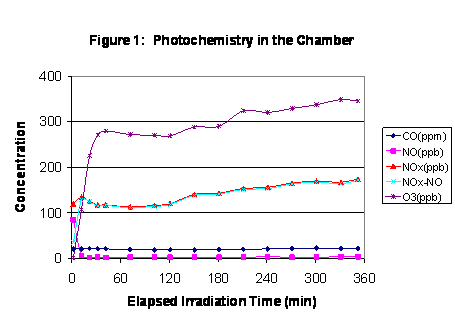
Our first step in adapting the TERESA approach to mobile source emissions has been to conduct pilot laboratory studies with diluted automobile exhaust. Tailpipe emissions from a single vehicle (a ten year old compact automobile) running outside the lab with the throttle slightly open were collected and diluted with ambient air to achieve a range of CO concentrations spanning the concentrations measured in the ventilation stack of the selected traffic tunnel. Simulations of photochemical oxidation were conducted using the photochemical chamber developed for the coal plant TERESA study, after replacing the lights with UV-340 fluorescent lamps that better represent the ground-level solar spectrum. The photochemical oxidation of the diluted exhaust followed a fairly typical pattern of conversion of NO to NO2, accumulation of O3, and an initial burst of ultrafine particles, shown in Figure 1 below.
 
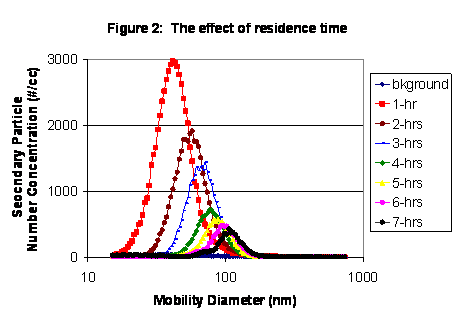
The residence time in the chamber was optimized for the production of secondary PM from the exhaust, as determined by the evolution of the particle size distribution measured using a Scanning Mobility Particle Sizer (SMPS), Figure 2:
 
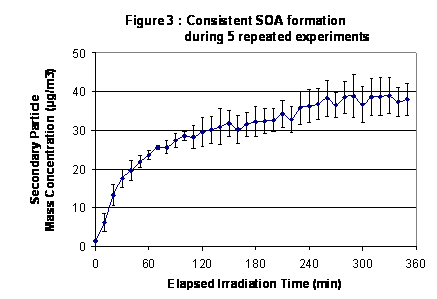
We also verified that the production of secondary particle mass was consistent. Figure 3 below shows secondary particle mass generated on across days with exhaust diluted to achieve consistent concentration of CO (as a surrogate for organics).
 
We found that the yield of secondary particle mass was improved when an inert seed aerosol was added (Table 1), and the stable concentration of secondary PM was achieved more quickly. The seed aerosol was added for three reasons: (1) to approximate the PM concentration expected in the tunnel; (2) to provide sufficient particle surface area to allow rapid aggregation of the freshly generated ultrafine particles, resulting in a stable accumulation mode size distribution; and (3) to make it possible to conduct pilot exposures using Primary and Secondary PM at similar concentrations, which was not achievable in the coal power plant TERESA studies.
 
Table 1: Average secondary aerosol yield as a function of initial seed aerosol concentration and residence time at 5 and 20 ppm CO
 
Baseline Seed Aerosol
Concentration (μg/m3)
CO Concentration
(ppm)
Residence Time
(min)
Secondary Particle Mass Generated (μg/m3)
12.5
5
50
54.5
26.0
20
50
108.8
9.5
5
100
51.5
12.5
20
100
99.1
 
After we optimized our technique for the formation of secondary particle mass from the dilute tailpipe emissions of a single car using inert seed aerosol, we conducted pilot exposures using normal male Sprague-Dawley rats, using Mount St Helen’s Ash (MSHA, Bates Ridge) as the seed aerosol, because it is chemically and toxicologically inert (Savage, et al., 2003).
 
For these pilot exposures, we measured pulmonary and cardiac oxidative stress using in vivo chemiluminescence as well as bronchoalveolar lavage to assess pulmonary inflammation. Two scenarios were tested, diluted car exhaust with MSHA (Primary PM), and diluted car exhaust with MSHA irradiated with UV light to produce secondary PM. The exposure results are summarized below in Table 2:
 
Table 2: Biological outcomes from pilot exposure study with car exhaust diluted to 5 ppm CO (at 50 min residence time)
 
 
Scenario
 
Seed PM (μg/m3)
 
PM (μg/m3)
 
EC/OC
(μg/m3)
 
BIOLOGICAL RESPONSES
In Vivo Chemiluminescence
Total BAL Cells
(x106)
Total BAL PMNs
(x105)
 
Primary PM
298*
298
N/A
No heart or lung difference from control
Lung: 2.3±1.3
No difference from control
0.4±0.8
No difference from control
0.0±0.1
Secondary PM
142*
212
0.5/6.9
Significant lung ↑↑↑ from control and Primary PM
15.7±6.0**
Significant ↑↑ from control and Primary PM
4.9±1.1**
Significant ↑ from control and Primary PM
3.7±1.1**
 
*MSHA: Mt St Helens Ash (from the Bates Ridge site), toxicologically and chemically inert particles
** Significant outcome differences from primary PM, p<0.05
 
These pilot exposures were small scale, using small numbers of exposed and sham rats (n=8), but show that secondary PM from car exhaust can significantly increase oxidant radicals in the lung, increase total BAL cells, and increase BAL polymorphonuclear leukocytes (PMNs) over sham controls (p=0.005, p=0.001, and p=0.05, respectively). Most importantly, there were significant differences between primary and secondary PM for all of these outcomes (p<0.05) even with slightly less mass in the secondary PM exposure, thus further supporting our specific hypotheses.
 
Field study setup using an urban highway tunnel to provide mobile source emissions:  Progressing from our laboratory development studies using the diluted exhaust of a single vehicle to a field study has involved several steps. Because the concentrations of primary pollutants with particle forming potential in the ventilation stack of the highway tunnel are much lower than those in the coal power plant stack emissions, it is not possible to dilute the output of the photochemical chamber in order to provide sufficient flow for exposure of animals and characterization of the exposure. Hence, the chamber must be larger to allow sufficient residence time for photochemical reactions, while providing an adequate flow for exposure and characterization.
 
Additionally, since chamber output cannot be diluted for exposure, it was necessary to design and build a new, larger denuder to remove un-reacted organics, NOx, CO, downstream of the chamber before animal exposures.  The new denuder was designed based on the previous parallel plate membrane denuder (Ruiz, et al., 2006) but with dimensions optimized to handle a larger flow rate.  Evaluation of the high flow denuder in the lab showed that the particle losses and removal efficiency for CO were both consistent with the original low flow denuder, and additional experiments were done with BTEX organics in vehicle exhaust in conjunction with the lab pilot study. These results are summarized in Table 3.
 
Table 3: Denuder performance (Sample flow rate 16.7 LPM, purge: sample ratio 2:1, 30 ppm CO)
 
 
Compound
 
D (cm2/s)*
Penetration (%)
 
Benzene
 
0.125
17.7
 
Toluene
 
0.115
18.9
 
Ethylbenzene
 
0.107
21.5
 
m/p Xylene
0.107
21.2
 
o Xylene
 
0.107
19.3
*D is the molecular diffusion coefficient in air
 
Using the results from our laboratory study and our projected needs for chamber output sufficient for exposure and characterization, we designed and built a photochemical chamber. The chamber is 8.1 m3, constructed of 2mil Teflon FEP film and Teflon-coated aluminum. The enclosure around the photochemical chamber supports 180 UV lamps.
 
This larger size (than for the preliminary laboratory tests) necessitated locating our photochemical chamber and exposure system inside the ventilation building itself. The site within the ventilation building has been constructed and secured, electrical service established, sampling lines to the plenum have been installed. Instrumentation for the study has been installed and calibrated. Preliminary experiments with the diluted vehicular emissions collected from the plenum are under way.
 

Future Activities:

Our goal is to complete the field study by the spring of 2010. The initial field tests, currently in progress, require optimizing the features of the reaction chamber to correspond to differences between the single vehicle exhaust used for lab tests and the mixed vehicle exhaust from the traffic tunnel. These differences include the NO to VOC ratio differences, and the presence of a large mass concentration of carbonaceous primary particles. We expect it will take about a month to complete the optimization tests. Toxicological exposures to primary and secondary aerosols from vehicular emissions are expected to be completed before the end of the spring 2010.

References:

Ruiz, PA, Lawrence, JE, Ferguson, ST, Wolfson, JM, Koutrakis, P (2006) A counter-current parallel-plate membrane denuder for the non-specific removal of trace gases.  Environmental Science & Technology 40(16): 5058-5063.
 
Ruiz, P.A., et al., (2007a) Development and Evaluation of a Photochemical Chamber to Examine the Toxicity of Coal-Fired Power Plant Emissions. Inhalation Toxicology 19(8):597-606
 
Ruiz, PA, Gupta, T, Kang, CM, Lawrence, JE, Ferguson, ST, Wolfson, JM, Rohr, AC, Koutrakis, P (2007b) Development of an exposure system for the toxicological evaluation of particles derived from coal‑fired power plants.  Inhalation Toxicology 19(8):607-619.
 
Savage ST, Lawrence J, Katz T, Stearns RC, Coull BA, Godleski JJ (2003). Does the Harvard/US environmental protection agency ambient particle concentrator change the toxic potential of particles? Context Sensitive Links Journal of the Air & Waste Management Association 53(9):1088-1097.

Journal Articles:

No journal articles submitted with this report: View all 9 publications for this subproject

Supplemental Keywords:

traffic related particles, acute cardiovascular effects, primary and secondary particle effects, RFA, Health, Air, Scientific Discipline, Health Risk Assessment, Risk Assessments, particulate matter, Environmental Chemistry, Toxicology, biological mechanisms, chemical characteristics, autonomic dysfunction, biological mechanism , airborne particulate matter, cardiovascular vulnerability, chemical composition, animal model, oxidative stress, ambient particle health effects, PM, atmospheric particulate matter, automobile exhaust, ambient air quality, concentrated ambient particulates (CAPs), human health effects, traffic related particulate matter

Relevant Websites:

http://www.hsph.harvard.edu/epacenter/exit EPA

Progress and Final Reports:

Original Abstract
  • 2006
  • 2007
  • 2008 Progress Report
  • 2010 Progress Report
  • Final Report

  • Main Center Abstract and Reports:

    R832416    Health Effects Institute (2015 - 2020)

    Subprojects under this Center: (EPA does not fund or establish subprojects; EPA awards and manages the overall grant for this center).
    R832416C001 Cardiovascular Responses in the Normative Aging Study: Exploring the Pathways of Particle Toxicity
    R832416C002 Cardiovascular Toxicity of Concentrated Ambient Fine, Ultrafine and Coarse Particles in Controlled Human Exposures
    R832416C003 Assessing Toxicity of Local and Transported Particles Using Animal Models Exposed to CAPs
    R832416C004 Cardiovascular Effects of Mobile Source Exposures: Effects of Particles and Gaseous Co-pollutants
    R832416C005 Toxicological Evaluation of Realistic Emission Source Aerosol (TERESA): Investigation of Vehicular Emissions

    Top of Page

    The perspectives, information and conclusions conveyed in research project abstracts, progress reports, final reports, journal abstracts and journal publications convey the viewpoints of the principal investigator and may not represent the views and policies of ORD and EPA. Conclusions drawn by the principal investigators have not been reviewed by the Agency.

    Project Research Results

    • Final Report
    • 2010 Progress Report
    • 2008 Progress Report
    • 2007
    • 2006
    • Original Abstract
    9 publications for this subproject
    9 journal articles for this subproject
    Main Center: R832416
    206 publications for this center
    199 journal articles for this center

    Site Navigation

    • Grantee Research Project Results Home
    • Grantee Research Project Results Basic Search
    • Grantee Research Project Results Advanced Search
    • Grantee Research Project Results Fielded Search
    • Publication search
    • EPA Regional Search

    Related Information

    • Search Help
    • About our data collection
    • Research Grants
    • P3: Student Design Competition
    • Research Fellowships
    • Small Business Innovation Research (SBIR)
    Contact Us to ask a question, provide feedback, or report a problem.
    Last updated April 28, 2023
    United States Environmental Protection Agency

    Discover.

    • Accessibility
    • Budget & Performance
    • Contracting
    • EPA www Web Snapshot
    • Grants
    • No FEAR Act Data
    • Plain Writing
    • Privacy
    • Privacy and Security Notice

    Connect.

    • Data.gov
    • Inspector General
    • Jobs
    • Newsroom
    • Open Government
    • Regulations.gov
    • Subscribe
    • USA.gov
    • White House

    Ask.

    • Contact EPA
    • EPA Disclaimers
    • Hotlines
    • FOIA Requests
    • Frequent Questions

    Follow.