


Grantee Research Project Results
2007 Progress Report: Synthesis and Application of a New Class of Stabilized Nanoscale Iron Particles for Rapid Destruction of Chlorinated Hydrocarbons in Soil and Groundwater
EPA Grant Number: GR832373Title: Synthesis and Application of a New Class of Stabilized Nanoscale Iron Particles for Rapid Destruction of Chlorinated Hydrocarbons in Soil and Groundwater
Investigators: Zhao, Dongye , Roberts, Christopher B.
Current Investigators: Zhao, Dongye , Roberts, Christopher B. , He, Feng
Institution: Auburn University Main Campus
EPA Project Officer: Hahn, Intaek
Project Period: August 1, 2005 through July 31, 2008 (Extended to July 31, 2009)
Project Period Covered by this Report: November 1, 2006 through October 31,2007
Project Amount: $280,215
RFA: Greater Research Opportunities: Research in Nanoscale Science Engineering and Technology (2004) RFA Text | Recipients Lists
Research Category: Hazardous Waste/Remediation , Nanotechnology , Safer Chemicals
Objective:
WORK STATUS AND PROGRESS
The overall goal of this research project is to develop a cost-effective, in-situ remediation technology employing a new class of soil-dispersible, iron (Fe)-based nanoparticles for rapid destruction of chlorinated hydrocarbons in soil and groundwater. In Year 2, the researchers completed the following: (1) prepared nanoparticles of various sizes using carboxymethyl cellulose (CMC) as a stabilizer; (2) tested effects of particle stabilization on reactivity; (3) tested transport behaviors of zero-valent iron (ZVI) nanoparticles in porous media; (4) tested degradation of trichloroethylene (TCE) in soils; and (5) pilot-tested in situ dechlorination in soils using stabilized ZVI nanoparticles. We developed a method for synthesizing ZVI nanoparticles of controllable size, soil mobility, and reactivity. We found that factors such as CMC molecular weight, the CMC:Fe ratio, pH, and temperature can greatly affect transport and reactivity of nanoparticles. We demonstrated that stabilized ZVI nanoparticles can be delivered and distributed in soils. The nanoparticles can effectively degrade nonaqueous phase liquids in soils and groundwater and may boost biodegradation.
Progress Summary:
Preliminary results:
Figure 1 shows an innovative strategy for preparing stabilized ZVI nanoparticles with controllable size.
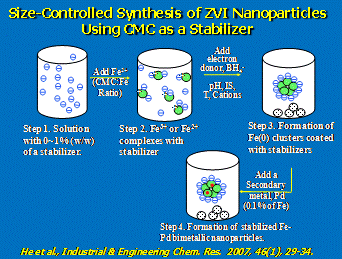
Figure 1. An innovative approach for preparing stabilized, size-controllable ZVI nanoparticles.
Figure 2 shows that ZVI nanoparticles of desired size can be prepared by varying the CMC-to-Fe ratios in the preparation. Figure 2 shows the size distribution of ZVI nanoparticles synthesized using CMC of various molecular weight (MW). Highly dispersible ZVI nanoparticles can be prepared using CMC with a MW of 90k or higher.
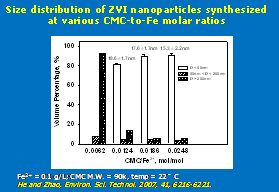
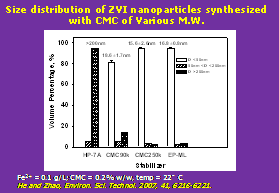
Figure 2. Size distribution of ZVI nanoparticles Figure 3. Size distribution of ZVI
synthesized at various CMC-to-Fe molar ratios. Nanoparticles synthesized using CMC of
various molecular weight (MW).
Figure 4 indicates that synthesizing temperature can greatly impact the particle size. Smaller (≤18.8 nm) nanoparticles were obtained at ≤18 oC, whereas larger (≥200 nm) ZVI particles were resulted in at ≥25 oC. Figure 5 shows that with increasing CMC:Fe ratio, faster TCE degradation rate was achieved, indicating smaller particles are more reactive. Figure 6 shows that The same amount Pd showed greater catalytic activity for TCE degradation when added as separate nanoparticles than coated on ZVI nanoparticles. Figure 7 shows that the reaction rate reached its maximum at a Pd dosage of 0.1% of Fe. The degradation rate remained the same when Pd loading was further increased, indicating Pd is not rate-limiting when Pd exceeds this critical loading value. Figure 8 demonstrates that CMC-stabilized ZVI nanoparticles can be easily dispersed through a loamy sand column while the non-stabilized ZVI aggregates are all caught on top of the sand bed.
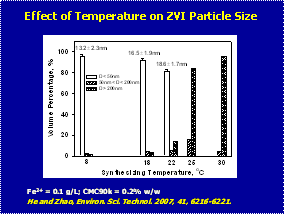
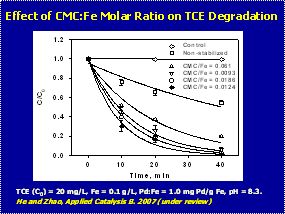
Figure 4. Effect of temperature on the ZVI Figure 5. Effect of CMC:Fe molar ratio
particle size in the presence of CMC (MW=90k). on TCE degradation.
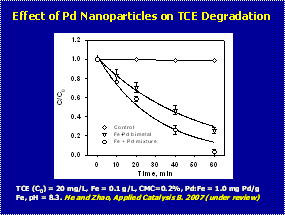
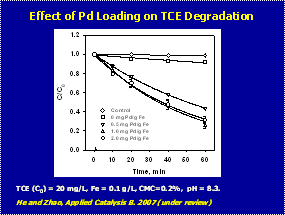
Figure 6. Effect Pd on TCE degradation. Figure 7. Effect of Pd concentration on TCE degradation.
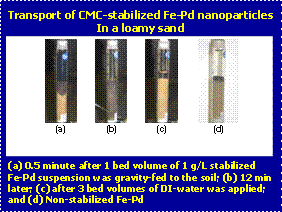
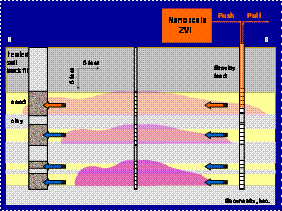
Figure 8. Transportability of CMC-stabilized Figure 9. The vertical geological profile of a
ZVI nanoparticles through a loamy sand. California aquifer.
Figure 9 shows the vertical geological profile of a California aquifer where a series of push-pull tests were carried out with CMC-stabilized ZVI nanoparticles to test the soil deliverability of the nanoparticles under real-world conditions. Figure 10 shows histories of iron and bromide (tracer) concentrations during a well extraction following an injection of the stabilized Fe-Pd nanoparticles and coupled degradation of two primary contaminants, cis-DCE and VC, at a California site. The total ZVI recovery amounted to 46% compared to 78% for the tracer. This observation confirms that the stabilized ZVI can be delivered into the contaminated aquifer zone simply via gravity, and the injected nanoparticles can effectively degrade the chlorinated hydrocarbons (i.e. vinyl chloride, VC, and cis-dichloroethylene, cis-DCE).
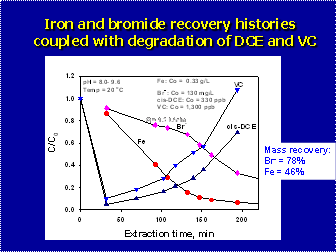
Figure 10. Histories of iron and bromide concentrations during a well extraction following an injection of the stabilized Fe-Pd nanoparticles and coupled degradation of two primary contaminants, cis-DCE and VC, at a California site.
Evaluation: The project has been moving smoothly toward a great success story. By now, we developed an optimized protocol for developing novel and controllable iron nanoparticles for in situ degradation of chlorinated hydrocarbons in soils and groundwater. The technology has attracted broad interest from academia, industries and government agencies such as DoD. So far, this research has resulted in more than 10 journal papers and 10+ presentations at national and international meetings.
Comparison of actual accomplishments with stated goals and objectives: The overall goal of this research is to develop a cost-effective, in-situ remediation technology that employs a new class of dispersed iron-based nanoparticles for the rapid destruction of chlorinated hydrocarbons in soil and groundwater. To this end, we have achieved highly promising results through successful synthesis and testing of the stabilized Fe nanoparticles at both bench and field scales. All the proposed objectives have been reasonably met.
Acknowledgments
The research team is grateful to EPA STAR Grant project manager, Dr. Nora Savage, for her advice and assistance throughout the project.
Students and post-docs involved in this project:
Feng He, Graduate Research Assistant, Ph.D. candidate, Department of Civil Engineering, 08/01/2005-present
Sunghee Joo, Post-doc Researcher, Department of Civil Engineering, 09/01/2005-11/01/2006
Juncheng Liu, Post-doc Researcher, Department of Chemical Engineering, 08/01/2005-present
Zhong Xiong, Graduate Research Assistant, Ph.D. candidate, Department of Civil Engineering, 08/01/2005-present
Yinhui Xu, Graduate Research Assistant, Ph.D. candidate, Department of Civil Engineering, 08/01/2005-present
Sam Chang, Summer Undergraduate Student, Rice University, Summer 2006.
Journal Articles on this Report : 4 Displayed | Download in RIS Format
| Other project views: | All 35 publications | 19 publications in selected types | All 19 journal articles |
|---|
| Type | Citation | ||
|---|---|---|---|
|
|
He F, Zhao D, Liu J, Roberts CB. Stabilization of Fe-Pd nanoparticles with sodium carboxymethyl cellulose for enhanced transport and dechlorination of trichloroethylene in soil and groundwater. Industrial & Engineering Chemistry Research 2007;46(1):29-34. |
GR832373 (2006) GR832373 (2007) GR832373 (Final) |
Exit |
|
|
He F, Zhao D. Manipulating the size and dispersibility of zerovalent iron nanoparticles by use of carboxymethyl cellulose stabilizers. Environmental Science & Technology 2007;41(17):6216-6221. |
GR832373 (2007) GR832373 (Final) |
Exit |
|
|
Liu R, Zhao D. Reducing leachability and bioaccessibility of lead in soils using a new class of stabilized iron phosphate nanoparticles. Water Research 2007;41(12):2491-2502. |
GR832373 (2007) |
Exit Exit Exit |
|
|
Xiong Z, Zhao D, Pan G. Rapid and complete destruction of perchlorate in water and ion-exchange brine using stabilized zero-valent iron nanoparticles. Water Research 2007;41(15):3497-3505. |
GR832373 (2007) GR832373 (Final) |
Exit Exit Exit |
Supplemental Keywords:
Sustainable Industry/Business, RFA, Scientific Discipline, TREATMENT/CONTROL, Waste, Water, Technology for Sustainable Environment, Sustainable Environment, Environmental Chemistry, Contaminated Sediments, Treatment Technologies, Environmental Engineering, chlorinated hydrocarbons (CHCs), chlorinated aromatic hydrocarbons (CAHs), nanoparticle remediation, nanomaterials, contaminated sediment, dechlorination, contaminated groundwater, nanotechnology, decontamination, groundwater rememdiationProgress and Final Reports:
Original AbstractThe perspectives, information and conclusions conveyed in research project abstracts, progress reports, final reports, journal abstracts and journal publications convey the viewpoints of the principal investigator and may not represent the views and policies of ORD and EPA. Conclusions drawn by the principal investigators have not been reviewed by the Agency.