


Grantee Research Project Results
2022 Progress Report: Practical PFAS Treatment with Functionalized Sawdust
EPA Grant Number: SV840386Title: Practical PFAS Treatment with Functionalized Sawdust
Investigators: Tu, Maobing , Lu, Mingming , Harrison, Canaan , Udeshi Edirisinghe, Don Isanka
Institution: University of Cincinnati
EPA Project Officer: Chung, Serena
Phase: II
Project Period: April 1, 2022 through March 31, 2024 (Extended to March 31, 2025)
Project Period Covered by this Report: April 1, 2022 through March 31,2023
Project Amount: $99,895
RFA: P3 Awards: A National Student Design Competition for Sustainability Focusing on People, Prosperity and the Planet - Phase 2 (2022) Recipients Lists
Research Category: Urban Air Toxics , Heavy Metal Contamination of Soil/Water , P3 Awards , P3 Challenge Area - Safe and Sustainable Water Resources
Objective:
EPA and other research institutes have identified PFAS as emerging contaminants because they have demonstrated potential health effect to human and animals and environmental risk to ecosystem. The objective of this Phase II project is to further expand the application of functionalized sawdust (FS) for short chain and long chain perfluoroalkyl acids (PFAA) and PFAS removal, demonstrate the PFAS removal with FS in a test operation and conduct techno-economic analysis (TEA) and life cycle assessment (LCA) (Fig. 1). The project is also expected to test the integration of combustion and mineralization to treat the spent FS to potentially eliminate the need for costly regeneration process. It is expected that the association of PFAS chain length and removal efficiency will be established and about 4-8 undergraduate students will be trained under this project.
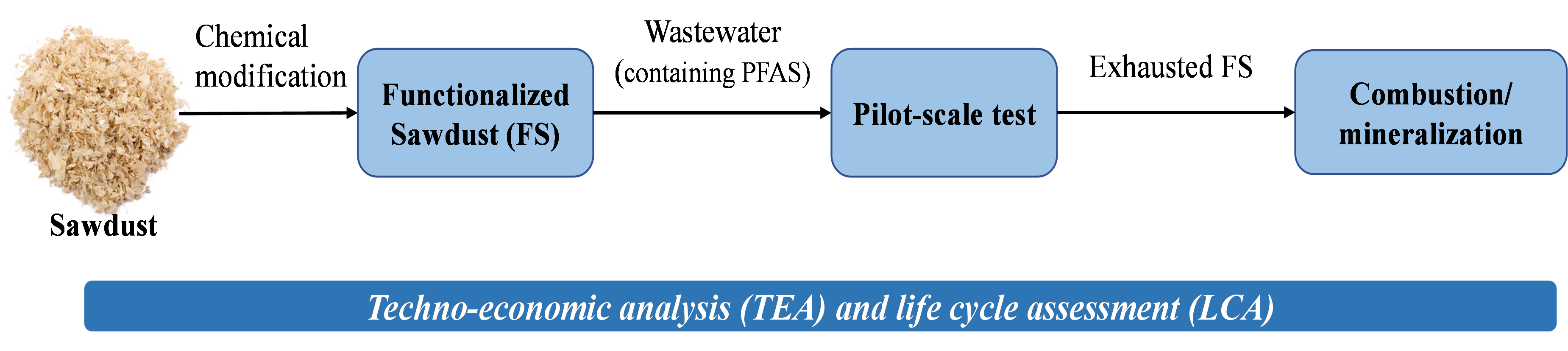
Fig. 1 PFAS Removal in wastewater using functionalized sawdust
Progress Summary:
This project seeks to demonstrate the potential applicability of sustainable biomass-based materials to remove PFAS from wastewater and drinking water and ultimately protect the environment from PFAS contamination and reduce the risks of PFAS to human health. In this reporting period, students have learned how to functionalize sawdust by reaction with epichlorohydrin and dimethylamine. Fourier transform infrared spectroscopy (FTIR) was also used to characterize the chemical reactions (mainly between cellulose and epichlorohydrin and dimethylamine) during the sawdust biomass functionalization. It can be observed that strong C-H stretching at 2900 cm-1, N-H stretching at 1634 cm-1, C-N stretching at1260 cm-1, N-H wagging at 750 cm-1 after functionalization, which can confirm the reaction was occurred during the functionalization. The kinetic and isothermal adsorption experiments with PFBA, PFBS, PFHxA, PFPA and PFDoA on FS have been carried out to evaluate the effects of PFAS chain lengths and functional groups on adsorption behavior. The major output of the effort in the period is the determination of adsorption isotherm of PFBA, PFBS, PFHxA, PFPA and PFDoA on FS and modification of PFAS analysis method using LC/QTOF. Undergraduate students (Anna Chen, Nicholas Sippy, and Dayton Raflik) and graduate student (Isanka Edirisinghe) at University of Cincinnati have been recruited to work on the project in year 1.
The first task was to determine the effect of PFAS chain length and functional group on PFAS removal with FS. To achieve this, the adsorption kinetics of PFHxA and PFDoA and adsorption isotherm of PFBA, PFBS, PFPA, PFHxA and PFDoA have been conducted with FS. Subsequently the equilibrium data was modelled using the Langmuir and Freundlich isotherms and to assess the adsorption behavior of target compounds on the FS. It has been observed that adsorption of PFHxA and PFDoA reached equilibrium at 48h. The adsorption of PFHxA and PFDoA with 100 mg/L initial concentration after 120 h was determined to be 88.1% and 92.50% respectively. Overall, the results obtained suggested that long chain of PFDoA affected the adsorption kinetics and isotherm. The long chain potentially extended the time for reaching equilibrium and the sulfonate group reduced the adsorption capability of PFBS and PFOS.
In the current reporting period, the project team also solved the solubility issue of short chain PFAS compounds by preparing the initial stock solution (1 mg/mL) in methanol and then diluting it into water for LC/QTOF analysis. New range of PFAS standard concentration solution has been established, which can help collect the stable data from LC/QTOF analysis. New pump has been purchased and tested for PFAS removal from wastewater. New glassware has been purchased and assembled for integration of combustion and mineralization test.
To ensure the quality of our data results, the LC/QTOF method for PFAS analysis has been modified to confirm the reproducibility of analysis results with different chain-length compounds. The isothermal adsorption experiments have been performed in duplicates. The standard PFAS samples have been used to build a standard curve for quantitative measurement.
Future Activities:
The experimental plan is on the right track. Task 3, 4 and 5 will be completed in a subsequent year. The project team will continue to determine the effects of PFAS chain length and functional group on FPAS removal with FS. The detailed future activities will include:
- The column test of PFAS removal in wastewater will be assessed and compared with GAC column test.
- The integration of combustion and mineralization of spent FS will be conducted, and major products will be quantified.
- TEA and LCA analysis of PFAS removal from wastewater with FS will be conducted.
Journal Articles:
No journal articles submitted with this report: View all 2 publications for this projectSupplemental Keywords:
PFAS, functionalized sawdust, treatment, column test, thermal combustion and mineralization, wastewater
Progress and Final Reports:
Original AbstractP3 Phase I:
Practical PFAS Treatment with Sawdust | 2020 Progress Report | Final ReportThe perspectives, information and conclusions conveyed in research project abstracts, progress reports, final reports, journal abstracts and journal publications convey the viewpoints of the principal investigator and may not represent the views and policies of ORD and EPA. Conclusions drawn by the principal investigators have not been reviewed by the Agency.