


Grantee Research Project Results
2013 Progress Report: Ensuring Safe Drinking Water in Lake Erie: Quantifying Extreme Weather Impacts on Cyanobacteria and Disinfection Byproducts (DPBs)
EPA Grant Number: R835192Title: Ensuring Safe Drinking Water in Lake Erie: Quantifying Extreme Weather Impacts on Cyanobacteria and Disinfection Byproducts (DPBs)
Investigators: Lee, Jiyoung , Shum, C.K. , Liang, Song
Institution: The Ohio State University
EPA Project Officer: Packard, Benjamin H
Project Period: June 1, 2012 through May 31, 2016
Project Period Covered by this Report: June 1, 2013 through August 21,2014
Project Amount: $748,902
RFA: Extreme Event Impacts on Air Quality and Water Quality with a Changing Global Climate (2011) RFA Text | Recipients Lists
Research Category: Air Quality and Air Toxics , Water Quality , Water , Air , Climate Change
Objective:
Our scientific objectives are: 1) the assessment of the link between historic and current extreme weather events and water quality indicators using satellite and field work data, including water color, temperature, turbidity, precipitation, water level, and ice/snow/flood extents; 2) improved understanding of the links between extreme weather events and the source and finished water quality including cyanobacteria densities, cyanotoxins, DBPs, and nutrient concentrations; and 3) the modeling and prediction of adverse impacts to source and finished water to understand the future impact of climate-change induced extreme weather events on water safety in Lake Erie.
Progress Summary:
We initiated an innovative interdisciplinary approach using historic and current satellite remote sensing and geodetic data, molecular microbiology tools for comprehensive understanding cyanobacterial dynamics and its influence on drinking water quality in the Lake Erie region. During the second project year, we performed two main tasks: 1) we analysed historical data (from 2002 to 2012) of harmful algal blooms (HABs) in Lake Erie to examine temporal variability and environmental drivers; and 2) we performed laboratory measurements of the collected water samples (toxin, DBPs, molecular detection of toxin-producing cyanobacteria, etc.) and satellite images of the source water in Lake Erie.
Below are key findings from tasks 1 and 2:
1) Analysis of historical data (from 2002 to 2012) about harmful algal blooms (HABs) in Lake Erie to know temporal variability and environmental drivers:
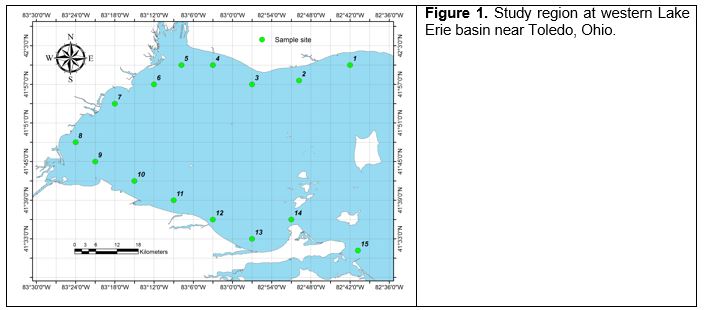
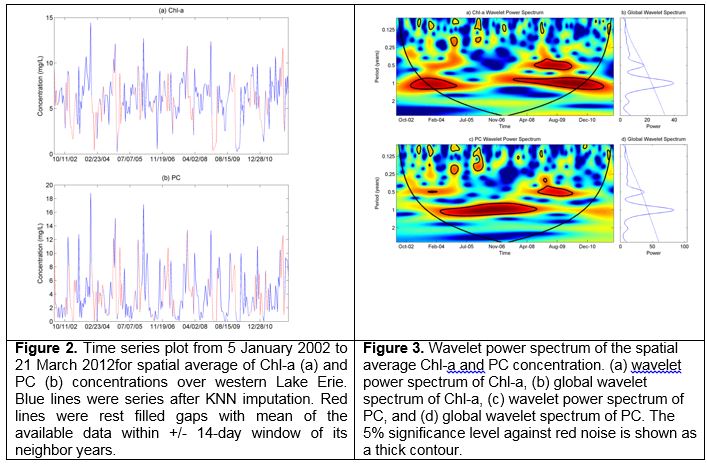
We explored the environmental driving factors and characterized temporal variability of Chlorophyll a (Chl-a) and Phycocyanin (PC), which are determinants of HABs, in western Lake Erie (Fig. 1). Ten years’ biweekly Chl-a and PC over western Lake Erie were derived from the satellite remote sensing (MERIS) data. Nine environmental factors (water quality parameters, hydrometeorological variables) also were collected. While Chl-a and PC showed different predictabilities and differences in importance of environmental drivers at different locations and seasons using the Multivariate Adaptive Regression Splines (MARS) with the Variance Inflation Factor (VIF) method, hydrometeorological variables generally showed great influences on Chl-a and PC in four seasons. For Chl-a, the most influential environmental drivers are solar radiation and wind speed in spring, water temperature solar radiation, and total Kjeldahl nitrogen concentration in summer, wind speed in fall, and water temperature and streamflow in winter. For PC, the most important environmental drivers are solar radiation and wind speed in spring; precipitation, water temperature, wind speed, and total Kjeldahl nitrogen concentration in summer; wind speed in fall; and precipitation, water temperature, and streamflow in winter. Wavelet analysis suggested that Chl-a and PC showed strong seasonal and inter-annual pattern – the 0.5- and 1-year periods are the dominant modes for both Chl-a and PC series (Fig. 2 and 3).
2) Analysis of laboratory measurements of the collected water samples and satellite images of the source water in Lake Erie:
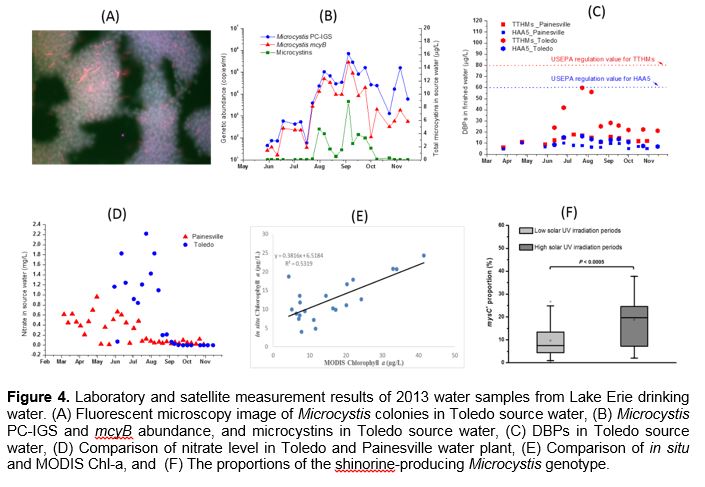
We have received source and drinking water samples from the two water treatment plants (59 sampling events in 2013, and ongoing for 2014) and have monitored the physical, chemical and biological parameters (e.g., hardness, nutrient concentrations, heterotrophic plate count, E. coli, phosphorus and nitrate; phytoplanktonic composition, Microcystis, microcystin, and DBPs, etc.). These routine parameters help us comprehensively evaluate the source and drinking water quality. There are five important findings in this reporting period (Fig. 4). First, both microcystins and DBPs in the samples from Toledo (western Lake Erie) and Painesville (central Lake Erie) water plants did not exceed the guideline by the World Health Organization or the U.S. EPA regulation; especially in spite of high levels of toxic Microcystis abundance and total microcystins observed in Toledo source water. The low levels of microcystins in finished water (<1 µg/L) were probably due to the utilization of the additional activated carbon treatment process. Second, our present data suggest that the abundant Microcystis population in source water could increase the formation of DBPs in finished water. Therefore, cyanobacterial blooms in source water can deteriorate water safety not only through producing toxin but also through increasing DBPs formation. Third, our data suggest an association between nitrate concentration and Microcystis abundance; therefore, controlling both nitrate and phosphorus levels should be considered for controlling cyanobacterial bloom. Fourth, Microcystis abundance and toxic Microcystis abundance are highly correlated with the phycocyanin and chlorophyll-a; therefore, it was confirmed that measurements of phycocyanin and chlorophyll-a (using satellite remote sensing) can be a rapid predictor for the Microcystis and microcystin occurrence. Fifth, the results show that the shinorine produced by some Microcystis strains might be of certain ecological significance for the Microcystis bloom development, suggesting a new prospective for understanding and controlling Microcystis blooms.
Future Activities:
For the subsequent reporting period, we plan to do following activities:
- Receive water samples from the two water treatment plants until the planned ending time in 2014
- Extract DNA from both source and drinking water samples
- Quantify total and toxic Microcystis abundance in water samples
- Determine microcystins using HPLC-PAD (Shimadzu LC-20A) and ELISA kit (Abraxis)
- Analyze the phytoplanktonic composition in the source water
- Compile data and statistical analyses
- Continue data meetings and discussion within the team members
- Prepare manuscripts and presentations
Journal Articles:
No journal articles submitted with this report: View all 13 publications for this projectSupplemental Keywords:
Drinking water, global climate change, disinfection byproducts, DBPs, microcystin, limnology, geodesy, environmental microbiology, satellite remote sensing, empirical modeling, harmful algal bloom, HAB, Great Lakes, Lake Erie, Ohio, OHProgress and Final Reports:
Original AbstractThe perspectives, information and conclusions conveyed in research project abstracts, progress reports, final reports, journal abstracts and journal publications convey the viewpoints of the principal investigator and may not represent the views and policies of ORD and EPA. Conclusions drawn by the principal investigators have not been reviewed by the Agency.