U.S. flag

An official website of the United States government

Here’s how you know

Dot gov

Official websites use .gov
A .gov website belongs to an official government organization in the United States.

HTTPS

Secure .gov websites use HTTPS
A lock (LockA locked padlock) or https:// means you have safely connected to the .gov website. Share sensitive information only on official, secure websites.

  • Environmental Topics
  • Laws & Regulations
  • Report a Violation
  • About EPA
Contact Us

Grantee Research Project Results

2010 Progress Report: Integrated Design, Modeling, and Monitoring of Geologic Sequestration of Anthropogenic Carbon Dioxide to Safeguard Sources of Drinking Water

EPA Grant Number: R834386
Title: Integrated Design, Modeling, and Monitoring of Geologic Sequestration of Anthropogenic Carbon Dioxide to Safeguard Sources of Drinking Water
Investigators: McPherson, Brian J. , Solomon, Douglas Kip , Deo, Milind D. , Goel, Ramesh
Current Investigators: McPherson, Brian J. , Deo, Milind D. , Solomon, Douglas Kip , Goel, Ramesh
Institution: University of Utah
EPA Project Officer: Aja, Hayley
Project Period: December 1, 2009 through November 30, 2012 (Extended to November 30, 2013)
Project Period Covered by this Report: March 16, 2010 through March 15,2011
Project Amount: $899,567
RFA: Integrated Design, Modeling, and Monitoring of Geologic Sequestration of Anthropogenic Carbon Dioxide to Safeguard Sources of Drinking Water (2009) RFA Text |  Recipients Lists
Research Category: Drinking Water , Water

Objective:

The University of Utah project team will utilize existing CO2 geologic sequestration (GS) demonstration sites to develop an "Aquifer Risk Assessment Framework," or ARAF. The ARAF will be a systematic framework that researchers may use to assess and quantify potential risks to Underground Sources of Drinking Water (USDWs) at a specific GS site. The most useful application of the ARAF will be determination of optimized engineering conditions that minimize risks to USDWs for a given set of geologic conditions at a specific GS site.
 
Objectives/Hypothesis: We hypothesize that (1) geologic sequestration will impact USDWs, but (2) at suitable sites, GS will not adversely impact USDWs. The specific objectives of our study are to (1) identify risks specific to USDWs and develop associated Probability Density Functions (PDFs), (2) quantify risks to USDWs by pressure/brine/CO2 migration through seals, (3) quantify risks to USDWs by lateral migration of pressure/brine/CO2, and (4) determine conditions that minimize (or eliminate) the risks to USDWs.
 
Approach: A key to making the ARAF truly effective is to identify which factors (processes, parameters, etc.) are most important with respect to adverse impacts on USDWs, and to achieve this we will use a case-study approach to test and evaluate the specific components with real data and results. The case study sites include (1) the Gordon Creek field in north-central Utah (PRIMARY SITE)--this site has never been subjected to CO2 injection and will begin injection in 2012; (2) an active CO2 injection field site in the Permian Basin in western Texas--CO2 injection at this site began in October 2008 and injection is not slated to cease until 2012 at the earliest; and (3) an active CO2 injection field site in the San Juan Basin in northern New Mexico--CO2 injection at this site began in July 2008, and injection ceased in August 2009. The latter two of these field sites are part of the Validation Phase of the Southwest Regional Partnership on Carbon Sequestration, a partnership and project sponsored by the U.S. Department of Energy and its National Energy Technology Laboratory. A PI of this EPA STAR project (Grant No. R834386) also formed the Southwest Regional Partnership and has led that project since 2003. Thus, access to the field sites and associated data are assured. Although the Gordon Creek Field is the primary site for analysis, we plan to include all three of these field sites in the EPA-sponsored Aquifer Risk Assessment Framework (ARAF) STAR project (Grant No. R834386), if at all possible. These three sites represent the three primary permutations of a CCS geologic site, to facilitate evaluation of different stages of risk analysis and framework development. Specifically, Gordon Creek is a new project area slated for future CO2 injection, and thus it represents a site with no baseline CCS analysis data at the onset of the project. The Permian Basin site represents active CO2 injection and monitoring with a relatively mature set of fundamental geologic evaluation, monitoring and simulation data to support ARAF development. Finally, San Juan represents a site that has run the full course of CO2 injection from drilling to well closure (albeit a medium-scale demonstration).
 
For the ARAF, we will evaluate the properties and attributes that make each of these a capable storage site. We then will quantify selected risks for all three sites, and attempt to quantify all significant risks for one site. We anticipate this approach to provide essential ARAF elements. Additionally, we will examine alternative natural sites that leak CO2 such as the Crystal Geyser in Utah, to provide context regarding what attributes may compromise storage sites and to evaluate the nature and processes of leakage. We will use simulations to evaluate a range of possible injection scenarios, and use results to evaluate what engineering conditions will minimize risks. Furthermore, we propose a field program in which fundamental geologic, hydrologic, and key environmental tracer data will be used to demonstrate methodology as well as test the concepts derived from our numerical modeling. Finally, we will compare ARAF development at all three sites, especially pre-injection results to post-injection results, to evaluate what aspects of the ARAF are most and least effective.

Progress Summary:

Task 1—: Simulation of Natural Analog Sites
 
Subtask 1.1 – Analysis of Known Leakage Sites
 
Understanding Eruption Mechanisms of CO2-saturated Cold Geyser: Analogues to Failed CO2 Sequestration Sites
 
The purpose of work associated with Subtask 1.1 is to evaluate the processes that may cause or otherwise influence leakage of CO2 from target reservoirs to USDWs via abandoned wells or other high-permeability conduits. Rather than speculate regarding conceptual models, we started with analysis of a known CO2 leakage site located in central Utah, just 3 hours drive from the University of Utah. The Crystal Geyser, located near the town of Green River, Utah, emits low levels of CO2 continuously, and also “erupts” with a significantly larger emission of CO2 daily. Whether this system is representative of a failed CCS site is unclear, and thus we made characterization and simulation analysis of this system as a starting point for the ARAF. The following summary of initial analysis of the Crystal Geyser CO2 leakage site is split into five sections, as a starting point (draft) for submission to a journal.
 
Introduction
 
Two basic types of mechanisms could result in CO2 leakage from geologic sinks (Figure 1). The first mechanism is fast-flow path leakage, which would primarily involve CO2 movement through either transmissive faults or fractures in the cap rock above the geologic sink [Pruess, 2008] or poorly sealed or failed injection well casings/cement [Bachu and Bennion, 2009; Barlet-Gouedard, et al., 2009] and improperly abandoned wellbores [Gasda, et al., 2004; Nordbotten, et al., 2004; Nordbotten, et al., 2005; Watson and Bachu, 2007]. The second mechanism is slow leakage, which would primarily involve gas transport by diffusion processes [Altevogt and Celia, 2004; Annunziatellis, et al., 2008; Klusman, 2006] and loss of dissolved CO2 because of hydrodynamic flow of formation water out of the geologic sink [Oldenburg and Lewicki, 2006].


Figure 1. (a) Potential leakage pathway through an abandoned well [Norbotten, et al., 2005]; (b) Changes of geochemical signature above CO2 injection formation in Weyburn CO2-enhanced oil recovery site [Emberley, et al., 2004]

Among these addressed risks, one major risk in CO2 injection sites is a sudden CO2 eruption from the stored formation. CO2 is highly compressible fluid, which is enforced to store in the high pressure and temperature formation, typically over the critical condition for CO2 being supercritical fluid (Pressure: 7.38 MPa and temperature: 31.1°C). If this compressed CO2 reaches a highly permeable conduit such as a fault that is continuous to the surface, CO2 leakage could be dramatic. In general, the pressure gradient within these highly permeable conduits radically changes from the stored formation to the surface with atmospheric pressure conditions. In this situation, CO2 escaped from the stored formation instantaneously reaches the surface while CO2 experiences adiabatic expansion, which results in Joule-Thomson cooling.
 
The addressed eruptive mechanisms are analogues to the natural CO2 eruption mechanisms, which could be found in cold-CO2 geysers widely spread all around the world (Table 1). Therefore, proper understanding of the eruption mechanisms in cold-CO2 geysers will aid in predicting conditions favorable to CO2 eruptions for engineered CO2 storage sites.
 
Table 1. CO2-saturated cold geysers of the world [Glennon and Pfaff, 2005].
 
Name
Location
Height
Interval
Duration
Crystal Geyser
Green River
Utah, USA
15–20 meters
11–18 hours
15–45 minutes
Woodside Geyser
(Roadside Geyser)
Woodside
Utah, USA
6–10 meters
28 minutes
1.0–1.5 hours
Champagne Geyser
(Chaffin Ranch Geyser)
Green River
Utah, USA
7–8 meters
2 hours
5 minutes
Ten Mile Geyser
Green River
Utah, USA
2.5–3.5 meters
6 hours
42 minutes
51 seconds
Tumbleweed Geyser
Green River
Utah, USA
0.3–1.5 meters
2–8.5 minutes
46–94 minutes
Unnamed Geyser
Salton Sea
California, USA
0.1–0.5 meters
10–60 seconds
Seconds
Jones Fountain of Life
Clearlake
California, USA
< 1.0 meters
60 minutes
22 minutes
Cold Water Geyser
Yellowstone
Wyoming, USA
0.5 meters
Unknown
10 minutes
Source Intermittente de Vesse
Bellerive,
France
1–6 meters
230–270 minutes
45–50 minutes
Andernach Geyser
Andernach,
Germany
40–60 meters
1.5–4 hours
7–8 minutes
Boiling Fount
Local name: Brubbel
Wallenborn,
Germany
2–3 meters
30 minutes
“a few minutes”
Mokena Geyser
North Island,
New Zealand
0.5–5 meters
minutes–hours
seconds–minutes
Povremeni Geyser
Sijarinska,
Serbia
20 meters
9 minutes
2 minutes
Herlany Geyser
Herlany,
Slovakia
20–30 meters
32–34 hours
30 minutes
Persi Geyser
Persi,
Slovakia
“smaller than Herlany Geyser”
hours (“shorter than Herlany Geyser”)
minutes (probably < 30)
 
 
Geologic Setting
 
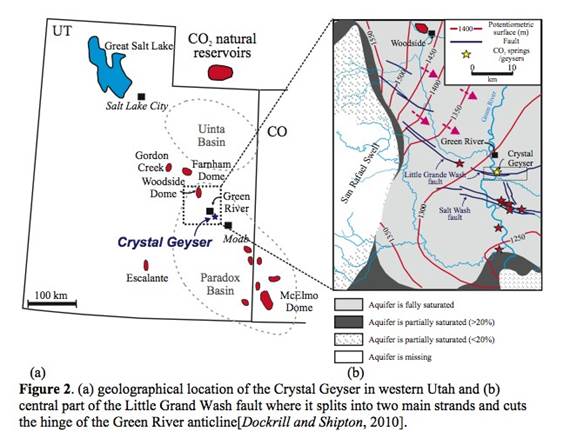
In the greater Colorado Plateau covering western Utah to southern Colorado shown in Figure 2a, the CO2 natural reservoirs including Woodside, Farnham, and McElmo Domes are present on the string extending from northwest to southeast [Allis, et al., 2001]. In these reservoirs, CO2 of more than 98% purity is trapped in dome-like structures and has been produced for commercial usages such as dry ice, industrial uses, and CO2 enhanced oil recovery.
 
Figure 2
 
Close to the Green River in the middle of these CO2 natural reservoir strings, two major faults, the Little Grand Wash and Salt Wash Graben faults, cross from west to east. Several CO2 saturated natural geysers and springs shown in Table 1 were discovered on top of these two fault lines, and they have been intensively studied in the past [Assayag, et al., 2009; Gouveia and Friedmann, 2006; Heath, et al., 2009; Shipton, et al., 2005]. Among these springs and geysers, we chose one of the CO2-saturated natural geysers, the Crystal Geyser, to evaluate the cyclic eruption mechanisms of a CO2-saturated geyser as an analogue to a failed CO2 sequestration site.
 
Methodology
 
To characterize the periodicity and eruption mechanisms of the Crystal Geyser, we collected the time-series changes of pressure and temperature by installing Geokon Model 4500 vibrating-wire piezometers during two different periods--from August 4 to 6 and September 1 to 5. The piezometer uses a pressure-sensitive stainless-steel diaphragm to which a wire is connected; the other end is attached to a fixed position in the body of the instrument. Pressure variations in the fluid deflect the diaphragm, which causes changes in the tension in the wire. The wire is regularly “plucked” by an electromagnet and the natural frequency of vibration is recorded. This frequency then is interpreted in terms of diaphragm movement and hence pressure change.
 

                                  Figure 3. Schematic diagram of well configuration and piezometer installation
During the early trip from August 4 to 6, we first measured the maximum depth where the piezometer could be installed and found that there was an unknown obstacle at the 16 m depth (Figure 3). We were not able to determine the exact reason why the piezometer does not go deeper than 16 m in this study. However, anecdotal reports and discussions with several local people revealed that one individual had used dynamite to enhance the eruption ability of the adjacent geyser and others had tried to use railroad ties to cap the geyser [Shipton et al., 2004; Waltham, 2001]. During our two field-trip periods, we observed a few groups of tourists tossing small rocks into the Crystal Geyser. Interestingly, the researcher who studied the CO2 exsolution mechanism in the Crystal Geyser 20 years ago [Mayo, et al., 1991] indicated that he had no problem inserting a video camera to a depth greater than 20 meters at that time (Personal Communication with Mayo, 2010).
 
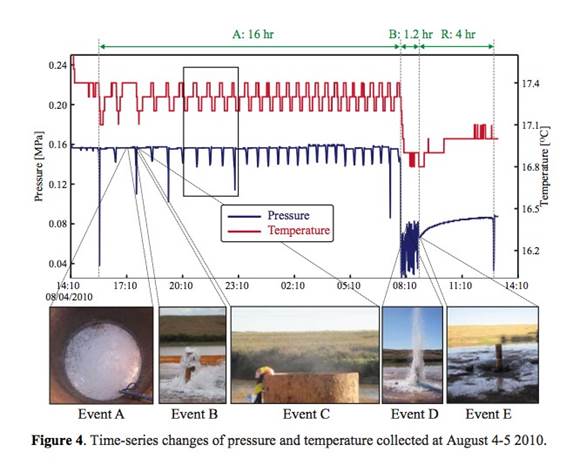
Due to the presence of an unknown obstacle, one piezometer was installed at the approximate depth of 16 m immediately above the obstacle, and it measured fluid pressure and temperature every 20 seconds. The piezometer was installed at 14:10 pm on August 4, and the observed static pressure and temperature was close to 0.16 MPa and 17.3°C at that time (Figure 4). After the major eruption continued for about 1 hour from 7:30 am to 8:40 am on August 5, however, we noticed that the static pressure and temperature were changed to approximately 0.08 MPa and 17.0°C. We determined that this change occurred because the continuous groundwater discharge through the 0.39 m diameter well was so powerful that the installed piezometer was pushed from a depth of 16 m depth to a depth of 8 m. Therefore, we stopped the monitoring at 12:40 pm immediately after the recharge period and began to record pressure and temperature manually. In the second trip from September 1 to 5, we installed a 1.9 cm-diameter PVC pipe that extended from the top of the well-casing to immediately above the unknown obstacle (Figure 3) and attached two piezometers to the PVC pipe at the depths of 6 m and 13 m, respectively. This configuration was designed to prevent the abrupt movement of the piezometers during the large-scale eruption. The measurements were initiated at 13:10 pm on September 1 at 20 second intervals and they were stopped at 10:30 am on September 5.
 
Results and Discussion
 
Field Trip from August 4 to 5
 
Figure 4 shows the time series changes of pressure and temperature measured at 14:10 pm on August 4 to 12:40 pm on August 5, explicitly conceptualizing the disturbance of fluid pressure and temperature during the eruption period. In detail, our observation using the piezometer installed at a depth of 16 m indicated that both pressure and temperature regularly dropped during the eruption period. In the absence of eruption activity, both the pressure and temperature stayed at consistent levels (0.15 MPa and 17.3°C).
 
Figure 4
 
General Characteristics of Eruptions: Intensity and Duration
 
Two distinctive patterns of eruptions (small and large eruptions) were identified (Figure 4). Twenty-six small-scale eruptions with an average eruption duration of 0.12 hour (7 minutes) occurred during the 16 hours from 15:30 pm on August 4 to 7:30 am on August 5 (Table 2) prior to a single, large-scale eruption, which continued for about an hour. Representative snap-shots of small- and large-scale eruptions are shown in Event B and Event D of Figure 4, respectively.
 
Table 2. Description of the eruption and recharge sequences during two field-trip periods
 
Field Trip
Starting time
Ending time
Eruption type
Duration
Comment
8/4-8/6
8/4
15:30 pm
8/5
7:30 am
A-type
16 hour
 
 
8/5
7:30 am
8/5
8:40 am
B-type
1.2 hour
 
 
8/5
8:40 am
8/5
12:40 pm
Recharge
4 hour
Because the levels of static pressure and temperature were changed, we stopped the recording at the piezometer.
 
8/5
12:40 pm
8/5
18:15 pm
C-type
5.6 hour
We began to record manually.
 
8/5
18:15 pm
8/6
over
1:00 am (?)
Probably D-type
Over
6.8 hour (?)
Eruptions continued past 1:00 am on 8/6. We do not know the exact time when it stopped.
 
8/6
over
1:00 am (?)
8/6
10:00 am
Recharge
 
At 10:00 am on August 6, the geyser was completely drained as shown in Event D of Figure 4.
9/1-9/5
9/1
16:50 pm
9/2
6:10 am
A-type
13.3 hour
 
 
9/2
6:10 am
9/2
7:10 am
B-type
1 hour
 
 
9/2
7:10 am
9/2
10:00 am
Recharge
2.8 hour
 
 
9/2
10:00 am
9/2
16:20 pm
C-type
6.3 hour
 
 
9/2
16:20 pm
9/2
21:00 pm
D-type
4.7 hour
PVC pipe attached to piezometers is broken. The level of static pressure and temperature was changed slightly.
 
9/2
21:00 pm
9/3
7:10 am
Recharge
10.2 hour
 
 
9/3
7:10 am
9/3
18:40 pm
A-type
11.5 hour
 
 
9/3
18:40 pm
9/3
19:30 pm
B-type
0.8 hour
 
 
9/3
19:30 pm
9/3
21:50 pm
Recharge
2.3 hour
 
 
9/3
21:50 pm
9/4
3:50 am
C-type
6 hour
 
 
9/4
3:50 am
9/4
9:10 am
D-type
5.3 hour
 
 
9/4
9:10 am
9/4
19:50 pm
Recharge
7.7 hour
 
 
9/4
19:50 pm
9/5
6:30 am
A-type
10.7 hour
 
 
9/5
6:30 am
9/5
7:30 am
B-type
1 hour


Multiple Small-Scale Eruptions: In general, during the 5 to 10 minutes prior to every small-scale eruption, we observed that CO2 bubbles were actively emitted within the geyser (Event A in Figure 4), indicating that CO2-saturated brine reached the boiling point and started to exsolve CO2 gas from CO2-dissolved brine. Despite the notable change inside the well, the water pool around the geyser stayed calm during this period. Five to 10 minutes later, the notable small-scale eruption began through the hole at the contact between the well and travertine surface. Because the intensity of the geyser eruption was still small, water discharge did not reach the top of the well casing but flew through the hole at the contact between the well and travertine surface. Soon, the water discharge reached the well casing top (Event B of Figure 4) and the eruption continued approximately 0.12 hour (7 minutes). When the small-scale eruption activity stopped, the water did not bubble anymore but a notable amount of CO2 gas was emitted instantaneously at the casing top with hissing sounds (Event C of Figure 4). Interestingly, our field observation addressing the sequence of CO2–-driven cold geyser eruption was similar to the field observation and numerical experiments of temperature-driven hot geyser [Ingebritsen and Rojstaczer, 1993 and 1996; White, 1967]. In the hot geyser, there was a period of liquid-only discharge at the beginning of the eruption, and the condition changed to two-phase flow, indicating both water and steam were emitted together. At the final stage, the water discharge stopped early and then only steam was emitted.

Single Large-Scale Eruption: Single large-scale eruption, characterized by large reduction of both pressure and temperature and, at the same time, longer eruption duration, occurred from 7:30 am to 8:40 am on August 5 after a series of multiple small- scale eruptions (Figure 4). In detail, we differentiated between large- and small-scale eruptions based on three major components such as intensity, duration, and drainage period. First, the intensity of the large-scale eruption was strong and, due to the power of instantaneous CO2 gas emission, the water column reached approximately over 10 m above the surface (Event D in Figure 4) but it only reached the casing top in the small-scale eruption (Event B in Figure 4). Due to the intensity difference, both the pressure and temperature drop was significantly larger in the large-scale eruption than in the small-scale eruption. Second, the average duration of the small-scale eruptions was approximately 0.12 hour (7.2 minutes) but that of large-scale eruption was 1.2 hours. Finally, we did not observe any change of height in the water pool around the geyser immediately after the small-scale eruption although a slight decrease of hydrostatic pressure was measured. However, after the large-scale eruption of 1.2 hours ceased, the water pool was completely drained into the geyser (Event E in Figure 4), and the water level inside the geyser well was approximately 2.5 to 3 m below the surface.
After the end of the intensive large-scale eruption, the recharge period began from 8:40 am and ended at 12:40 pm on August 5 with the first occurrence of a small-scale eruption. As we addressed in the “Methodology” section, at this moment, we discovered that the static levels of pressure and temperature had changed. Therefore, we stopped the piezometer measurement and recorded manually until 10:00 am on August 6. After the recharge period ended at 12:40 pm on August 5, we observed that an addition series of multiple small-scale eruptions continued (Table 2). The general characteristics of the small-scale eruptions were similar to those observed on August 4, but on August 5, the duration of the multiple small-scale eruptions prior to the single large-scale eruption was only 5.6 hours, which was approximately three times shorter than those the previous day (16 hours). After the multiple small-scale eruptions, the single large-scale eruption began at 18:15 pm on August 5 and continued past 1:00 am on August 6. Although we did not observe the exact time when this large eruption ended, its duration was more than 6.8 hours. The well was completely dry when we visited it at 7:00 am on the morning of August 6.
 
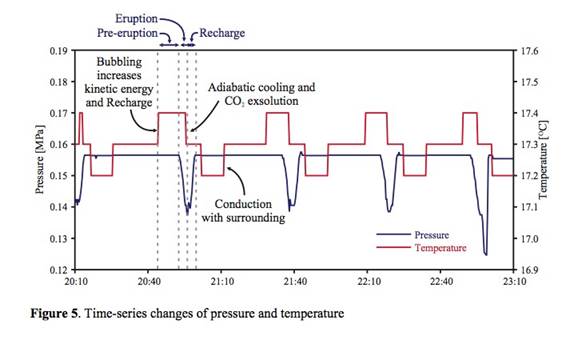
Identification of Single- and Large-Scale Eruptions: From the observation of August 4– field trip, we identified four different eruption patterns (A, B, C, and D) and two recharge periods in the Crystal Geyser (Table 2). A-type is characterized as multiple small-scale eruptions that continued for 16 hours. Immediately after the end of the A-type eruption period, the B-type eruption, which is characterized by a single large-scale eruption, continued for 1.2 hours. At the end of the B-type eruption, the level of groundwater inside the well fell to 2-3 m under the surface. A recharge period of approximately 4 hours was required prior to the occurrence of additional multiple small- scale eruptions, which we identified as the C-type eruption. The C-type eruption was multiple small-scale eruptions similar to A-type eruptions but the duration of the C-type eruption was shorter (5.6 hours). After the C-type eruption ended, the D-type eruption--a single large-scale eruption--continued for more than 6.8 hours. The identified patterns were captured in detail during the second field trip on September 1 to –5, and will be discussed further in the paper entitled "Coupled Natures of CO2-Driven Geyser Activity: Based on the Observation of Multiple Small-Scale Eruptions." We determined that all eruptions had three regular phases:  pre-eruption, eruption, and recharge (Figure 5). In addition, the changes in pressure and temperature during the eruption period were closely intercorrelated, similar to the observation of the other CO2-driven cold geyser in New Zealand [Lu, et al., 2005].
 
During the pre-eruption period, pressure was consistent but a 0.1°C increase in temperature was observed (Figure 5). We believe that this slight temperature increase was due to the increase of kinetic energy caused by CO2 bubbling in the system and the recharge of relatively hot groundwater from deeper formations. Prior to the pre-eruption period, CO2 bubbling, as shown in Event A of Figure 4, has not been observed within the geyser, which implies that the slight increase of temperature is somehow related to CO2 bubbling.
 
During the eruption period, we observed that both pressure and temperature dropped instantaneously (Figure 5). The reduction of hydrostatic pressure indicates that a certain portion of the water column above the piezometer is displaced with CO2 bubbles. The instantaneous temperature drop is primarily caused by the cooling contribution from the Joule-Thomson effect and endothermic CO2 exsolution. The Joule-Thomson effect addressed the temperature drop of CO2 due to the instantaneous expansion of CO2 gas volume induced by the pressure reduction during the isenthalpic condition (enthalpy change is zero). This has been studied previously [Han, et al., 2010; Katz and Lee, 1990; Oldenburg, 2007]. In the Crystal Geyser, CO2 gas is exsolved from CO2-saturated brine at a certain depth below the surface. Immediately after the nucleation of the CO2 gas bubble, the CO2 gas will migrate vertically through the water column of the well because of its buoyancy. As CO2 gas migrates closer to the surface, the hydrostatic pressure falls and the volume of CO2 gas increases. If these processes occur simultaneously, we could expect a substantial decrease in temperature. Further, it is well understood that the CO2 dissolution process is an exothermic reaction within the appropriate range of enthalpy variations from -440 to -200 kJ/kg at temperatures ranging from 25°C to 100°C [Carroll, et al., 1991; Duan and Sun, 2003; Ellis, 1959; Ellis and Golding, 1963; Koschel, et al., 2006]. Because the reaction is an exothermic reaction, heat evolves as the CO2 dissolves in the brine. The CO2 exsolution from liquid is simply the opposite process of the CO2 dissolution in liquid. In principle, the corresponding enthalpy change in CO2 exsolution is going to be the same with CO2 dissolution except it is defined as an endothermic reaction; the brine cools as the CO2 gas exsolves from the fluid. Therefore, we attribute the slight temperature decrease observed during the eruption period to the cooling contribution from both the Joule-Thomson effect and CO2 exsolution. Interestingly, we found that the temperature decreased again after the recharge phase. We believe this occurs because the temperature change in the system is relatively slow compared to the pressure change.
 
Figure 5
 
Field Trip from September 1 to –5
 
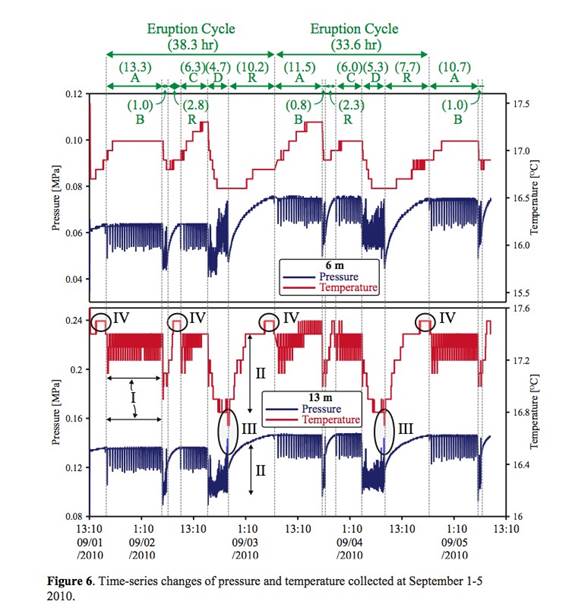
General Characteristic of Eruptions: Intensity and Duration: The observation from the second field trip on September 1– to 5 revealed the consistent eruption cycle observed during the first field trip. Thus, we were able to construct a clearer eruption cycle for the Crystal Geyser (Figure 6). As we discussed in the previous section, “Identification of Single- and Large-Scale Eruptions”, the data from the September field trip also confirmed that the eruption cycle is composed of four different eruption types (A-, B-, C-, and D-types) and two recharge periods (Table 2 and Figure 6). Two eruption cycles were captured and the time scales for these two cycles were 38.3 hours and 33.6 hours, respectively.
 
Figure 6
 
Within the eruption cycle, both B- and D-type eruptions are characterized as large-scale eruptions, which occurred immediately after the end of A- and C-type eruptions, respectively. Interestingly, there are distinctive features between B- and D-type eruptions, including eruption duration, recharge period, and the characteristic of multiple small-scale eruptions occurring prior to a large-scale eruption.
 
First, the D-type eruption was always longer than the B-type eruption (Figure 6 and Table 2). Within the first eruption cycle in Figure 6, B- and D-type eruptions continued for 0.8 and 4.7 hours, respectively.
 
Second, the D-type eruption always required a longer recharge period until the first small-scale eruption occurred.
 
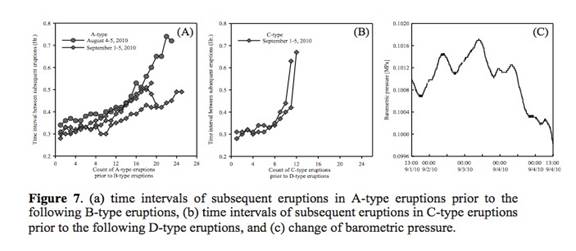
Finally, prior to these two large-scale eruptions (B- and D-types), multiple small-scale eruptions (A- and C-types) occurred but their number of eruptions differed. As seen in Figure 7, the number of A-type eruptions that occurred was less than the number of C-type eruptions. These characteristics were consistently observed during both the August and September field trips. This finding differs from the general understanding that the periodic eruption of a geyser shows the bimodal pattern [Azzalini and Bowman, 1990; Rinehart, 1980]. However, despite this finding, we were not able to determine the exact reason why two single large-scale eruptions occurred with different eruption durations.
 
Figure 7
 
The previous study associated with a temperature-driven hot geyser discovered that the change of barometric pressure could affect eruption cycles [Rinehart, 1972; Rojstaczer, et al., 2003; White, 1967]. In general, although the boiling temperature of pure water at atmospheric conditions is 100°C, it varies with pressure conditions and the amount of dissolved gas content in the water. Specific to the pressure variation, the boiling temperature increases with depth as the hydrostatic pressure increases but it decreases as the atmospheric pressure is reduced. For this reason, the change of barometric pressure could affect the boiling temperature in the hot geyser, resulting in a change of the eruption characteristics of the geyser. For example, previous studies showed that as the barometric pressure decreased, the discharge amount from the geyser is increased and the eruption interval becomes shortened [Rinehart, 1972; White, 1967]. To investigate the effect of barometric pressure change, we gathered barometric pressure data from the closest weather station located at Moab, Utah (Figure 7c). During the 5 days from September 1 to –5, barometric pressure reached a maximum (> 0.016 MPa) the morning of September 3 and decreased continuously until 13:00 (1:00 pm) on September 5.
 
Although barometric pressure changes were observed, we found that this external force did not control the interval between the multiple small-scale eruptions. We observed that the interval gets smaller as the time for the single large-scale eruption approaches (Figure 7 a and b). This specific trend, which was observed only at the Crystal Geyser, confirmed that the event of the small-scale eruptions induced the reduction of hydrostatic pressure causing the exsolution of more CO2 gas from the CO2-saturated brine. Therefore, a series of multiple small-scale eruptions (A- and C-types) could trigger a single large-scale eruption (B- and D-types).
 
Specific Characteristic (I, II, III, and IV) in Eruption Cycle: We observed four different characteristics (I, II, III, and IV), identified in Figure 6, in the eruption cycles. Both characteristics I and II represent the systematic coupled-nature of pressure and temperature due to CO2-related chemical reactions such as Joule-Thomson cooling and endothermic CO2 exsolution. Typically, larger-scale eruptions caused more significant reduction of both pressure and temperature than small-scale eruptions (comparison between I and II). In addition, although temperature change during the large scale-eruption distinctively appeared at both 6 m and 13 m, we found that thermal effect is relatively smaller at the shallower depth. This is because the CO2 bubbles, which are relatively colder than the surrounding fluid due to Joule-Thomson cooling and endothermic CO2 exsolution, lose their heat due to thermal conduction while they migrate vertically. For this reason, thermal disturbance caused by multiple small-scale eruptions was distinctive at 16 m but not at 6 m. Characteristic III specifically pointed out the process at the end of large-scale eruptions, where the measured hydrostatic pressure is increased but temperature reached the minimum. At the end of the large-scale eruption continued over 4 hours, the temperature of the fluid in the geyser becomes cool due to the continuous CO2 exsolution and adiabatic cooling processes. The decrease in temperature induced an increase in brine density, which resulted in an increase of the hydrostatic pressure in the geyser. Finally, we observed the slight increase of temperature immediately before multiple small-scale eruptions (characteristic IV in Figure 6). As we discussed earlier, the slight increase of temperature shown in Figure 5 was considered to be due to the increase of kinetic energy caused by CO2 bubbling in the system and the recharge of relatively hot groundwater from deeper formations.
 
Conceptual Description of CO2-Driven Cold Geyser Eruption Mechanisms
 
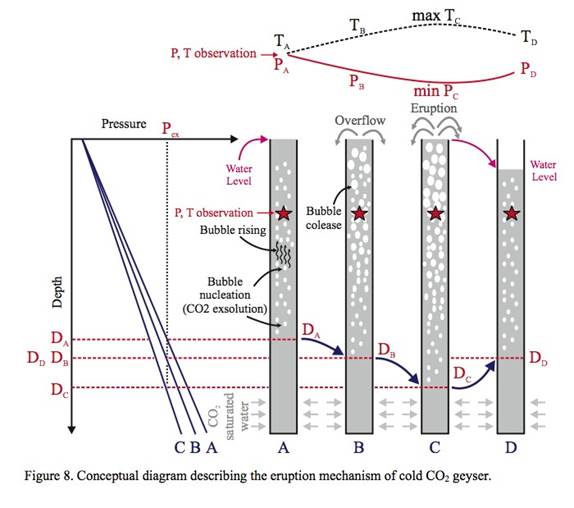
CO2 exsolution results in the decrease of the hydrostatic pressure and also reduces the temperature during both small and large eruption periods. Based on our observations, we developed a conceptual model describing the physical and chemical mechanisms causing cyclical eruptions from a CO2-driven cold geyser. Stage A in Figure 8 indicates the start of the geysering cycle, when the water reaches the top of the well and overflows. During the overflow process, CO2 exsolves from the CO2-saturated water at the depth above the critical exsolution pressure point and thus, CO2 bubbles begin to form in the water. At Stage B, the refilling of the well at the bottom by the recharging aquifer, causes the water level to rise in the well. When the overflow starts, the bubbles rising with the fluid begin to decrease the hydrostatic pressure at the top of the well (see the hydrostatic line in Stage B). The water level is fixed at the wellhead, so any slight density change progresses down the well as gaseous CO2 is released from solution, and the rate of bubble formation increases. CO2 bubbles continue coalescing and the depth of the critical CO2 exsolution pressure point becomes deeper as more CO2 bubbles are exsolved, which results in a further decrease of the hydrostatic pressure. At Stage C, eruption begins once the depth of the critical CO2 exsolution pressure point reaches the deepest point. At this stage, the hydrostatic pressure reaches its minimum. Once the eruption is over at Stage D, CO2 bubbles escape to the atmosphere, causing the water leve within the well to decrease. In addition, the depth of CO2 exsolution pressure becomes shallower. Finally, CO2-saturated brine is recharged from the bottom of well and Stage A begins again.
 
Figure 8
 
Task 2—: Simulation of Engineered Storage Sites (San Juan Basin, SACROC, Gordon Creek)
 
The ARAF team is evaluating multiple site case studies for the sake of analyzing the risks at sites at different stages of CCS operation, including three sites now available for access and analysis. These sites include:
 
  1. The Gordon Creek field in north-central Utah, just 25 miles from the original Farnham Dome site (and thus our baseline geologic and hydrologic knowledge is very solid). This site has never been subjected to CO2 injection, and will not begin injection for at least 1 year from now.
  2. Our SWP (“Phase 2”) field site in the Permian Basin in western Texas; we started CO2 injection at this site in October 2008, and injection is not slated to cease until 2010 at the earliest.
  3. Our SWP (“Phase 2”) field site in the San Juan Basin in northern New Mexico; we started CO2 injection at this site in July 2008, and injection is ceasing this week (the week of August 17, 2009).
We plan to include all three of these field sites in the ARAF STAR project to some extent, but our priority is the Gordon Creek field, and thus it will receive most of our time and effort. These three sites represent the three primary permutations of a CCS geologic site, to facilitate evaluation of different stages of risk analysis and framework development. Specifically, Gordon Creek is a new project area slated for future CO2 injection, and thus it represents a site with no baseline CCS analysis or data at the onset of the project. The Permian Basin site represents active CO2 injection and monitoring with a relatively mature fundamental geologic evaluation, and substantial monitoring and simulation data to support ARAF development. Finally, San Juan represents a site that has run the full course of CO2 injection from drilling to well closure (albeit a medium-scale demonstration).
 
The primary focus for the first year of the ARAF project was the Gordon Creek field, representing a site in pre-injection mode.
 
Task 2.1: Analysis of Pre-Injection Site: Gordon Creek Field, Utah
 
Geologic Model Development and Analysis
 
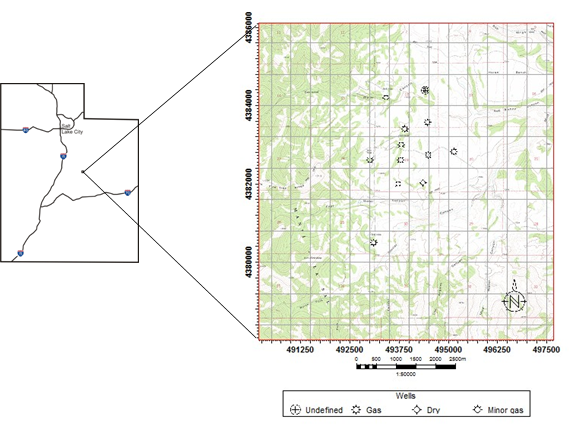
The Gordon Creek project area is one of the three field sites proposed in the EPA-sponsored ARAF STAR project we are performing. Gordon Creek field is a proposed large-scale CO2 injection site of the Southwest Regional Partnership on Carbon Sequestration (SWP). Gordon Creek field is a natural gas field located in T14S, R7-8E, Carbon County, Utah, producing methane from the Cretaceous Ferron Sandstone (Figure 1). The Permian White Rim Sandstone provides an estimated rate of 8,900 MCFPD of 98.82% CO2 (Morgan and Chidsey, 1991).
 
Gordon Creek field is located on the eastern flank of Wasatch Plateau. Closed anticline structure trending north-south in the field is approximately 9 miles long and 5 miles wide and serves as a structural trap for methane gas in the Ferron Sandstone and possibly CO2 in the White Rim. Geology in the proposed site exhibits a stacked system of alternating reservoirs and seals, which provides optimal conditions for geologic CO2 storage. The target CO2 injection formations are the Jurassic Navajo and Entrada formations due to their intermediate depth and the current use of salt water disposal into the Navajo.
 
Figure 9
 
Figure 9. Location map of Gordon Creek project area, Carbon County, Utah.
 
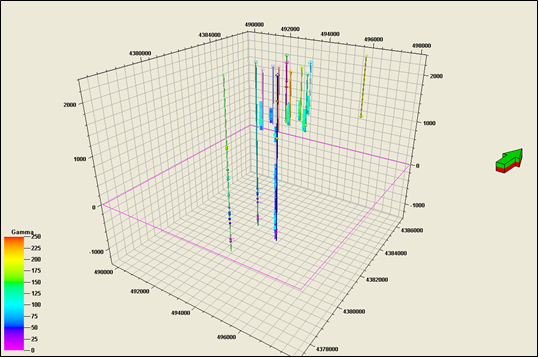
In this task, we focused on developing a site-specific static model based on the data collected specific to the Gordon Creek site. The location of the Gordon Creek site is illustrated in Figure 9. We gathered the stratigraphic formation top picks, well information, and well log images available from the project site. The distribution of wells in the site is shown in Figure 10. The well log images were digitized into the digital format (LAS).
 
Figure 10
 
Figure 10. Location of wells with digitized gamma ray logs. Vertical exaggeration is 2x.
 
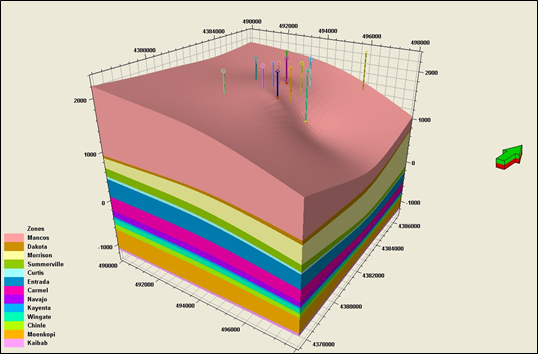
For the static geologic model development, we utilized the formation tops data tied to isochore surfaces. The resulting static model within the model boundary is shown in Figure 11. The model domain covers 8.2 km by 9.2 km in the x and y direction, centered at the proposed injection well. The constructed model contains 13 formations starting with the Cretaceous Mancos shale on top to the Kaibab formation at the bottom.
 
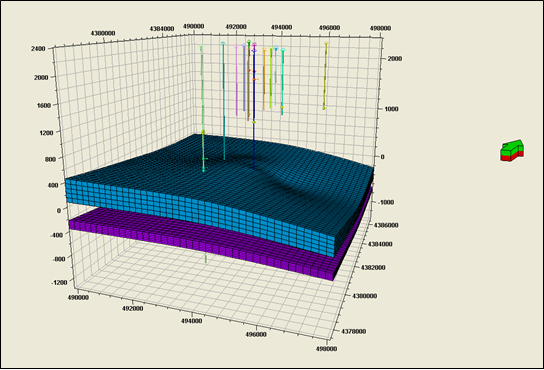
Figure 12 illustrates the grid setting of our target formations, Navajo and Entrada formations. Currently, the grid configuration is 41 x 46 x 65 cells in the x, y, and z direction, respectively, with a cell dimension of 200 m by 200 m. Five cells were equally spaced vertically in each formation. The average thickness of target formations within the model domain is found to be approximately 19.2 m and 63 m, respectively, for the Navajo and Entrada formations.
 
Figure 11
 
Figure 11. Stratigraphic distribution of geologic formations within the Gordon Creek site model boundary. Vertical exaggeration is 2x.
 
Fogure 12
 
Figure 12. Grid settings of target formations (Navajo and Entrada). Horizontal cell dimension is 200 m x 200m. Vertical exaggeration is 2x.
 
Overpressure Sensitivity Study
 
Using the initial Gordon Creek 3-D grid, we evaluated conditions under which overpressures might form in the Navajo Sandstone, the primary storage target reservoir. Because we have very little data (e.g., permeability, porosity, etc.) for the area to date, this initial analysis is a sensitivity study by definition.
 
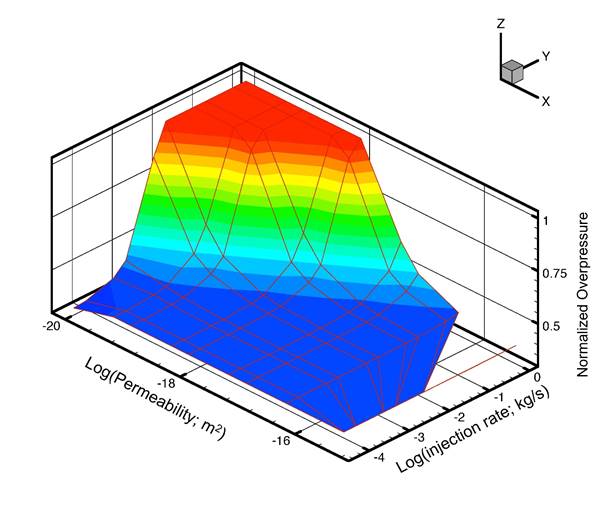
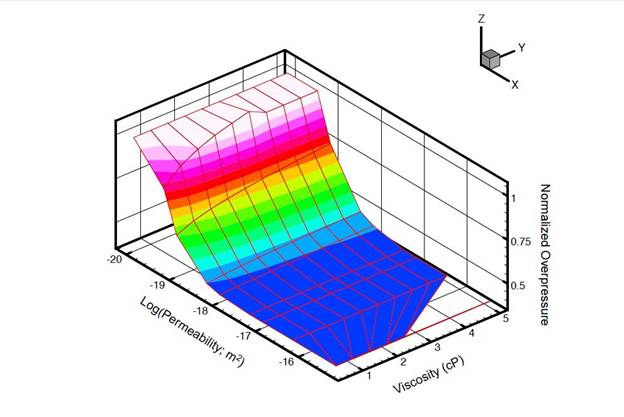
For this area, the fracture gradient approaches 80% of lithostatic pressure, and thus these simulations provide an initial glimpse regarding conditions that will lead to seal failure via fractures. This initial analysis will serve as a starting point for development of probability density functions for this pre-injection site. Figure 13 suggests that for the specific thickness and geometry of the preliminary model, overpressures may develop only if permeabilities are less than approximately 5 x 10-17 m2, for any significant CO2 injection rates (greater than 1000 tons per year, for example).
 
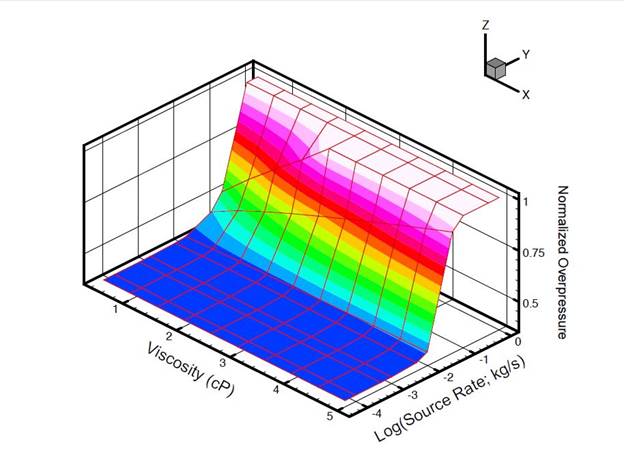
Likewise, once CO2 is injected in the reservoir, the viscosity of the water/brine/CO2 mixture changes as composition changes. While the viscosity of pure (liquid) CO2 at storage-reservoir conditions will not exceed 0.1 cP, water/brine viscosities can approach 1 cP, or even higher if oil is in place. Figure 14 indicates that fluid mixtures must approach relatively high viscosities (> approximately 1.5 to 2 cP) to favor overpressure development. These general results are corroborated by re-plotting the results of normalized overpressure as a function of viscosity and permeability (Figure 15).
 
We will use these general results to limit the “parameter space” required for development of probability density functions for induced seismicity. We will begin analysis of risk of induced seismicity for the Gordon Creek site during this next quarter.
 
Figure 13
 
Figure 13. Isometric projection of normalized overpressure versus injection rate and permeability, calculated for the generalized 3-D Gordon Creek site grid.
 
Figure  14
 
Figure 14. Isometric projection of normalized overpressure versus injection rate and fluid (injected) viscosity, calculated for the generalized 3-D Gordon Creek site grid.
 
Figure 15Log
 
2Viscosity c
 
Figure 15. Isometric projection of normalized overpressure versus permeability and fluid (injected) viscosity, calculated for the generalized 3-D Gordon Creek site grid.
 
Task 3—: Identification of Risk Elements and Development of PDFs
 
Subtask 3.2: Methods of Probability Density Function (PDF) Development
 
Analysis of CO2 Leakage into Overlying Formations
 
Given the presence of a major fault located 500 meters from the planned injection site, we will develop probability density functions (PDFs) for risk of (a) leakage through this fault, and (b) induced slip on this fault, following CO2 injection; we will deliver these PDFs and a detailed description of the process and algorithms used to develop these PDFs. Thus, the subtask 3.2 activities during this first year consisted of two main components.
  1. Development of a methodology for calculating the probability of leakage of CO2 into USDWs, especially via known (or unknown) fault pathways;
  2. A study of the impact of the fault structure on possible leakage of CO2 into overlying formations.
A generalized experimental design approach was developed to generate response surfaces and subsequently PDFs of important outcomes (overpressure, free CO2 concentration, etc.) as functions of significant input variables (porosity, permeability, anisotropy, etc.). Detailed methodology with results will be discussed in the next report. In this report we provide results of the effect of fault structure on CO2 leakage and possible consequences to USDWs. More details can be found in Pasala (2010).
 
Faults and fractures provide one of the primary risk factors for leakage in an engineered system. Injected CO2 may find its way out of the repository and into USDWs. In this part of the project, faults in various settings were examined to determine their influence on CO2 flow with reservoir rock and fault-affected rock. Fluid flow simulation results in this study help to constrain how engineered sites might best be designed to reduce the risk of leakage, and to examine the possible consequences of a leaking system.
 
The Navajo sandstone is a good analog for reservoir simulation and study. Porosity values of the Navajo sandstone can be as large as 20 to 30%. Permeability values measured in the Navajo sandstone typically range from 100 to 1000 millidarcies (md), with values as large as 8000 md [Freethy, et al., 1991]. Average permeability values for Navajo sandstone of 450 to 860 md also have been reported. Joints are features that can either enhance permeability or reduce it.
 
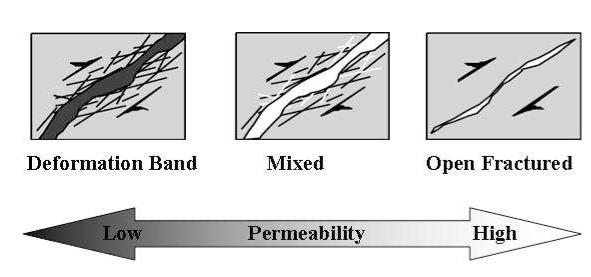
Joints are extension-induced mode I fractures that exhibit only opening displacement (white features in Figure 16). Deformation bands are planar, light-colored, vein-like features formed of ground and crushed sandstone grains and fine powder (dark features in Figure 16). Both joints and deformation bands are found as single features, or in networks, aligned sub-parallel to fault zones. Joints or deformation bands may be found alone, or together, leading to the possibility of a wide range of deformation-induced permeability variation within and near faults.
 
Figure 16
 
Figure 16. Typical arrangements of deformation-induced features in faulted sandstone. Arrows show direction of fault slip. Black features are individual/ amalgamated deformation bands. White features are open fractures.
 
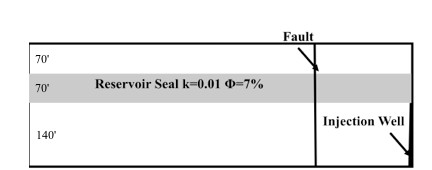
A sealed case with a high permeability fault and its impact on the CO2 leakage is investigated. The model volume used in all of the above simulations was 600.5 feet by 420 feet in plan and 280 feet thick. Vertical, impermeable faults are assumed to surround a sandstone aquifer that is sealed by low permeability rocks both above and below the aquifer. A 35 x 60 x 40 (84,000 grid blocks) Cartesian grid was used for all simulations. The 35 grid blocks in the X direction are of lengths 16 x 25, 3 x 15, 7.5, 5.0, 3.5, 2.25, 1.5, 1.0, 1.5, 2.25, 3.5, 5.0, 7.5, 15, and 4 x 25 feet. The 60 grid blocks in the Y direction are of lengths of 7 feet each. This makes the areal dimension of the field 600.5 x 420 feet. In the vertical (Z) direction, there were 40 layers of 7 feet each. A vertical, north-south trending fault is located 100 feet west of the injection well and fully penetrates the reservoir/aquifer. The fault is 15.5 feet wide. Fault grid blocks with sides as small as 1 foot are included in the model. Such fine grid blocks resolutions are needed to capture the small physical size of fault zone details.
 
The reservoir is basically divided into three sections, upper reservoir, sealed middle section, and lower reservoir, as shown in Figure 17. The thicknesses of the upper reservoir and middle seal were 70 feet each.
 
The injection well used a rate constraint of 100 MSCF/day. Injection was uniform and was selected to occur over the entire thickness of 140 feet (of the reservoir) for 500 days, which means the total amount of gas injected is 50,000 MSCF (50 MMSCF). The basic idea was to observe CO2 flow paths and investigate a long-term CO2 injection study.
 
The success of CO2 sequestration by deep injection depends on the ability of upper and lateral seals to confine the over-pressured fluid. One potentially serious problem associated with injection into underground formations is the possible leakage of injected CO2 through or along faults into USDWs. Over long time scales, these faults/fractures may serve as short-circuit pathways for ultimate leakage into upper formations. This is of great concern because leakage of CO2 in large quantities would compromise the integrity of USDWs.
 
Figure 17
 
Figure 17. Front view of the reservoir simulator set-up in the reservoir with horizontal seal case.
 
Permeable fault-related fractures in sandstone can focus CO2 flow to leakage points where permeable faults breach reservoir-sealing units and enable injected CO2 to leak into overlying USDW formations. On the other hand, low-permeability faults can restrict access to fault-bounded CO2 sequestration volumes. The total amount of gas injected for 500 days was 50,000 MSCF (50 MMSCF). The top and the bottom layers have the same reservoir properties.
 
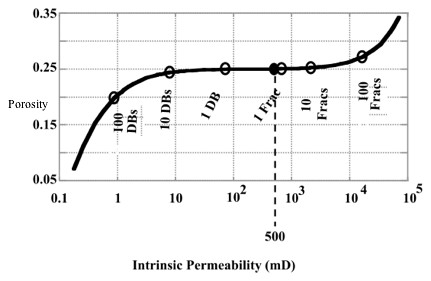
Depending on whether the fault zone is characterized by the deformation band or the joint, the permeability of the fault zone could vary by as much as six orders of magnitude (Figure 18).
 
The sealed middle layer has a permeability and porosity of 0.01 md and 7%. The two end member cases for fault permeability structure as discussed earlier were studied, the high-permeability fault containing open fractures and the low permeability fault containing deformation bands.
 
Figures 19 and 20 show vertical views of dissolved CO2 distributions for a deformation band and fractured fault case after 100 and 500 days. The injected gas spreads out in the bottom layers and does not escape into the top reservoir due to reservoir seal. A low permeability fault even though it cut across the entire reservoir does not allow any leakage of CO2 into the overlying formations.
 
Figure 21 shows the volume of CO2 sequestered in the three layers. In the fractured fault case, CO2 has leaked to the top layer as opposed to in the deformation band fault. The fractured fault broke the seal and migrated into the top layer. About 22.75% of the injected CO2 has leaked into the upper layer in the fractured fault case. On the other hand, in the deformation band fault, 87.3% of the CO2 resided in the bottom layer. Basically, there is negligible CO2 migration into the top layer in this case. Hence, the DB fault almost has no leakage into the USDWs compared to the fractured fault.
 
Figure 18
 
Figure 18. Variation in equivalent porosity and permeability of a 1 m3 rock block for two different host rocks as low-k deformation bands (DBs: _ = 0.07, k = 500 mD, 1 mm thick) and high-k fractures (Fracs: aperture = 0.1 mm) are added. The upper line is for host k of 500 mD and poro

Future Activities:

Task 1: —Simulation of Natural Analog Sites
  • Summary report of leakage mechanisms and processes for natural analogue leakage sites;
  • Summary report of characterization of a natural CO2 storage site (non-leaking) site; the planned site for this analysis and report is the Farnham CO2 Dome in central Utah.
Task 2—: Simulation of Engineered Storage Sites (San Juan Basin, SACROC, Gordon Creek)
  • Summary report of Gordon Creek model simulation analyses for basic CO2 migration and leakage assessment (these simulations will be the primary tool for developing probability density functions associated with selected risks).
  • If time affords, we also will develop summary reports of analyses of the other two field sites (San Juan Basin, NM, and SACROC field, TX).
Task 3: —Identification of Risk Elements and Development of PDFs
  • Summary report of probability density functions (development method and outcomes) for an engineered storage site. Given the presence of a major fault located 500 meters from the planned injection site, we will develop probability density functions (PDFs) for risk of (a) leakage through this fault, and (b) induced slip on this fault, following CO2 injection. We will deliver these PDFs and a detailed description of the process and algorithms used to develop these PDFs.
  • Generalized Risk Registry (tabulation of risks) for sites with USDWs present.
  • Detailed (specific) risk registry for the Gordon Creek field site.
Task 4: —Hydrodynamic Analysis of Tracer, Microbiologic, Chemistry and Physical Field Data and Use of These Data to Calibrate Quantitative Risk Assessment
  • Summary report of methods and associated validation approach for tracer, microbiologic, chemical and physical field data used for calibration of quantitative risk assessment.
  • Brief summary report of approach for application of tracer, microbiologic, chemical and physical field data in reservoir models.
  • Brief summary report of approach for application of tracer, microbiologic, chemical and physical field in developing risk estimates (in the form of PDFs).
Task 5: —Calibration and Refinement of Simulation Models Using Tracer/ Microbiology/Chemistry/Physical Field Data
  • Summary report of efficacy of gathered data for refining risk estimates in the form of PDFs.
Task 6: —Integration and Delivery of Comprehensive Aquifer Risk Assessment Framework (ARAF)
 
The outcome of Task 6 will be the primary outcome of the entire project: the final ARAF will take the form of a documented protocol for USDW risk assessment published in a summary report. We also will develop a set of companion web-pages to provide practical access to the ARAF. At the end of the project, we will deliver this report and these web-pages to EPA, but we plan to continue updating the framework over the long term.
 
Task 7: —Project Management
 
Annual reports of progress, followed by the final summary project report.
 
Task 8: —Education and Outreach
  • A website targeting K-12 students for education regarding geologic CCS, USDWs, potential risks to USDWs, and plans to mitigate those risks.
  • Presentations at annual project review meetings.
  • Presentations at national and regional conferences to describe the outcomes of this research to colleagues and other stakeholders.

References:

Allis, R., T. C. Chidsey, W. Gwynn, C. Morgan, S. White, M. Adams, and J. Moore (2001), Natural CO2 reservoirs on the Colorado plateau and southern Rocky Mountains: candidates for CO2 sequestration.
 
Altevogt, A. S., and M. A. Celia (2004), Numerical modeling of carbon dioxide in unsaturated soils due to deep subsurface leakage, 40.
 
Annunziatellis, A., S. E. Beaubien, S. Bigi, G. Ciotoli, M. Coltella, and S. Lombardi (2008), Gas migration along fault systems and through the vadose zone in the Latera caldera (central Italy): Implications for CO2 geological storage, International Journal of Greenhouse Gas Control, 2, 353-372.
 
Assayag, N., M. Bickle, N. Kampman, and J. Becker (2009), Carbon isotope constraints on CO2 degassing in cold-water geyser, Green river, Utah, Energy Procedia, 1, 2361- 2366.
 
Azzalini, A., and A. W. Bowman (1990), A look at some data on the Old Faithful Geyser, Applied Statistics, 39(3), 357-365.
 
Bachu, S., and D. B. Bennion (2009), Experimental assessment of brine and/or CO2 leakage through well cements at reservoir conditions, International journal of Greenhouse Gas Control, 3, 494-501.
 
Barlet-Gouedard, V., G. Rimmele, O. Porcherie, and J. Desroches (2009), A solution against well cement degradation under CO2 geological storage environment, International journal of Greenhouse Gas Control, 3, 206-216.
 
Carroll, J. J., J. D. Slupsky, and A. E. Mather (1991), The solubility of carbon dioxide in water at low pressure, Journal of Physical and Chemical Reference Data, 20(6), 1201- 1209.
 
Dockrill, B., and Z. K. Shipton (2010), Structural controls on leakage from a natural CO2 geologic storage site: Central Utah, U.S.A., Journal of Structural Geology.
 
Duan, Z., and R. Sun (2003), An improved model calculating CO2 solubility in pure water and aqueous NaClsolutions from 273 to 533 K and from 0 to 2000 bar, Chemical Geology, 193, 257-271.
 
Ellis, A. J. (1959), The solubility of carbon dioxide in water at high temperature, American Journal of Science, 257, 217-234.
 
Ellis, A. J., and R. M. Golding (1963), The solubility of carbon dioxide above 100°C in water and in sodium chloride solutions, American Journal of Science, 261, 47-60.
 
Emberley, S., I. Hutcheon, M. Shevalier, K. Durocher, W. D. Gunter, and E. H. Perkins (2004), Geochemical monitoring of fluid-rock interaction and CO2 storage at the Weyburn CO2-injection enhanced oil recovery site, Saskatchewan, Canada, Energy, 29, 1393-1401.
 
Gasda, S. E., S. Bachu, and M. A. Celia (2004), Spatial characterization of the location of potentially leaky wells penetrating a deep saline aquifer in a mature sedimentary basin, Environmental Geology, 46, 707-720.
 
Glennon, J. A., and R. M. Pfaff (2005), The operation and geography of carbon dioxide-driven, cold-water "geysers," The GOSA Transactions, IX, 184-192.
 
Gouveia, F. J., and S. J. Friedmann (2006), Timing and prediction of CO2 eruptions from crystal geyser, UTRep., Lawrence Livermore National Laboratory.
 
Han, W. S., G. A. Stillman, M. Lu, C. Lu, B. J. McPherson, and E. Park (2010), Evaluation of potential nonisothermal processes and heat transport during CO2 sequestration, Journal of Geophysical Research, 115(B07209).
 
Heath, J. E., T. E. Lachmar, J. P. Evans, P. T. Kolesar, and A. P. Williams (2009), Hydrogeochemical characterization of leaking, carbondioxide-charged fault zones in east-central Utah, with implications for geologic carbon storage, in Carbon Sequestration and its Role in the Global Carbon Cycle, edited by B. J. McPherson and E. T. Sundquist, pp. 147-158, American Geophysical Union, Washington, D.C.
 
Ingebritsen, S. E., and S. A. Rojstaczer (1993), Controls on geyser periodicity, Science, 262, 889-892.
 
Ingebritsen, S. E., and S. A. Rojstaczer (1996), Geyser periodicity and the response of geysers to small strains in the Earth, Journal of Geophysical Research, 101, 21891- 21907.
 
Katz, D. L., and R. L. Lee (1990), Natural gas engineering, McGraw-Hill New York. Klusman, R. (2006), Detailed compositional analysis of gas seepage at the National Carbon Storage Test Site, Teapot Dome, Wyoming, USA 21(9), 1498-1521.
 
Koschel, D., J.-Y. Coxam, L. Rodier, and V. Majer (2006), Enthalpy and solubility data of CO2 in water and NaCl(aq) at conditions of interest for geological sequestration, Fluid Phase Equilibria, 247, 107-120.
 
Lu, X., A. Watson, A. V. Gorin, and J. Deans (2005), Measurments in a low temperature CO2-driven geysering well, viewed in relation to natural geysers, Geothermics, 34, 389- 410.
 
Mayo, A. L., D. B. Shrum, and T. C. Chidsey (1991), Factors contributing to exsolving carbon dioxide in ground water systems in the Colorado plateau, Utah in Geology of east- central Utah, edited by T. C. Chidsey, Utah Geological Survey, Salt Lake City.
 
Nordbotten, J. M., M. A. Celia, and S. Bachu (2004), Analytical solutions for leakage rates through abandoned wells, Water Resources Research, 40.
 
Nordbotten, J. M., M. A. Celia, S. Bachu, and H. K. Dahle (2005), Semianalytical solution for CO2 leakage through an abandoned well, Environmental Science and Technology, 39, 602-611.
 
Oldenburg, C. M. (2007), Joule-Thomson cooling due to CO2 injection into natural gas reservoirs Energy Conversion and Management, 48, 1808-1815.
 
Oldenburg, C. M., and J. L. Lewicki (2006), On leakage and seepage of CO2 from geologic storage sites into surface water, 50, 691-705.
 
Pruess, K. (2008), On CO2 fluid flow and heat transfer behavior in the subsurface, following leakage from a geologic storage reservoir, Environmental Geology, 54, 1677- 1686.
 
Rinehart, J. S. (1972), Fluctuations in geyser activity caused by variations in earth tidal forces, barometric pressure, and tectonic stresses, Journal of Geophysical Research, 77, 342-350.
 
Rinehart, J. S. (1980), Geysers and Geothermal Energy, Springer-Verlag, New York. Rojstaczer, S. A., D. L. Galloway, S. E. Ingebritsen, and D. M. Rubin (2003), Variability in geyser eruptive timing and its causes: Yellowstone National Park, Geophysical Research Letters, 30(18).
 
Shipton, Z. K., J. P. Evans, D. Kirschner, P. T. Kolesar, A. P. Williams, and J. Heath (2004), Analysis of CO2 leakage through 'low-permeability' faults from natural reservoirs in the Colorado Plateau, east-central Utah, in Geological Storage of Carbon Dioxide, edited by S. J. Baines and R. H. Worden, pp. 43-58, Geological Society, London.
 
Shipton, Z. K., J. P. Evans, B. Dockrill, J. Heath, A. Williams, D. Kirchner, and P. T. Kolesar (2005), Natural leaking CO2-charged system as analogs for failed geologic storage reservoirs, in Carbon Dioxide Capture for Storage in Deep Geologic Formations, edited by D. C. Thomas and S. M. Benson, pp. 699-712, Elsevier, New York.
 
Waltham, T. (2001), Crystal geyser - Utah's cold one, Geology Today, 17(1), 22-24. Watson, T. L., and S. Bachu (2007), Evaluation of the potential for gas and CO2 leakages along wellbores, SPE.
 
White, D. E. (1967), Some principles of geyser activity, mainly from Steamboat springs, Nevada, American Journal of Science, 265, 641-684.
 
Task 3: —Identification of Risk Elements and Development of PDFs
 
Freethey, G. W.; Cordy, G. E. U.S. Geologic Survey 1991, 1411, 118–119.
 
Pasala, 2010, CO2 Displacement Mechanisms, Phase Behavior Effects and Carbon Dioxide Sequestration Studies, Ph.D. Dissertation, University of Utah, December 2010.
 
Task 4: —Hydrodynamic Analysis of Tracer, Microbiologic, Chemistry and Physical Field Data and Use of These Data to Calibrate Quantitative Risk Assessment
 
Hendry, J. M., Kotzer, T. G., and Solomon, D. K., 2005, Sources of radiogenic helium in a clay till aquitard and its use to evaluate the timing of geologic events, Geochimica et Cosmochimica Acta, Vol. 69, No. 2, pp. 475-483.
 
Osenbrück, J. Lippmann, and C. Sonntag, Dating very old pore waters in impermeable rocks by noble gas isotopes, Geochim. Cosmochim. Acta 62 (1998) 3041–3045.
 
Sheldon, A, L. and Solomon, D. K., 2003, Radiogenic helium in shallow groundwater within a clay till, southwestern Ontario, Water Resources Research, Vol. 39, No. 12, 1331, doi:10.1029/2002WR001797.

Journal Articles:

No journal articles submitted with this report: View all 3 publications for this project

Progress and Final Reports:

Original Abstract
  • 2011 Progress Report
  • 2012 Progress Report
  • Final Report
  • Top of Page

    The perspectives, information and conclusions conveyed in research project abstracts, progress reports, final reports, journal abstracts and journal publications convey the viewpoints of the principal investigator and may not represent the views and policies of ORD and EPA. Conclusions drawn by the principal investigators have not been reviewed by the Agency.

    Project Research Results

    • Final Report
    • 2012 Progress Report
    • 2011 Progress Report
    • Original Abstract
    3 publications for this project
    1 journal articles for this project

    Site Navigation

    • Grantee Research Project Results Home
    • Grantee Research Project Results Basic Search
    • Grantee Research Project Results Advanced Search
    • Grantee Research Project Results Fielded Search
    • Publication search
    • EPA Regional Search

    Related Information

    • Search Help
    • About our data collection
    • Research Grants
    • P3: Student Design Competition
    • Research Fellowships
    • Small Business Innovation Research (SBIR)
    Contact Us to ask a question, provide feedback, or report a problem.
    Last updated April 28, 2023
    United States Environmental Protection Agency

    Discover.

    • Accessibility
    • Budget & Performance
    • Contracting
    • EPA www Web Snapshot
    • Grants
    • No FEAR Act Data
    • Plain Writing
    • Privacy
    • Privacy and Security Notice

    Connect.

    • Data.gov
    • Inspector General
    • Jobs
    • Newsroom
    • Open Government
    • Regulations.gov
    • Subscribe
    • USA.gov
    • White House

    Ask.

    • Contact EPA
    • EPA Disclaimers
    • Hotlines
    • FOIA Requests
    • Frequent Questions

    Follow.