U.S. flag

An official website of the United States government

Here’s how you know

Dot gov

Official websites use .gov
A .gov website belongs to an official government organization in the United States.

HTTPS

Secure .gov websites use HTTPS
A lock (LockA locked padlock) or https:// means you have safely connected to the .gov website. Share sensitive information only on official, secure websites.

  • Environmental Topics
  • Laws & Regulations
  • Report a Violation
  • About EPA
Contact Us

Grantee Research Project Results

2009 Progress Report: Interactions of Natural Organic Matter with C60 Fullerene and their Impact on C60 Transport, Bioavailability and Toxicity

EPA Grant Number: R834093
Title: Interactions of Natural Organic Matter with C60 Fullerene and their Impact on C60 Transport, Bioavailability and Toxicity
Investigators: Li, Qilin , Alvarez, Pedro J.
Institution: Rice University
EPA Project Officer: Hahn, Intaek
Project Period: January 1, 2009 through December 31, 2011
Project Period Covered by this Report: July 1, 2008 through June 30,2011
Project Amount: $399,995
RFA: Exploratory Research: Nanotechnology Research Grants Investigating Fate, Transport, Transformation, and Exposure of Engineered Nanomaterials: A Joint Research Solicitation - EPA, NSF, & DOE (2007) RFA Text |  Recipients Lists
Research Category: Nanotechnology , Safer Chemicals

Objective:

The objectives of this research are to (1) understand the chemical nature of NOM­ C60 interactions and their impact on “solubility” and physicochemical properties of nC60 in realistic aqueous environments; (2) determine the effect of NOM on nC60 adsorption/deposition and transport in surface water and groundwater systems; and (3) investigate the effect of NOM-C60 interactions on nC60 toxicity mechanisms. During our investigation, solar irradiation was found to greatly alter the physicochemical properties of nC60, and consequently influence its fate, transport, and toxicity. Another type of carbon based nanomaterials, carbon nanotubes, were also found to undergo photochemical transformation under sunlight. As a result, we adjusted our focus to include the investigation on the role of sunlight and expanded our scope of research to include carbon nanotubes.

Progress Summary:
The project is progressing as scheduled. We have obtained expected results #1, 2 and 5 and most of #4 described in the proposal. Objective #1 has been achieved; tasks related to objective #2 are close to completion; tasks designed to achieve objective #3 have started.
 
In this report, we summarized the efforts and results to date about the impact of solar irradiation and humic acid on the aggregation and deposition behavior of nC60 and carboxylated multi-walled carbon nanotubes.
 
1. Impact of solar irradiation and humic acid on the deposition kinetics of nC60.
 
Our study in the previous year revealed that UVA irradiation resulted in surface oxidation of nC60, leading to changes in physicohemical properties of nC60. In the current project year, we investigated the influence of such changes on the aggregation and deposition behavior of nC60 in two ways: (1) direct impact on particle stability and (2) alter the interactions between nC60 nanoparticles and other environment components like NOM, resulting in indirect impact on stability.
 
Aggregation of nC60 suspensions in various solution conditions was characterized by monitoring the intensity weighted average particle size as a function chime via time-resolved dynamic light scattering (DLS) measurement. The initial aggregation rate was decided by linear regression of initial stage of the aggregation curve. The attachment efficiency α was calculated using the aggregation rate in the solution of interest normalized by the rate in the diffusion-limited regime. Electrophoretic mobility of nC60 was measured by phase analysis light scattering.


(1) Aggregation Kinetics in NaCl solutions.
 
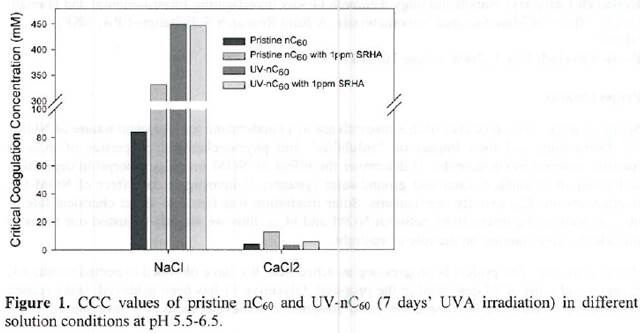
Figure 1 summarized the critical coagulation concentration (CCC) of nC60 with and without SRHA in NaCl and CaCl2. The aggregation behaviors of nC60 in NaCl can be qualitatively described by the Derjaguin-Landau-Verwey-Overbeek (DLVO) theory which considers the combined effect of electrostatic repulsion and van der Waals attraction. nC60 aggregation rate decreased with increasing UVA irradiation time during 7-day period. It is attributed to the surface oxygen-containing functional groups introduced by UV irradiation. For both the pristine and UV irradiated samples, particle electrophoretic mobility became less negative with increasing NaCl concentration due to charge screening. The pristine nC60 and nC60 after 7 days irradiation (7DUV- nC60) were similarly charged at NaCl concentrations below 10 mM, while at higher NaCl concentration up to 200 mM, the 7DUV- nC60 surface was notably more negatively charged, consistent with the higher colloidal stability. The difference in response to the charge screening effect of NaCl is attributed to the changes in nC60 surface chemistry. A close examination of the electrophoretic mobility data reveals that changes in particle electrophoretic mobility alone could not account for all the observed increase in particle stability after UV irradiation. Such inconsistency between the electrophoretic mobility and the stability of nanoparticles was attributed to the fact that electrophoretic mobility reflects the potential at the plane of shear, not the actual surface charge. Another potential explanation is that the surface oxygen functional groups increased nC60 hydrophilicity and hindered hydrophobic interactions, as described by the extended DLVO theory. Humic acid readily adsorbs onto nC60, altering its surface properties and potentially mediating colloidal aggregation. SRHA at 1 mg/L greatly stabilized the pristine nC60, increasing the CCC from 84 to 331 mM NaCl. Negligible changes in electrophoretic mobility of nC60 before and after contact with SRHA and nC60 stability at NaCl concentrations up to 1.5 M NaCl in the presence of 10 mg/L SRHA suggest that steric hindrance rather than electrostatic repulsion is the main stabilizing mechanism. Humic acid has much less effect on the stability of 7DUV- nC60, due to decreased adsorption of humic acid on the oxidized nC6o surface.
 
(2) Aggregation kinetics in CaCh solutions.
 
The CCCs of CaCh for the pristine and 7DUV- nC60, 4.25 and 3.24 mM CaCh, respectively, were markedly lower than those of NaCl (Figure 1). Contrary to the observations in NaCl solutions, the 7DUV-nC60 was less stable than the pristine nC6o in CaCh solutions. Comparison between the electrophoretic mobility of the pristine and the 7DUV-nC60 reveals that the 7DUV­nC60 was less negatively charged than the pristine nC60 over the CaCh concentration range tested, suggesting that Ca2+ was more effective in neutralizing negative charges on the oxidized nC60 surface than on the pristine nC60. Schulze-Hardy Rule was not applicable to 7DUV-nC60 aggregation data, suggesting Ca2+ specifically interacts with the 7DUV-nC60 surface, presumably with the oxygen containing functional groups. QCM-D experiments showed that Ca2+ facilitated SRHA sorption onto 7DUV-nC60 surface. As a result, the presence of 1 mg/L SRHA increased the stability of both pristine nC60 and 7DUV-nC60 in CaCl2.
 
 
3. Influence of humic acids on nC60 deposition kinetics
 
 
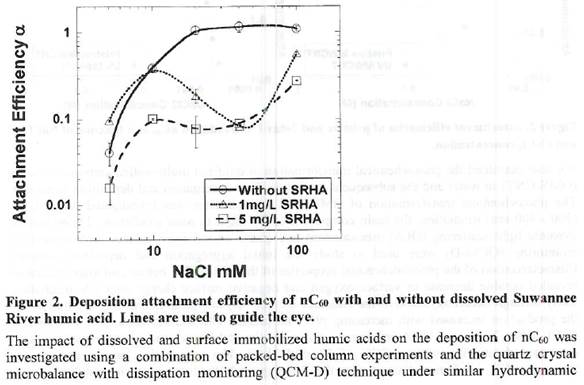
The impact of dissolved and surface immobilized humic acids on the deposition of nC60 was investigated using a combination of packed-bed column experiments and the quartz crystal microbalance with dissipation monitoring (QCM-D) technique under similar hydrodynamic conditions. The deposition attachment efficiencies of nC60 on bare silica surface measured by QCM-D were consistent with that from column experiments. Dissolved SRHA was found to have two important effects on nC60 deposition. First, it stabilized nC60, resulting enhanced mass transfer towards the silica surface at high ionic strength. Second, it reduced the deposition attachment efficiency mainly through steric hindrance effects as shown in Figure 2. The interactions between nC60 and surface immobilized humic acids were controlled by electrostatic and steric hindrance forces. Deposition of nC60 was facilitated at low ionic strength, which was consistent with the reduced surface charge of silica surface after coating. While in 10 mM NaCl, surface immobilized humic acids hindered deposition kinetics through steric hindrance effects. At high ionic strength, the steric hindrance effects diminished as the humic acid structure became more compact. Dissolved humic acid was found to play a more important role in nC60 deposition comparing to surface immobilized humic acids.
 
These findings suggest solar irradiation and NOM could play a critical role in the aggregation and deposition behavior of nC6o and consequently its environmental fate and transport.
 
2. Photochemical transformation of multiwalled carbon nanotubes (MWCNT) and its impact on MWCNT stability.
 
 
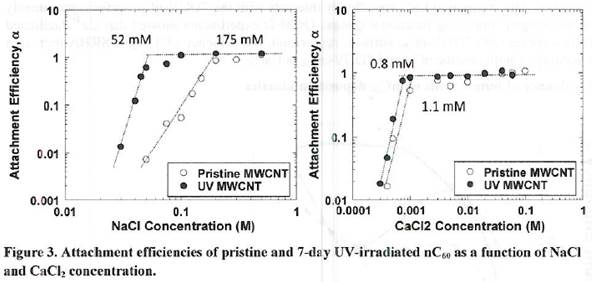
We also examined the photochemical transformation of oxidized multi-walled carbon nanotubes (OMWCNT) in water and the subsequent impact on their aggregation and deposition behaviors. The photochemical transformation of OMWCNT nanoparticles was investigated under UVA (300 - 400 nm) irradiation, the main component of UV light in solar irradiation. Time-resolved dynamic light scattering (DLS) measurement and quartz crystal microbalance with dissipation monitoring (QCM-D) were used to study the .initial aggregation and deposition kinetics. Characterization of the physicochemical properties of the OMWCNT before and after irradiation revealed notable decrease in surface oxygen and negative surface charge after UV irradiation, likely through decarboxylation of the nanotube surface. 1O2 was generated during irradiation and the production increased with increasing pH. The pristine OMWCNT has a CCC of 175 mM NaCl. After 7 days of UVA irradiation, however, the stability of the nanoparticles in NaCl decreased drastically, with a CCC of 52 mM NaCl. The aggregation rate increased with increasing UV irradiation time during the 7-day period. Such decrease in stability can be attributed to the decrease of oxygen-containing functional groups on the surface of the irradiated OMWCNTs as proved by XPS analysis. For both the pristine and UV irradiated samples, particle electrophoretic mobility became less negative with increasing NaCl concentration due to charge screening. However, the pristine OMWCNT was notably more negatively charged than the 7day irradiated OMWCNT, consistent with the higher colloidal stability. Cations of higher valence are more efficient in coagulation. As a result, in CaCl2 solutions, the CCCs of the pristine and 7DUV-OMWCNT were l .l and 0.8 mM CaCl2, respectively, which were markedly lower than those of NaCl. Contrary to the observations in NaCl solutions, the stability of OMWCNT before and after UV irradiation was similar. Comparison between the electrophoretic mobility of the pristine and the 7DUV-OMWCNT reveals that both were similarly negatively charged over the entire tested range of CaCh concentrations, suggesting that Ca2+ was more effective neutralizing negative charges on the pristine OMWCNT surface than on the 7DUV-OMWCNT.
 
Consistent with the decreased colloidal stability, the irradiated OMWCNTs had notably higher deposition rate than the pristine OMWCNTs in NaCl solutions. The surface potential of UV irradiated OMWCNT was lower than that of pristine OMWCNT in NaCl due to the loss of carboxyl functional groups during the irradiation. Thus UV irradiated OMWCNT experienced less electrostatic repulsion than pristine OMWCNT, which led to higher deposition rate. At higher ionic strength, significant aggregation of OMWCNT took place during the deposition process, which greatly hindered the convective-diffusive transport of OMWCNT towards silica crystal surface. Since the aggregation rates of pristine and UV irradiated OMWCNT were quite different at ionic strength less than their CCCs, the impact of aggregation on their deposition rates was also different. Pristine OMWCNT was much more stable than the UV irradiated sample. Aggregation had smaller impact on the deposition of pristine OMWCNT than the UV irradiated OMWCNT due to its slower aggregation rate and resulting higher diffusion coefficient. As a result, the deposition rate of pristine OMWCNT gradually reversed to higher than UV irradiated sample as ionic strength increased.


Future Activities:

We will continue to investigate the impact of NOM on the environmental fate and transport of nC60 nanoparticles. Research will focus on the role of humic acids on heterogeneous aggregation and deposition kinetics of fullerene nanoparticles. Natural river sediment samples have been collected from Buffalo Bayou, Houston, TX, and will be collected from two more locations where sediment properties differ. Heterogeneous aggregation of nC60 with river sediment will be investigated.


Journal Articles on this Report : 3 Displayed | Download in RIS Format

Publications Views
Other project views: All 13 publications 5 publications in selected types All 5 journal articles
Publications
Type Citation Project Document Sources
Journal Article Hwang YS, Qu X, Li Q. The role of photochemical transformations in the aggregation and deposition of carboxylated multiwall carbon nanotubes suspended in water. Carbon 2013;55:81-89. R834093 (2009)
R834093 (2010)
R834093 (Final)
  • Abstract: ScienceDirect-Abstract
    Exit
  • Journal Article Qu X, Hwang YS, Alvarez PJJ, Bouchard D, Li Q. UV irradiation and humic acid mediate aggregation of aqueous fullerene (nC60) nanoparticles. Environmental Science & Technology 2010;44(20):7821-7826. R834093 (2009)
    R834093 (Final)
  • Abstract from PubMed
  • Full-text: ResearchGate-Abstract & Full Text
    Exit
  • Abstract: ACS-Abstract
    Exit
  • Other: ResearchGate-Full Text PDF
    Exit
  • Journal Article Qu X, Alvarez PJJ, Li Q. Impact of sunlight and humic acid on the deposition kinetics of aqueous fullerene nanoparticles (nC60). Environmental Science & Technology 2012;46(24):13455-13462. R834093 (2009)
    R834093 (2010)
    R834093 (Final)
  • Abstract from PubMed
  • Full-text: Research Gate-Abstract & Full Text
    Exit
  • Abstract: ACS-Abstract
    Exit
  • Other: Research Gate-Full Text PDF
    Exit
  • Supplemental Keywords:

    Fullerene nanoparticles, nanomaterials, natural organic matter, UV, irradiation, transport, fate, bioavailability, toxicity, photochemical transformation, aggregation, deposition, sorption, stability, Health, Scientific Discipline, Water, Health Risk Assessment, Risk Assessments, Environmental Chemistry, Engineering, Chemistry, & Physics, Biochemistry, Drinking Water, community water system, toxicity, toxicokinetics, epidemelogy, nanomaterials, water quality, human exposure, engineered nanomaterials, drinking water system, drinking water contaminants, fate and transport, ambient particle health effects, nanotechnology, other - risk assessment, cellular responses, human health effects, human health risk, particle exposure, biochemical research

    Progress and Final Reports:

    Original Abstract
  • 2010 Progress Report
  • Final Report
  • Top of Page

    The perspectives, information and conclusions conveyed in research project abstracts, progress reports, final reports, journal abstracts and journal publications convey the viewpoints of the principal investigator and may not represent the views and policies of ORD and EPA. Conclusions drawn by the principal investigators have not been reviewed by the Agency.

    Project Research Results

    • Final Report
    • 2010 Progress Report
    • Original Abstract
    13 publications for this project
    5 journal articles for this project

    Site Navigation

    • Grantee Research Project Results Home
    • Grantee Research Project Results Basic Search
    • Grantee Research Project Results Advanced Search
    • Grantee Research Project Results Fielded Search
    • Publication search
    • EPA Regional Search

    Related Information

    • Search Help
    • About our data collection
    • Research Grants
    • P3: Student Design Competition
    • Research Fellowships
    • Small Business Innovation Research (SBIR)
    Contact Us to ask a question, provide feedback, or report a problem.
    Last updated April 28, 2023
    United States Environmental Protection Agency

    Discover.

    • Accessibility
    • Budget & Performance
    • Contracting
    • EPA www Web Snapshot
    • Grants
    • No FEAR Act Data
    • Plain Writing
    • Privacy
    • Privacy and Security Notice

    Connect.

    • Data.gov
    • Inspector General
    • Jobs
    • Newsroom
    • Open Government
    • Regulations.gov
    • Subscribe
    • USA.gov
    • White House

    Ask.

    • Contact EPA
    • EPA Disclaimers
    • Hotlines
    • FOIA Requests
    • Frequent Questions

    Follow.