U.S. flag

An official website of the United States government

Here’s how you know

Dot gov

Official websites use .gov
A .gov website belongs to an official government organization in the United States.

HTTPS

Secure .gov websites use HTTPS
A lock (LockA locked padlock) or https:// means you have safely connected to the .gov website. Share sensitive information only on official, secure websites.

  • Environmental Topics
  • Laws & Regulations
  • Report a Violation
  • About EPA
Contact Us

Grantee Research Project Results

Final Report: Improved Rapid Detection of Viable Waterborne Pathogens

EPA Contract Number: EPD07084
Title: Improved Rapid Detection of Viable Waterborne Pathogens
Investigators: Montagna, Richard A
Small Business: Innovative Biotechnologies International, Inc.
EPA Contact: Richards, April
Phase: II
Project Period: May 1, 2007 through April 30, 2009
Project Amount: $224,999
RFA: Small Business Innovation Research (SBIR) - Phase II (2007) Recipients Lists
Research Category: SBIR - Water and Wastewater , Small Business Innovation Research (SBIR) , Drinking Water

Description:

Environmental Problem
 
Drinking water in the United States is among the safest in the world. Despite that, undetected microbial contamination can lead to serious illness and death. One such pathogen, Cryptosporidium parvum, can cause debilitating diarrhea leading to serious illness. A number of outbreaks of Cryptosporidiosis have been reported in the United States, including a major outbreak in Milwaukee, WI, in 1993 that killed more than 100 people. To monitor drinking water for the presence of Cryptosporidium oocysts¸ water utilities often rely on collecting water samples that are then submitted to an outside reference laboratory for testing. Besides the expense of between $350–$650 per analysis, public health is jeopardized by the long delay in obtaining the final results (sometimes as much as 7–10 days).
 
Another problem inherent in current testing methods is that determination of the viability status of the oocysts requires additional complicated tests. As effective methods to inactivate Cryptosporidium are implemented on a widespread basis in water utilities, it will therefore be even more important to determine the viability status of microbes that still manage to make their way through the plant to the distribution system (even though they may have been successfully inactivated).

Summary/Accomplishments (Outputs/Outcomes):

With support from the EPA’s SBIR Program, Rheonix has developed a fully automated and rapid molecular diagnostic system that is not only able to detect single oocysts of Cryptosporidium parvum in drinking water but also can distinguish viable from non-viable oocysts. Moreover, the patented Rheonix CARD® (Chemistry And Reagent Device) disposable device is able to automatically perform all sample preparation, analysis and readout without user intervention. A “bench top” assay originally was developed by Innovative Biotechnologies International, Inc. (IBI, prior to its acquisition by Rheonix in 2008) that could be completed within a 4–6 hour period. Considerable “hands-on” efforts, however, were required. Those steps included: (1) immunomagnetic purification and washing of oocysts; (2) heat-shock induction of the hsp70 mRNA response to differentiate viable from nonviable oocysts; (3) lysis of oocysts; (4) extraction and purification of mRNA; (5) NASBA gene amplification of the target gene sequences; and finally (6) detection of the NASBA amplicons on a lateral flow system utilizing liposomes, conjugated to molecular probes, that also encapsulate signal-generating molecules to provide an inexpensive method to easily detect the amplicons.
 
Following the acquisition of IBI by Rheonix, the EPA contract was modified to migrate the bench top assay to the fully integrated Rheonix CARD® platform, which originally was developed to automatically analyze clinical specimens. Once a water sample is applied to the CryptoDetect CARD, all of the required steps are seamlessly and automatically performed without any further user intervention. Not only will this ease-of-performance reduce the currently high costs associated with monitoring drinking water for the presence of C. parvum, but the level of training required to perform this sophisticated molecular test has been significantly reduced. Therefore, once approved by EPA, water treatment plants should be able to more rapidly and inexpensively test drinking water for microbial safety.

Conclusions:

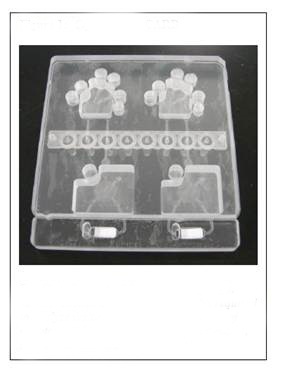
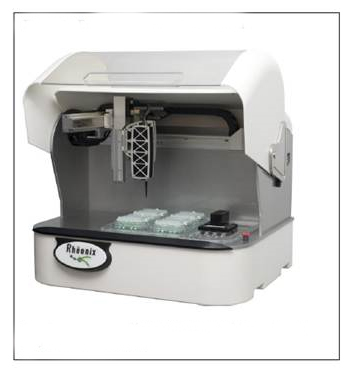
The Rheonix technology includes the disposable CARD cartridges (Figure 1) that can be inserted into the EncompassMDx™ Workstation (Figure 2). Depending upon the configuration of the CARD assay, up to 24 assays can be simultaneously performed under software control. A broad range of sample types and volumes can be automatically analyzed in the EncompassMDx™ system in a completely unattended manner. Once a raw sample is applied, no further “hands-on” efforts are required.
 
Figure 1
Figure 1. CryptoDetect CARD. The CryptoDetect CARD contains all pumps, valves, reaction and reagent reservoirs required to analyze wter samples for the presence of Cryptospidium parvum in a fully automated, unattended manner. 
Figure 2
Figure 2. EncompassMDxTM Workstation. The EncompassMDxTM can process up to 24 samples in a fully automated manner. 

The company currently is pursuing strategic relationships with companies that actively sell and service the drinking water industry. The ideal partner for Rheonix is a company that not only has a dominant presence in the marketplace, but also has complementary products whose sales can be leveraged by the availability of the unique CryptoDetect CARD. Although not presently an EPA approved method, the Company will continue to collaborate with EPA to achieve the necessary regulatory approvals to permit the CryptoDetect CARD to be implemented on a nationwide basis, thereby further improving the safety of the U.S. drinking water supply.

Supplemental Keywords:

waterborne pathogen, detection, potable water, oocyst, Cryptosporidium parvum, Sustainable Industry/Business, RFA, Scientific Discipline, Technology for Sustainable Environment, Sustainable Environment, Environmental Chemistry, Environmental Engineering, drinking water, biosensor, water treatment, environmental technology, waterborne patogen detection


SBIR Phase I:

Improved Rapid Detection of Viable Waterborne Pathogens  | Final Report

Top of Page

The perspectives, information and conclusions conveyed in research project abstracts, progress reports, final reports, journal abstracts and journal publications convey the viewpoints of the principal investigator and may not represent the views and policies of ORD and EPA. Conclusions drawn by the principal investigators have not been reviewed by the Agency.

Project Research Results

  • SBIR Phase I | Final Report

Site Navigation

  • Grantee Research Project Results Home
  • Grantee Research Project Results Basic Search
  • Grantee Research Project Results Advanced Search
  • Grantee Research Project Results Fielded Search
  • Publication search
  • EPA Regional Search

Related Information

  • Search Help
  • About our data collection
  • Research Grants
  • P3: Student Design Competition
  • Research Fellowships
  • Small Business Innovation Research (SBIR)
Contact Us to ask a question, provide feedback, or report a problem.
Last updated April 28, 2023
United States Environmental Protection Agency

Discover.

  • Accessibility
  • Budget & Performance
  • Contracting
  • EPA www Web Snapshot
  • Grants
  • No FEAR Act Data
  • Plain Writing
  • Privacy
  • Privacy and Security Notice

Connect.

  • Data.gov
  • Inspector General
  • Jobs
  • Newsroom
  • Open Government
  • Regulations.gov
  • Subscribe
  • USA.gov
  • White House

Ask.

  • Contact EPA
  • EPA Disclaimers
  • Hotlines
  • FOIA Requests
  • Frequent Questions

Follow.