


Grantee Research Project Results
Final Report: Exposure of Children to Pesticide in Yuma County, Arizona
EPA Grant Number: R825169Title: Exposure of Children to Pesticide in Yuma County, Arizona
Investigators: Lebowitz, Michael , O'Rourke, Mary Kay , Aguirre, A.
Institution: University of Arizona
EPA Project Officer: Aja, Hayley
Project Period: October 1, 1996 through September 30, 1999
Project Amount: $596,039
RFA: Exposure of Children to Pesticides (1996) RFA Text | Recipients Lists
Research Category: Children's Health , Pesticides , Human Health , Safer Chemicals
Objective:
Our goal is to determine whether children living in agricultural communities experience greater organophosphate (OP) pesticide exposure than people living elsewhere in Arizona and whether the pathways of exposure are the same. Exposure of children to pesticide has a potentially greater effect than similar exposure in adults because of children have developmental vulnerability and consume disproportionate amounts of food and beverage relative to body mass.
The overall goals will be realized by collecting information to achieve the following specific aims: 1) to evaluate multimedia for pesticides, 2) to evaluate multiple pesticide exposure pathways, 3) to employ biomarkers (urinary metabolites) as measures of exposure, 4) to employ screening techniques and identify the high end of the distribution, to compare distributions of pesticide exposure in children with those of adults in Yuma County and those of adults and children elsewhere in Arizona, to model exposure, and to evaluate the knowledge of caregivers regarding pesticide exposure in the home, and provide additional information as necessary.
Summary/Accomplishments (Outputs/Outcomes):
Recruited population: We recruited 140 households with a total of 154 children under the age of 6 years. The population was recruited from San Luis (46%), Somerton (49%), and Gadsden/Yuma (5%) Arizona within 15 miles of the U.S. Mexico Border. All children were Hispanic and most households were bilingual. Spanish was the preferred language for questionnaire completion in 97% of the homes surveyed. 51% of the children were male and 49% were female. The majority of the children ≤ six years of age were 5 years of age (47%) with near equal representation of three and four year-olds (21% and 25% respectively). Each age group had about the same gender split.
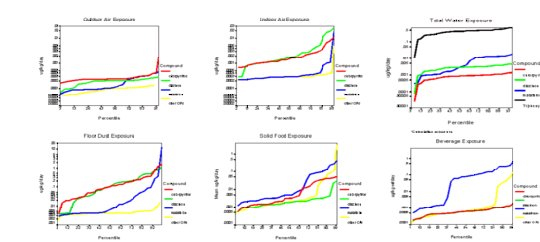
Specific Aim 1: To evaluate multimedia for pesticide content. Media representative of the three major pathways of exposure were collected and analyzed for pesticide content (i.e., air, dermal wipes, floor dust, and liquid and solid food). Range and distribution of the major OPs sampled (chlorpyrifos, diazinon, and malathion) differed little from those collected in the NHEXAS Arizona survey. The notable exception was the concentration of chlorpyrifos found in outdoor air samples. A background level of 2 ng/m3 was found in 90% of the outdoor air samples collected south of Yuma, Az.
Specific Aim 2: To evaluate multiple pesticide exposure pathways.
| When examining aggregate exposure to OPs, floor dust appears to be the major media through which young children are exposed (68.8%) followed by solid food (18.8%), and beverage (10.4%). Air and water (modeled from ABS and NHEXAS data) contribute less than 2% to the total aggregate exposure. The contribution of floor dust depends on an estimated exposure of .25 g of accidental house dust ingestion per day. This exposure factor is the major determinant of children's exposure. The accidental ingestion of house dust exposure factor needs further validation. |
Specific Aim 3: To employ biomarkers (urinary metabolites) as measures of exposure. Urinary biomarkers played an important role in the study design. During initial evaluation (Stage II), dialkylphosphates were evaluated to select individuals who were apt to have exposures at the high end of the distribution. Table 1. Percentage of the Stage II population with specific urinary metabolites above the detection limit. These values exceed the 95th percentile of non-occupationally exposed reference range of 1000 people.
Table 1
| Diethylphosphates (µg/g) | Dimethylphosphates (µg/g) | |||||||
|---|---|---|---|---|---|---|---|---|
| MDL (µg/L) | n | DEP | DETP | DEDT P | DMP | DMTP | DMDT P | |
| % Detects | 25 | 121 | 5% | 0% | 0% | 25% | 26% | 3% |
| Range | ND - 263 | ND | ND | ND - 981 | ND - 369 | ND - 37 | ||
| 95th % | 22 | ND | ND | 124 | 141 | 1 | ||
During Stage II sampling (30 high end homes) both the dialkylphosphates and specific urinary metabolites were measured. Measures collected at one tie were not predicative of exposure at a second time. The screening method was not as effective as envisioned.
There was no association between calculated cumulative exposure for chlorpyrifos and the specific urinary biomarker (2,3 TCPY) collected during the sampling period.
Specific Aim 4: To employ screening techniques and identify the high end of the distribution. Biomarkers used as screens (see specific aim 3) enhanced selection only slightly and were not predictive of a second elevation in exposure.
A modified ELISA assay was employed to evaluate OP concentrations in dust collected with the household vacuum cleaner. The approach appeared effective for aggregate concentrations of 2 ug/g of house dust. Approximately 11% of the homes tested positive. the aggregate assay costs approximately 10% of a specific assay run by GC/MS.
Specific Aim 5: To compare distributions of pesticide exposure in children with those of adults in Yuma County and those of adults and children elsewhere in Arizona. The children's pesticide survey recruited children under the age of 6 years. NHEXAS, a multimedia, multipathway survey of the state of Arizona, employed a PPS sampling strategy. An insufficient number of children in the same age group were recruited to obtain an exposure distribution. We were able to compare exposures for the Children's study (all under 6 years) with "children" (<13 years).
| Age group and body weight are factors influencing exposure. Although the concentrations are similar; population characteristics dictate the exposures will be different. Older children consume lower amounts of house dust (as indicated by the EPA Exposure Factors Handbook). Older children also weigh more, further reducing the potential dose. to make comparisons of exposure it will be essential to compare only children of equal age. |
Specific Aim 6: To model exposure.
Figure 4. The distribution of pesticide doses calculated for thirty children living in Yuma County,
Arizona. Little of the daily pesticide dose occurs through air or water. The majority occurs through
food and secondary injection of house dust.
Specific Aim 7: To evaluate the knowledge of caregivers regarding pesticide exposure in the home, and provide additional information as necessary. In this intensely farmed community, most people had some awareness of factors leading to enhanced pesticide exposure. People understood personal hygiene factors and outdoor activity factors. Most knew food from field should be thoroughly washed. Food preparation factors leading to increased pesticide exposure were the least known. In general, the population was well informed and relationships with exposure were ambiguous.
Journal Articles on this Report : 1 Displayed | Download in RIS Format
| Other project views: | All 19 publications | 1 publications in selected types | All 1 journal articles |
|---|
| Type | Citation | ||
|---|---|---|---|
|
|
O'Rourke MK, Lizardi PS, Rogan SP, Freeman NC, Aguirre G, Saint CG. Pesticide exposure and creatinine variation among young children. Journal of Exposure Analysis and Environmental Epidemiology 2000;10(6 Pt 2):672-681. |
R825169 (Final) |
Exit Exit |
Supplemental Keywords:
Agriculture, Pesticide, Organophosphate, Urinary Biomarkers of Exposure, Dialkylphosphates, Exposure Assessment, multimedia, multipathway, food, beverage, indoor air, PUF, floor dust, house dust, GC/MS, chlorpyrifos, diazinon, malathion, 2,3 TCPY, environmental chemistry, time-activity diaries, diary validation, automated data entry, Health, RFA, Scientific Discipline, Air, Geographic Area, Toxics, Susceptibility/Sensitive Population/Genetic Susceptibility, Health Risk Assessment, pesticides, Risk Assessments, State, genetic susceptability, Children's Health, indoor air, Biochemistry, air toxics, US Mexico Boarder, health effects, US Mexico Border, multi-media sampling, Diazinon, indoor air quality, environmental hazard exposures, sensitive populations, dust , harmful environmental agents, Yuma County, Arizona, pesticide exposure, AZ, low income community, hispanics, human exposure, agricultural community, dermal contact, insecticides, Arizona, pesticide residues, U.S. Mexico Border, children, exposure, rural communities, chlorprifos, environmental toxicant, exposure assessment, vulnerability, questionnaire, exposure and effectsRelevant Websites:
Progress and Final Reports:
Original AbstractThe perspectives, information and conclusions conveyed in research project abstracts, progress reports, final reports, journal abstracts and journal publications convey the viewpoints of the principal investigator and may not represent the views and policies of ORD and EPA. Conclusions drawn by the principal investigators have not been reviewed by the Agency.