


Grantee Research Project Results
2021 Progress Report: Characterization and Quantification of per- and polyfluoroalkyl substances in landfill gas and estimate of emissions from U.S. Landfills
EPA Grant Number: R839600Title: Characterization and Quantification of per- and polyfluoroalkyl substances in landfill gas and estimate of emissions from U.S. Landfills
Investigators: Barlaz, Morton A. , Field, Jennifer , Simonich, Staci
Institution: Oregon State University , North Carolina State University at Raleigh
EPA Project Officer: Hahn, Intaek
Project Period: September 1, 2019 through August 31, 2022 (Extended to August 31, 2024)
Project Period Covered by this Report: September 1, 2020 through August 31,2021
Project Amount: $900,000
RFA: Practical Methods to Analyze and Treat Emerging Contaminants (PFAS) in Solid Waste, Landfills, Wastewater/Leachates, Soils, and Groundwater to Protect Human Health and the Environment (2018) RFA Text | Recipients Lists
Research Category: Drinking Water , Water Quality , Human Health , Water , PFAS Treatment
Objective:
The overall research objective is to estimate the mass of per- and polyfluoroalkyl substances (PFAS) that are present in landfill gas (LFG) and the mass of PFAS emitted as fugitive emissions. Sub-objectives are to: (1) develop methods to sample and analyze LFG for targeted and non-targeted PFAS; (2) measure PFAS concentrations at a cross section of U.S. landfills in different climatic regions; (3) develop a model to estimate PFAS production and emissions at the U.S. national scale; (4) evaluate the potential impact of soil attenuation on PFAS emissions; (5) measure gas-phase PFAS release from mixed waste and food packaging materials.
Progress Summary:
Task 1: Develop methods to sample and analyze PFAS in LFG
We have developed a sampling system to collect landfill gas (LFG) and analyze samples for PFAS by thermal desorption gas chromatography coupled with mass spectrometry (TD-GC-MS). A total of 47 target, semi-quantitative, and suspect volatile PFAS from nine classes are being analyzed including fluorotelomer alcohols (4:2, 6:2, 8:2, and 10:2 FTOHs), C8 perfluorinated sulfonamides (N-MeFOSA, N-EtFOSA), and C8 perfluorinated sulfonamidoethanols (N-MeFOSE, N-EtFOSE). Suspect PFAS include the C2-C7 perfluorinated sulfonamidoethanols and14:2-FTOH.
Task 2: Measure PFAS concentrations at a cross section of US landfills in different climate regions.
We have identified a total of 30 landfills in arid, moderate and wet regions of the U.S. and to date, we have sampled 26 landfills at least once and 17 landfills at least twice. The preliminary data for eight wet landfills is presented in Figure 2 and shows that PFAS in LFG is dominated by fluorotelomer alcohols. We have also detected minor components such as olefins and acrylates.
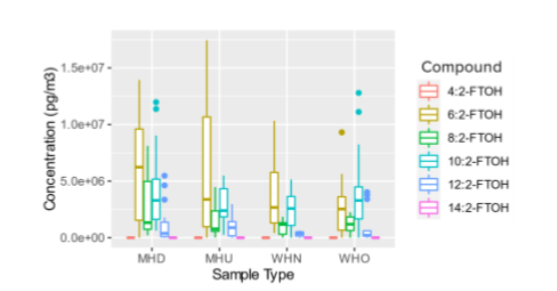
Figure 2. Fluorotelomer alcohols dominate the PFAS in landfill gas from 8 wet landfills (precipitation > 40 in/yr). MHD – Main Header Upstream; MHU – Main Header Downstream; WHN – Well Head New (<5 y); WHN – Well Head Old (>10 y). The horizontal line in the middle is the median and the outer edges are the inter – quartile (middle 50%). The lines that extend from the outer edges are upper and lower quartiles.
Task 3: Develop a model to estimate PFAS production and emissions at the US national scale.
To quantify the mass of PFAS released in LFG, a national inventory of LFG generation, collection, and fugitive emissions is under development using data from the U.S. EPA Greenhouse Gas Inventory and the U.S. EPA’s Landfill Methane Outreach Program database. Using available data, we are able to estimate the volume of LFG that is generated, recovered (flared or energy recovery) and emitted in each climatic region of the U.S. We will then apply the PFAS concentration data developed in Task 2 to estimate a U.S. inventory for PFAS in LFG.
Task 4: Assess the impact of soil on the attenuation of PFAS in LFG that is not collected.
We have fabricated a static chamber for this task to measure the concentration signature of PFAS that has been released through a soil cover (Figure 2). We will compare this concentration signature with that of PFAS collected in LFG in the buried waste adjacent to and below soil cover. To date, we have conducted two successful flux measurements. We plan to do measurements at two sites and two sampling location in each site.
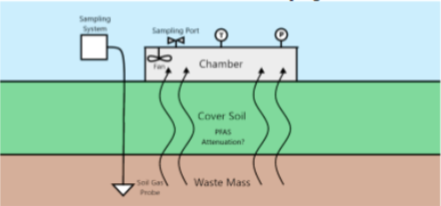
Figure 2. Experimental approach to look for evidence of PFAS transformations within the landfill cover soil.
Task 5: Measure the production of volatile PFASs from residential MSW and food waste packaging during anaerobic decomposition.
We have identified 11 packaging samples that contain PFAS, and we are fabricating a reactor system in which to conduct decomposition experiments and measure gaseous PFAS. We have confirmed that our microbial inoculum as well as reactor components do not release PFAS to the aqueous phase.
Journal Articles on this Report : 1 Displayed | Download in RIS Format
| Other project views: | All 15 publications | 3 publications in selected types | All 3 journal articles |
|---|
| Type | Citation | ||
|---|---|---|---|
|
|
Titaley IA, De la Cruz FB, Field JA. Comment on “Release of Volatile Per-and Polyfluoroalkyl Substances from Aqueous Film-Forming Foam”. Environmental Science & Technology Letters 2020;7(11):866-8. |
R839600 (2020) R839600 (2021) R839600 (Final) |
Exit |
Supplemental Keywords:
landfill gas, emissions inventory, landfill model, food packaging, PFASRelevant Websites:
Progress and Final Reports:
Original AbstractThe perspectives, information and conclusions conveyed in research project abstracts, progress reports, final reports, journal abstracts and journal publications convey the viewpoints of the principal investigator and may not represent the views and policies of ORD and EPA. Conclusions drawn by the principal investigators have not been reviewed by the Agency.