


Grantee Research Project Results
Final Report: How will cleaner cooking and lighting practices impact regional air quality and climate in the Sahel of Africa?
EPA Grant Number: R835424Title: How will cleaner cooking and lighting practices impact regional air quality and climate in the Sahel of Africa?
Investigators: Hannigan, Michael P. , Dukic, Vanja , Wiedinmyer, Christine , Dickinson, Katie , Hayden, Mary , Monaghan, Andrew
Institution: University of Colorado at Boulder , National Center for Atmospheric Research , Navrongo Health Research Center
EPA Project Officer: Keating, Terry
Project Period: June 1, 2014 through May 31, 2017 (Extended to December 31, 2018)
Project Amount: $1,500,000
RFA: Measurements and Modeling for Quantifying Air Quality and Climatic Impacts of Residential Biomass or Coal Combustion for Cooking, Heating, and Lighting (2012) RFA Text | Recipients Lists
Research Category: Air Quality and Air Toxics , Tribal Environmental Health Research , Air , Climate Change
Objective:
The overarching goal for this proposed work is to develop a better understanding of the social, physical, and climatological determinants of regional emissions and air quality linked to cooking and lighting practices in the African Sahel. To reach that goal we have four specific objectives: (1) test hypotheses about the impact of different cooking technologies on behavior and emissions at the local scale, (2) develop a comprehensive set of emissions measurements from traditional cooking and lighting practices, as well as from cleaner burning alternatives, (3) develop realistic scenarios of regional-scale technology adoption and emissions by scaling up the observed social data and derived emissions relationships, and (4) assess how clean cooking and lighting practices could impact regional air quality and climate.
Summary/Accomplishments (Outputs/Outcomes):
Overview. Much of the fourth year was be spent exploring emissions in northern Ghana, specifically moving beyond residential cooking. The information gained from that exploration will further refine the emission factors for subsequent GEOS-CHEM modeling as well as be used in an ambient PM2.5 source apportionment analysis. Due to a temporary shift in the project assignment of our field engineer, Evan Coffey, we ended up taking longer than anticipated with this emission source analysis. The good news is that the assignment shift resulted in underspending Yr 4 funds, so we were able to request and secure a No Cost Extension for the project to move into a fifth year. We anticipate the completion of the project by December 31, 2018.
Field Measurement Overview:
In year 4, in northern Ghana we were able to collect and analyze additional emissions samples as well as cooking area and personal exposure samples. Additionally, we have developed new collaborations with researchers at the Kintampo Health Research Center (KHRC) and at the Ghana Environmental Protection Agency (Ghana EPA) that are opening the door to additional PM2.5 filter samples collected in Kintampo and Accra. These field measurements are being used to improve emission inventories, which will be employed subsequently in the GEOS-CHEM model to assess impact of various emission scenarios, as well as to drive source apportionment analysis using a Chemical Mass Balance approach.
Ambient air quality in rural & urban Ghana:
In Year 3, we published two papers that explored the origins of ambient and personal exposure PM2.5 in northern Ghana, in both rural and urban areas. From that previous work, we realized the importance of gaining an improved understanding of the links between emissions and exposure. In Year 4, we explored those links using two approaches: PM2.5 source apportionment using chemical analysis of collected PM2.5 samples and CO exposure attribution using proximity monitoring. The source apportionment approach follows on Yr 3 work but involves the incorporation of newly collected emission source profiles as described the next section of this report. The completion of this analysis moved into the final 6 months of the project. The second approach, CO exposure attribution, is described below. We anticipate publication of this CO attribution in the final year.
Emissions measurements:
In Years 3 and 4, we undertook 50 in-field emissions tests for source types that can be grouped into four categories: commercial cooking, trash burning, kerosene lighting, and backup diesel generators. For each emission test, we determined the emission factor (mass of pollutant/mass of fuel) of CO, organic carbon (OC) particulate matter and elemental carbon (EC) particulate matter. In addition, we have quantified several organic molecular markers in the PM emissions that will be used in subsequent source apportionment analysis. In the figure below, we highlight commercial cooking PM emission factors that we observed in relation to the emission factors for the literature which consist of mostly residential, smaller scale cooking. Within commercial cooking, we were able to test four types of cooking: smoking, frying, meat charbroiling, and pito brewing. Of those cooking tests, the meat charbroiling is most similar to those observed previous in-field residential cooking studies. The frying and pito brewing tests showed substantially higher OC emissions than observed in the previous literature. Though fuel use for commercial activity is documented to be lower than that of household cooking (see Marais 2016), the possibility of increased emissions from these different commercial practices makes their characterization an important factor for health and atmospheric modeling studies.
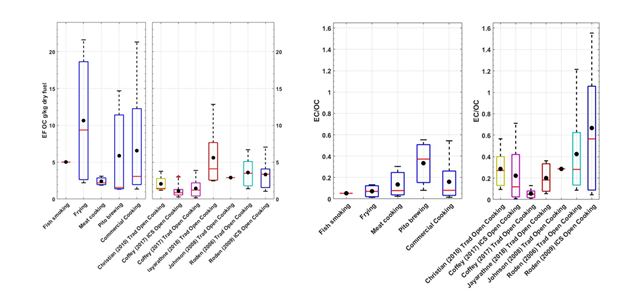
In addition to that interesting result for commercial cooking, we also found a lot of variability in trash burning emission factors. We tested seven different events and observed patterns associated with fuel moisture. Specifically, we observed OC emission factors that were ~4x higher during the rainy season than the dry season. These results highlight the need to adjust emission inventory estimates based on season. We will submit a manuscript documenting these results toEnvironmental Science and Technologyby the end of the project.
Continent scale air quality modeling
The focus in Yr 4 was on the emissions characterization described above. We will will use those results to develop scaled up emissions inventory estimates in the last year of the project.
Journal Articles on this Report : 5 Displayed | Download in RIS Format
| Other project views: | All 17 publications | 11 publications in selected types | All 11 journal articles |
|---|
| Type | Citation | ||
|---|---|---|---|
|
|
Piedrahita R, Dickinson KL, Kanyomse E, Coffey E, Alirigia R, Hagar Y, Rivera I, Oduro A, Dukic V, Wiedinmyer C, Hannigan M. Assessment of cookstove stacking in Northern Ghana using surveys and stove use monitors. Energy for Sustainable Development 2016;34:67-76. |
R835424 (2015) R835424 (Final) |
Exit Exit Exit |
|
|
Piedrahita R, Coffey E, Hagar Y, Kanyomse E, Verploeg K, Weidinmyer C, Dickinson K, Oduro A, Hannigan M. Attributing Air Pollutant Exposure to Emission Sources with Proximity Sensing. ATMOSPHERE 2019;10(7):395. |
R835424 (Final) |
Exit Exit |
|
|
Piedrahita R, Coffey E, Hagar Y, Kanyomse E, Wiedinmyer C, Dickenson K, Oduro A, Hannigan M. Exposures to Carbon Monoxide in a Cookstove Intervention in Northern Ghana. ATMOSPHERE 2019;10(7). |
R835424 (Final) |
Exit Exit |
|
|
Wiedinmyer C, Dickinson K, Piedrahita R, Kanyomse E, Coffey E, Hannigan M, Alirigia R, Oduro A. Rural-urban differences in cooking practices and exposures in Northern Ghana. Environmental Research Letters 2017;12(6):065009 (10 pp.). |
R835424 (2016) R835424 (Final) |
Exit Exit |
|
|
Pfotenhauer, DJ, Coffey ER, Piedrahita R, Ago D, Alirigia R, Muvandimwe D, Lacey F, Wiedinmyer, Dickinson KL, Dalaba M, Kanyomse E, Oduro A, Hannigan MP. Updated Emission Factors from Diffuse Combustion Sources in Sub-Saharan Africa and Their Effect on Regional Emission Estimates. Environmental Science & Technology 2019;53(11):6392-6401. |
R835424 (Final) |
Exit |
Progress and Final Reports:
Original AbstractThe perspectives, information and conclusions conveyed in research project abstracts, progress reports, final reports, journal abstracts and journal publications convey the viewpoints of the principal investigator and may not represent the views and policies of ORD and EPA. Conclusions drawn by the principal investigators have not been reviewed by the Agency.