U.S. flag

An official website of the United States government

Here’s how you know

Dot gov

Official websites use .gov
A .gov website belongs to an official government organization in the United States.

HTTPS

Secure .gov websites use HTTPS
A lock (LockA locked padlock) or https:// means you have safely connected to the .gov website. Share sensitive information only on official, secure websites.

  • Environmental Topics
  • Laws & Regulations
  • Report a Violation
  • About EPA
Contact Us

Grantee Research Project Results

2010 Progress Report: Production of Secondary Organic Aerosol from Multiphase Terpene Photooxidation

EPA Grant Number: R833750
Title: Production of Secondary Organic Aerosol from Multiphase Terpene Photooxidation
Investigators: Shepson, Paul
Institution: Purdue University
EPA Project Officer: Chung, Serena
Project Period: November 1, 2007 through October 31, 2010 (Extended to October 31, 2011)
Project Period Covered by this Report: November 1, 2009 through October 31,2010
Project Amount: $333,397
RFA: Sources and Atmospheric Formation of Organic Particulate Matter (2007) RFA Text |  Recipients Lists
Research Category: Particulate Matter , Air Quality and Air Toxics , Air

Objective:

The objective of this research is to improve our quantitative and mechanistic understanding of the production of secondary organic aerosol, an important type of air pollutant, from the atmospheric oxidation of α- and β-pinene. We aim to determine product yields for major gas phase OH- and O3-induced oxidation products with much smaller uncertainty bounds than have been reported previously, thereby improving the capability of air quality models that simulate aerosol production from BVOCs. We will study the oligomerization of aerosol phase species, and study the extent to which photochemistry in aerosols and in cloud water contributes to secondary organic aerosol production. The information produced from the linked laboratory and field studies will be used to develop improved computer model modules that describe secondary organic aerosol from these important terpenes.

Progress Summary:
1. Summary of Work Status/Progress to Date.
The aims of the project relative to the original application have not changed. In the first year, we proposed to begin smog chamber experiments with α-pinene, and begin analysis of the aerosol phase composition, using DESI-MS. That work is continuing, and an update is provided below. To conduct the aerosol analysis, we proposed to apply DESI-MS. To establish our methods, and to begin work on a simple system, we first studied the oligomerization of methacrolein, under acidic conditions. This has led to a manuscript, Fiddler, et al., 2010, which was submitted for publication. As a result of reviewer comments, it is being revised to focus on our observation that organosulfates are present in cloud water. We proposed to begin work at the University of Michigan Biological Station (UMBS), involving Proton Transfer Reaction Linear Ion Trap (PTRLIT) measurements of VOC and OVOC aerosol precursors, simultaneous with aerosol measurements, and that took place in June - August 2008 at UMBS, and in July and August 2009. The PTRLIT development has been very successful, and a great data set was obtained in the summer of 2008. That data set was interpreted and a paper, Mielke, et al., 2010, was published in the climate change special issue of Analytical Chemistry. In that paper we were able to show that isoprene measurements via the PTRMS technique are not plagued by interferences, as long as methyl butenol (MBO) is not present. We also are now using that data set in support of our 1D model development  effort, which is being used to examine the BVOC precursors to aerosol at the UMBS site. We believe that a very useful 1D model has been developed to examine the relative importance of various BVOCs to production of specific products (e.g., organic nitrates), as well as SOA. A manuscript is in preparation on the 1D model development. We have been focused on identification and quantification of organic nitrates produced from OH reaction with α-pinene, as organic nitrates are implicated in SOA production. We recently have been measuring the partitioning of these nitrates between the gas and aerosol phases in our chamber studies. In the summer of 2009, we conducted a series of measurements of the vertical profiles of aerosol above the UMBS forest, to evaluate the contribution to new aerosol production from BVOC oxidation. Vertical profiles were obtained above the UMBS forest from our aircraft, N762JT. This process led to the discovery that small particles (~20-30 nm) are being generated above the surface of the Great Lakes, and we hypothesize that this arises as a result of wave breaking. We are in the process of evaluating filter samples from near the lake shore to evaluate this hypothesis. During our measurements at UMBS, we became re-focused on interpretation of the morning peak in NOx, and the impact that has on BVOC chemistry. That led to a new paper, described below. Details on various aspects of progress are provided below in section 5.
 
 
2. Results to Date.
A.   Development and Testing of the Proton Transfer Reaction Linear Ion Trap (PTRLIT). An objective of this work is to apply a newly developed technology, the PTRLIT, to studies of terpene oxidation and the nature of oxidation products that may undergo gas-to-particle conversion. While the PTRLIT was developed with methyl vinyl ketone (MVK) and methacrolein (MACR) as test cases, it had not been evaluated previouslyfor terpenes and their oxidation products. We have completed a series of experiments in which we evaluated the ability to trap and selectively detect terpene isomers through collision-induced dissociation (CID) experiments. The PTRLIT was intercompared with a conventional triple quadrupole mass spectrometer. We find that the CID spectra are very similar in the two cases. However, the PTRLIT enables ion chemistry in the trap for pursuit of improved selectivity. These results are described in our manuscript, Müller, et al., 2009. Work for the future will involve use of reagent gases in the trap, e.g., vinyl methyl ether (Colorado, et al., 1998), that could be used to improve the selectivity of the PTRLIT for terpenes and sesquiterpenes.
 
B.   Aerosol and BVOC Measurements.
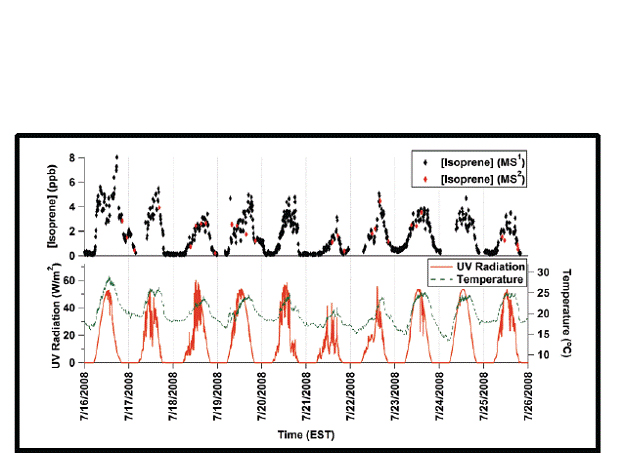
During the summer of 2008, we conducted measurements of a variety of VOCs in the atmosphere above the mixed deciduous/coniferous forest at UMBS, using the PTRLIT. The PTRLIT was shown to enable selective detection of the structural isomers MVK and MACR, and those data have established the PTRLIT as a new method that takes the PTRMS instrument to the next level in selectivity and sensitivity. Among the things we learned was the extent to which there can be interferences in the conventional PTRMS. A good example is isoprene measurements, regarded as very good via the PTRMS. However, we compare in Figure 1 isoprene determined operating in conventional PTRMS ("scan out") mode, and in PTRLIT ("CID") mode, in which we isolate the parent ion (m/z=69), and then conduct CID on that ion, and quantify isoprene through measurement of the fragment at m/z=41. As shown, while often the apparent agreement between the two determinations is very good, on July 19 and 25, the differences can be as large as a factor of two in mid-day. Possible interferences include furan, and we are in the process of evaluating that possibility. This is discussed in Mielke, et al. (2010).
 
Figure 1
Figure 1.  Comparison of PTRMS and PTRLIT modes of operation of PTRLIT, for isoprene at UMBS.
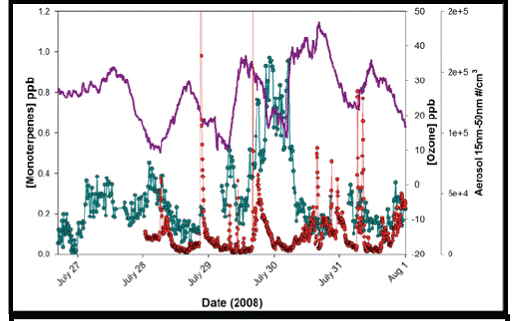
 
During the summer of 2008, we conducted aerosol measurements from the UMBS tower. The data, shown (as an example) in Figure 2, in which several new particle events were observed, have inspired us to examine the nature of the BVOCs contributing to SOA at the UMBS site.
 
Figure 2
Figure 2.  Aerosol formation event (red) in the presence of elevated monoterpenes (green)
and ozone (purple)

 
We have a particularly unique opportunity for that site, in that previous measurements of fluxes for isoprene, 2 aromatics, 3 alkanes, 20 monoterpenes (MTs), 8 oxygenated species, and 23 sesquiterpenes, were measured for this site, by the Detlev Helmig group. So, given literature data for the product yields, e.g., organic nitrates and aerosol, we are able to pursue the question of which BVOCs contribute the most to aerosol production in this forested environment. This is a particularly intriguing environment, as it is in a successional transition from largely isoprene emitting species to a mix with a substantial increase in terpene and sesquiterpene emitters (white pine). Thus, postdoctoral researcher Kerri Pratt has constructed a 1D model, using eddy diffusivities derived from turbulence data, by Allison Steiner’s group. The model includes 26 vertical layers, from the surface to 998 m above the surface. BVOC concentrations were calculated according to transport and reaction kinetics following equation I, which describes the change in the concentration of VOC i at altitude z and time t (ci(z,t)):
Scientific formula
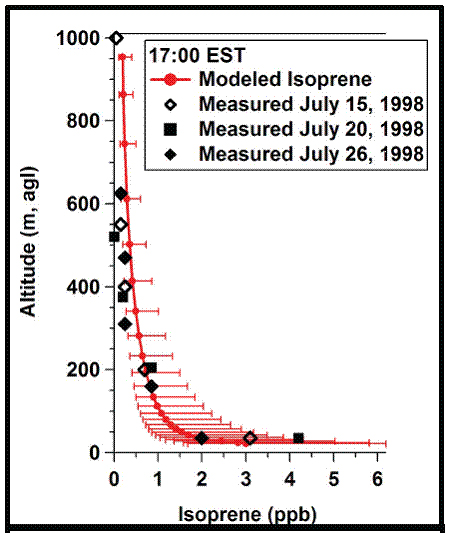
VOC terms include emission (E) into the first canopy bin, chemical production (P) and loss (L) based on chemical kinetics, upward and downward vertical fluxes (F↑ and F↓, respectively) divided by bin height (h), dry deposition (D), and horizontal advection (H). The (quite good) quality of the vertical mixing approach (and chemistry of BVOC consumption) was evaluated using aircraft vertical profiles for isoprene; a comparison of the aircraft and model simulated isoprene vertical profile is shown in Figure 3. We have completed studies of how the BVOCs are converted to organic nitrates, as one set of important SOA precursors for the BVOCs.
 
Figure 3
Figure 3.  Comparison of 1D model isoprene with aircraft mesurement data. 
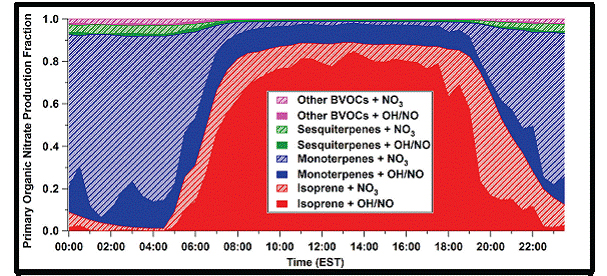
 
A sample set of results is presented in Figure 4, which shows the fractional contribution of organic nitrate production from various processes. Perhaps most significant and interesting is that NO3 chemistry (with terpenes and isoprene) is important during both night and daytime. This result will help motivate appropriate measurements during the upcoming SOAS study in the southeastern U.S. We are continuing work with this model now to produce estimates of the relative importance of each BVOC in producing SOA in this environment.
 
Figure 4
Figure 4. Fraction of the total organic nitrate production rate as a function of time of day. 

 
C.   Photochemical Reaction Chamber Studies of α-Pinene Oxidation. We have been conducting a series of experiments in which α-pinene oxidation is studied in our 5500 liter all-PFA Teflon photochemical reaction chamber. Thus far, these have involved traditional VOC/NOx irradiations, during which NO, NO2, NOy, individual organic nitrates, and total organic nitrates have been measured using a denuder-based method to separate the gas-phase and particle-phase nitrates. The aim is to measure the individual product yields, and, from the measurements in the two phases, and the total aerosol mass concentration, the partition coefficient, as described in Equation II (by Pankow).
 
 Scientific Formula
 
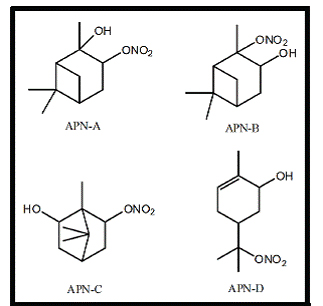
O3 is measured with traditional UV absorption instruments, and particle size distributions and number density are determined using our Scanning Mobility Particle Spectrometer (SMPS), purchased through this grant. Until recently, we have been focused on determination of the terpene nitrate yields (RONO2), as many recent publications have reported evidence of nitrate functionalities in ambient aerosol from forest-impacted air masses. We have synthesized and purified four of the “terpene nitrates” (TNs) that originate from OH radical addition across the double bond of α-pinene, as shown in Figure 5.
 
Figure 5
Figure 5.  Terpene nitrate isomers.
 
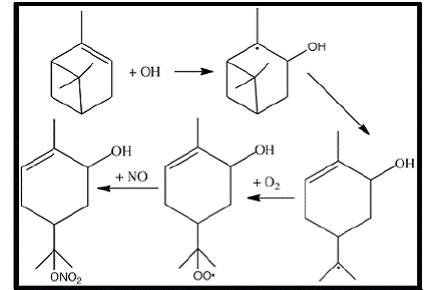
While isomers A and B were expected, recent indications are that there is a rearrangement of the initially produced carbon centered radical, leading to a different hydroxy nitrate that retains a double bond, as shown in Figure 6. When that hydroxy nitrate is oxidized, it is likely to produce a diol-nitrate, that would be highly likely to partition to the aerosol phase; if isomer D partitions to the aerosol phase, it is likely to undergo further reaction, e.g., oligomerization. We currently are studying these reactions.
 
Figure 6
Figure 6. Mechanism for productoin of α-pinene hydroxy nitrate.
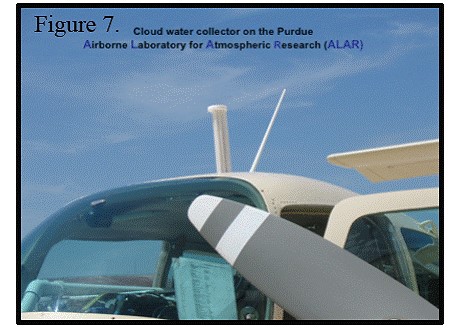
 
D.   Analysis of the Mechanisms for Methacrolein Oligomerization in the Presence of H2SO4. As a result of reviewer comments, we have been focusing on the observation of organosulfates in cloud water. This was done using the cloud water collector on our aircraft (see Figure 7), the Airborne Laboratory for Atmospheric Research.
 
Figure 7
Figure 7. Cloud water collector on the Purdue Airborne 
Laboratory for Atmospheric Research (ALAR)
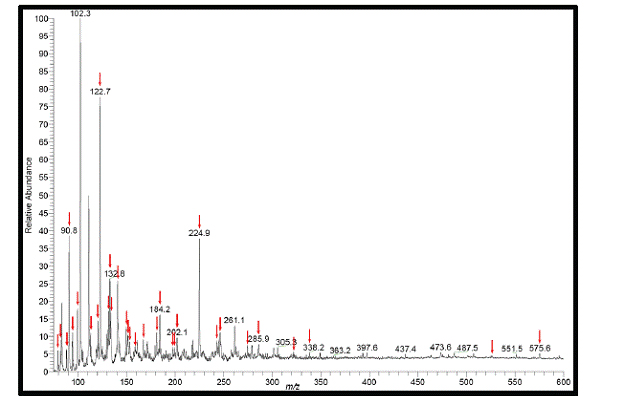
 
To investigate the extent to which oligomeric structures might be present in the condensed phase in isoprene impacted atmospheres, cloud water samples collected from the Missouri Ozarks site were analyzed using ESI-MS (DESI-MS analysis yielded few peaks significantly above those in the blank samples). ESI spectra from a cloud water sample (at 1.8 km) analyzed directly from the solution phase are shown in Figures 8 and 9 below for positive and negative mode, respectively.
 
Figure 8
Figure 8. (+) ESI-MS spectrum of cloud water from 7,000 ft. Peaks labled with red arrows are absent
from the blank. 
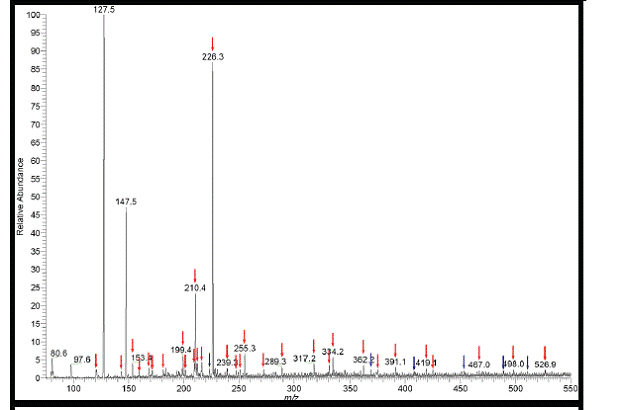
 
Figure 9
Figure 9.  (-) ESI-MS spectrum of cloud water from 7,000 ft. Peaks labled with red arrows are absent
from the blank. Peaks labled with blue arrows are not in the blank but are present in the 80 Da neutral
loss spectruym which indicates that these species are organosulfates. 
 
Peaks marked with red arrows are those not present in the blanks. These spectra provide unambiguous evidence that oligomeric material is present in cloud water, as shown previously for rainwater. Intensities were sufficient to determine if organosulfates were present by neutral loss experiments and those peaks are marked by blue arrows (Figure 9). Organosulfates have been observed previously in rainwater using ESI and high resolution mass spectrometry (Altieri, et al., 2008). The parent ion scan of m/z 97 (HSO4 -) did not yield any significant peaks. These spectra are atypical of soft ionization spectra of smog chamber or ambient SOA samples, in that there are several individual species with high abundance, rather than envelopes where a peak is present at every mass.
 
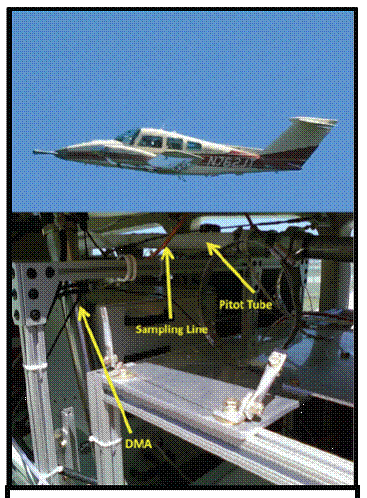
E.   Studies of Aerosol Production at the UMBS. During the summer of 2008, graduate student Nate Slade conducted aerosol measurements at UMBS, using the SMPS instrument. Number and size distributions between 15 nm and 750 nm were measured from ~10 meters above the forest canopy, from a small enclosure, and short inlet line, that enabled vertical profile measurements of aerosols above the forest canopy. Several instances of particle nucleation were observed at this site, as described in the previous annual reports. To pursue the hypothesis that the new particle production events were the result of oxidation of BVOCs at canopy level, we conducted vertical profile measurements, using our SMPS installed in the ALAR aircraft, pictured in Figure 10 below. We conducted a series of vertical profile measurements of aerosol through the boundary layer above the PROPHET tower at UMBS in the summer of 2009.
 
Figure 10
Figure 10. ALAR aircraft (top), with SMPS installed (bottom).
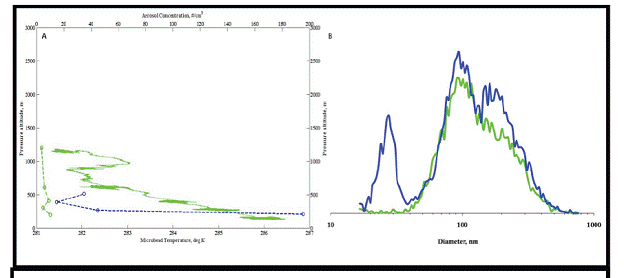
 
What we observed is a maximum in the total particle number in the middle of the boundary layer, consistent with what would be expected from transport of existing particles, and loss by dry deposition to the canopy surface. However, in the process of obtaining control profiles upwind over lake Michigan, we made a surprising discovery, that there is new particle formation near the lake surface, and the concentration of these small particles depends exponentially on wave height. In Figure 11 we show a sample vertical profile, and aerosol size spectrum for the lowest altitude over the lake, that shows the small particle mode in the spectrum.
 
Figure 11
Figure 11.  Vertical profile of temperature and aerosol number concentrations of Aitken mode particles (20-40nm)
over UMBS forest (green) and Lake Michigan (blue) for July 26 flight. Dashed lines represent vertical profile 
of aeorsol. (B) Average aerosol size distribution spectrum for spectra recorded over land (green) and lake (blue).
 
We believe that this mode results from evaporation of water from film droplets generated from breaking waves, leaving only the nonvolatile ions and organic matter to produce a particle (analogous to the well-understood mechanism for production of sea-salt aerosol from marine waves). We hypothesize that this may represent a mechanism for transfer of non-volatile POPs into the atmosphere. Current activities involve studies of marker compounds in the lake water that might be used to test this hypothesis further. We published the observation and our interpretation in Slade, et al., GRL, 2010.
 
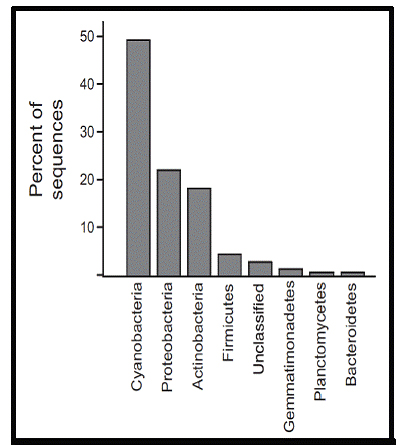
F.   Cloud Water Microbiology Studies. In the summer of 2008, we collected cloud water samples at UMBS, for analysis and speciation of microbes, that may contribute to in-cloud processing of organic matter, as discussed in our 2007 JGR paper (Hill, et al., 2007). We recently have completed all the analysis. The cloud water was analyzed for the diversity of bacterial phylotypes by denaturing gradient gel electrophoresis (DGGE) and sequencing of 16S rRNA gene amplicons, using a nested PCR approach. DGGE analyses of bacterial communities detected 17-21 bands per sample. Sequencing confirmed the presence of a diverse bacterial community; sequences from seven bacterial phyla were retrieved. Cloud water bacterial communities appeared to be dominated by members of the cyanobacteria, proteobacteria, actinobacteria and firmicutes, as summarized in Figure 12 below. This work supports and expands on recent findings of a diverse bacterial community in clouds, and raises interesting questions about microbial metabolites, and how they may contribute to SOA. This work recently was published in Kourtev, et al., 2011.
Figure 12
Figure 12. Classification of sequences from cloud water samples 
acquired in 2008.
 
G.   Studies of the Morning NOx Maximum. For decades the atmospheric chemistry community has been puzzled about the morning maximum in surface level NOx concentrations at rural and forest sites. This has been discussed in the literature as being caused by downward mixing upon breakup of the nocturnal boundary layer, followed by downward mixing of polluted air from aloft. We have shown, from measurements at UMBS, that this is not the case; rather, it results from surface emission, e.g., from soils, or local to regional scale combustion sources, followed by transport in the stably stratified surface layer. This is very important to BVOC chemistry and production of SOA precursors, as it enhances early morning chemistry, either by enhancing surface-based production of HONO, and thus OH, or by enhancing production of NO3. Again, this is likely to be important to SOA production in the U.S. Southeast. A paper has been submitted to ACP describing these results.

Future Activities:

  1. We are focusing on detection of specific lake water "markers" in the aerosol, for example, those from fresh water algae, e.g., palmitoleic acid. Graduate student Nick Veselka is completing a Master's degree on this problem.
  2. Smog chamber experiments. These experiments are focused on measurements of the yields and fates of organic nitrates from OH and NO3 reaction with α-pinene, as discussed above.
  3. 1D model development for SOA production from a suite of BVOCs. This will continue to be improved and developed.


Journal Articles on this Report : 6 Displayed | Download in RIS Format

Publications Views
Other project views: All 14 publications 7 publications in selected types All 7 journal articles
Publications
Type Citation Project Document Sources
Journal Article Alaghmand M, Shepson PB, Starn TK, Jobson BT, Wallace HW, Carroll MA, Bertman SB, Lamb B, Edburg SL, Zhou X, Apel E, Riemer D, Stevens P, Keutsch F. The morning NOx maximum in the forest atmosphere boundary layer. Atmospheric Chemistry and Physics Discussions 2011;11(10):29251-29282. R833750 (2010)
R833750 (Final)
  • Full-text: Atmospheric Chemistry and Physics Discussions-Full Text PDF
    Exit
  • Abstract: Atmospheric Chemistry and Physics Discussions-Abstract
    Exit
  • Journal Article Kourtev PS, Hill KA, Shepson PB, Konopka A. Atmospheric cloud water contains a diverse bacterial community. Atmospheric Environment 2011;45(30):5399-5405. R833750 (2010)
    R833750 (Final)
  • Full-text: Science Direct-Full Text HTML
    Exit
  • Abstract: Science Direct-Abstract
    Exit
  • Other: Science Direct-Full Text PDF
    Exit
  • Journal Article Mays KL, Shepson PB, Stirm BH, Karion A, Sweeney C, Gurney KR. Aircraft-based measurements of the carbon footprint of Indianapolis. Environmental Science & Technology 2009;43(20):7816-7823. R833750 (2009)
    R833750 (2010)
    R833750 (Final)
  • Abstract from PubMed
  • Full-text: ES&T-Full Text HTML
    Exit
  • Abstract: ES&T-Abstract
    Exit
  • Other: ES&T-Full Text PDF
    Exit
  • Journal Article Mielke LH, Pratt KA, Shepson PB, McLuckey SA, Wisthaler A, Hansel A. Quantitative determination of biogenic volatile organic compounds in the atmosphere using proton-transfer reaction linear ion trap mass spectrometry. Analytical Chemistry 2010;82(19):7952-7957. R833750 (2009)
    R833750 (2010)
    R833750 (Final)
  • Abstract from PubMed
  • Full-text: ACS-Full Text HTML
    Exit
  • Abstract: ACS-Abstract
    Exit
  • Other: ACS-Full Text PDF
    Exit
  • Journal Article Muller M, Mielke LH, Breitenlechner M, McLuckey SA, Shepson PB, Wisthaler A, Hansel A. MS/MS studies for the selective detection of isomeric biogenic VOCs using a Townsend Discharge Triple Quadrupole Tandem MS and a PTR-Linear Ion Trap MS. Atmospheric Measurement Techniques 2009;2(2):703-712. R833750 (2009)
    R833750 (2010)
    R833750 (Final)
  • Full-text: Atmospheric Measurement Techniques-Full Text PDF
    Exit
  • Abstract: Atmospheric Measurement Techniques-Abstract
    Exit
  • Journal Article Slade JH, VanReken TM, Mwaniki GR, Bertman S, Stirm B, Shepson PB. Aerosol production from the surface of the Great Lakes. Geophysical Research Letters 2010;37(18):L18807 (5 pp.). R833750 (2010)
    R833750 (Final)
  • Full-text: Wiley-Full Text PDF
    Exit
  • Abstract: Wiley-Abstract
    Exit
  • Progress and Final Reports:

    Original Abstract
  • 2008 Progress Report
  • 2009 Progress Report
  • Final Report
  • Top of Page

    The perspectives, information and conclusions conveyed in research project abstracts, progress reports, final reports, journal abstracts and journal publications convey the viewpoints of the principal investigator and may not represent the views and policies of ORD and EPA. Conclusions drawn by the principal investigators have not been reviewed by the Agency.

    Project Research Results

    • Final Report
    • 2009 Progress Report
    • 2008 Progress Report
    • Original Abstract
    14 publications for this project
    7 journal articles for this project

    Site Navigation

    • Grantee Research Project Results Home
    • Grantee Research Project Results Basic Search
    • Grantee Research Project Results Advanced Search
    • Grantee Research Project Results Fielded Search
    • Publication search
    • EPA Regional Search

    Related Information

    • Search Help
    • About our data collection
    • Research Grants
    • P3: Student Design Competition
    • Research Fellowships
    • Small Business Innovation Research (SBIR)
    Contact Us to ask a question, provide feedback, or report a problem.
    Last updated April 28, 2023
    United States Environmental Protection Agency

    Discover.

    • Accessibility
    • Budget & Performance
    • Contracting
    • EPA www Web Snapshot
    • Grants
    • No FEAR Act Data
    • Plain Writing
    • Privacy
    • Privacy and Security Notice

    Connect.

    • Data.gov
    • Inspector General
    • Jobs
    • Newsroom
    • Open Government
    • Regulations.gov
    • Subscribe
    • USA.gov
    • White House

    Ask.

    • Contact EPA
    • EPA Disclaimers
    • Hotlines
    • FOIA Requests
    • Frequent Questions

    Follow.