U.S. flag

An official website of the United States government

Here’s how you know

Dot gov

Official websites use .gov
A .gov website belongs to an official government organization in the United States.

HTTPS

Secure .gov websites use HTTPS
A lock (LockA locked padlock) or https:// means you have safely connected to the .gov website. Share sensitive information only on official, secure websites.

  • Environmental Topics
  • Laws & Regulations
  • Report a Violation
  • About EPA
Contact Us

Grantee Research Project Results

Final Report: Impacts of Manufactured Nanomaterials on Human Health and the Environment - A Focus on Nanoparticulate Aerosol and Atmospherically Processed Nanoparticulate Aerosol

EPA Grant Number: R831717
Title: Impacts of Manufactured Nanomaterials on Human Health and the Environment - A Focus on Nanoparticulate Aerosol and Atmospherically Processed Nanoparticulate Aerosol
Investigators: Grassian, Vicki H. , Thorne, Peter S. , O'Shaughnessy, Patrick
Institution: University of Iowa
EPA Project Officer: Aja, Hayley
Project Period: October 1, 2004 through September 30, 2007
Project Amount: $335,000
RFA: Exploratory Research to Anticipate Future Environmental Issues: Impacts of Manufactured Nanomaterials on Human Health and the Environment (2003) RFA Text |  Recipients Lists
Research Category: Nanotechnology , Human Health , Safer Chemicals

Objective:

In this research, the potential effects of manufactured nanoparticle aerosol on human health were investigated. This research was conducted to satisfy three main objectives. These objectives are to:

  • characterize fully a variety of manufactured nanomaterials in terms of their size, shape, bulk and surface properties;
  • determine if engineered nanomaterials are particularly deleterious to health compared to particles from combustion processes that have been more extensively studied; and
  • evaluate the relative health effects caused by different surface coatings on the nanoparticle.

To carry out these objectives a variety of different chemical classes of nanomaterials were investigated. Surface coatings, or capping groups, often are used to control particle size in manufacturing so we investigated the effects of surface coatings from the manufacturing process in the toxicity of manufactured nanomaterials. We have focused our attention on metal and metal oxide based nanomaterials as these materials have wide ranging applications and are being used in consumer products.

Summary/Accomplishments (Outputs/Outcomes):
In the past year, the potential effects of manufactured nanoparticles on human health have been investigated. In particular, a series of acute and sub-chronic exposures of titanium dioxide (TiO2) nanoparticles with a primary particle size of 5 nm have been completed. Although there have been earlier inhalation studies on TiO2 ultrafine particles, these have been done on particles with a particle size of 20 nm and above, there is some evidence that particles with a primary particle size less than 10 nm may behave differently than particles with a primary particle size greater than 10 nm. TiO2 nanoparticles with a primary size of 2-5 nm have not previously been studied in inhalation exposure models and represent some of the smallest manufactured nanoparticles. The properties of TiO2 nanoparticles as well as the characteristics of aerosols of these particles were evaluated. The purpose of this study was to assess the toxicity of these nanoparticles using a murine model of lung inflammation and injury. Mice were exposed to TiO2 nanoparticles in a whole-body exposure chamber acutely (4 hr) or sub-acutely (4 hr/day for 10 days). (See Figure 1 showing the schematic of the exposure chamber.) Toxicity in exposed mice was assessed by enumeration of total and differential cells, determination of total protein, LDH activity and inflammatory cytokines in bronchoalveolar fluid. Lungs also were evaluated for histopathological changes. Mice exposed acutely to 0.77 or 7.22 mg m-3 of nanoparticles demonstrated minimal lung toxicity or inflammation. Mice exposed sub-acutely (8.88 mg m-3) and necropsied immediately, 1 or 2 weeks post exposure had higher counts of total cells and macrophages in the broncheoalveolar lavage fluid compared to sentinels. However, mice recovered by third week post exposure. Other indicators were negative. From this study, we concluded that mice sub-acutely exposed to 2-5 nm TiO2 nanoparticles showed a significant but moderate inflammatory response among animals 0, 1 or 2 weeks after exposure that resolved 3 weeks post exposure.
 
In another study, instillation and acute inhalation exposures of different size TiO2 particles to mice are run to examine how nanoparticle size and exposure method affect inflammatory response. Through the use of a whole body exposure chamber and nasal instillation technique along with bulk and surface characterization techniques, it was found that the smaller 5 nm particles did not create a larger inflammatory response than 20 nm particles. The aggregation states of the particles were shown using TEM to behave very different in the instillation solution compared to the powder delivery in the acute inhalation exposure. One conclusion from this study is that the aggregation state of the particles, along with other surface and physical characteristics, is an important factor in the toxicity of nanoparticles.
 
Figure 1
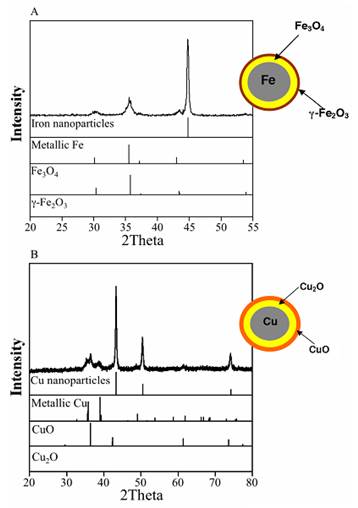
Figure 1. The powder XRD pattern of iron nanoparticles is shown along with reference spectra of Fe metal, Fe3O4 and g-Fe2O3. (B) The powder XRD pattern of copper nanoparticles is shown along with reference spectra of Cu metal, Cu2O and CuO. Based on the XTD data as well as TEM measurements and surface analysis using X-ray photoelectron spectroscopy, pictorial representations of the iron and copper nanoparticles with these different phases are shown.
 
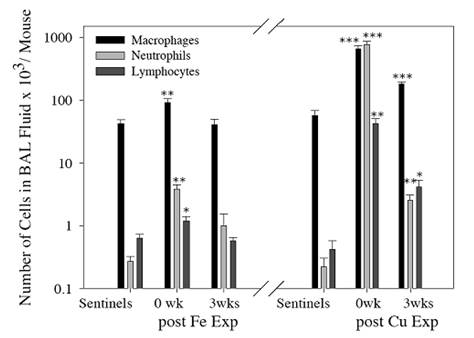
Finally, we have completed a study of acute and sub-acute exposures of 25 nm iron and copper nanoparticles. Based on the physicochemical characterization data, which include powder X-ray diffraction, TEM (from whole body chamber, vide infra) and X-ray photoelectron spectroscopy for these commercial materials, these nanoparticles consist of a metallic core and an oxide coating that contains two phases with the most oxide phase being on the surface of the nanoparticles (see Figure 1 which shows XRD data). The toxicity data shown below in Figure 2 give a comparison of the total number of cells and differential cell counts in the bronchoalveolar lavage fluid for control mice and for mice sub-acutely exposed to Fe and Cu nanoparticles. It can be seen from these data that Cu nanoparticles produce the greatest response and give rise to the highest cell count and the greatest percentage of neutrophils. Copper nanoparticle exposed mice show significantly larger response as well as signs of perivasculitis and aveolitis in lungs. After 3 weeks post-exposure, all inflammatory markers decreased and lungs were evaluated as normal for both Fe and Cu nanoparticle-exposed mice. In vitro dissolution studies showed that Cu nanoparticles displayed enhanced propensity for dissolution compared to Fe nanoparticles at biologically relevant pHs. Nanoparticle dissolution results in both dissolved ions and nanoparticles of decreased size. As such, it is surmised that both the formation of dissolved ions and the concomitant production of smaller nanoparticles below 10 nm that form during the dissolution process following inhalation of Cu nanoparticles, may be the cause of the increased inflammatory response in exposed mice.
 
Figure 2
Figure 2. Number of cells in BAL fluid from animals acutely sub-acutely exposed to Fe and Cu nanoparticles
 
We also began studies on Ag nanoparticle inhalation toxicity under this EPA grant that is being continued in other studies that now currently are funded by NIOSH.


Journal Articles on this Report : 1 Displayed | Download in RIS Format

Publications Views
Other project views: All 21 publications 6 publications in selected types All 5 journal articles
Publications
Type Citation Project Document Sources
Journal Article Grassian V. When Size Really Matters: Size-Dependent Properties and Surface Chemistry of Metal and Metal Oxide Nanoparticles in Gas and Liquid Phase Environments. JOURNAL OF PHYSICAL CHEMISTRY 2008;112(47):18303-18313 R831717 (Final)
  • Full-text: ACS Publications - Full Text HTML
    Exit
  • Supplemental Keywords:

    ambient air, risk assessment, health effects, human health, particulates, environmental chemistry, industry, scientific discipline, health, physical aspects, risk assessments, health risk assessment, physical processes, biochemistry, environmental chemistry, biochemical research, nanotechnology, respiratory impact, inhalation study, engineered nanomaterials, inhalation toxicology, carbon fullerene, cytokines, human health risk, particle exposure, ambient particle health effects, particulate matter, exposure, human exposure, Health, Scientific Discipline, PHYSICAL ASPECTS, Health Risk Assessment, Physical Processes, Risk Assessments, Environmental Chemistry, Biochemistry, cytokines, particle size, human exposure, particulate matter, engineered nanomaterials, exposure, ambient particle health effects, nanotechnology, respiratory impact, inhalation toxicology, human health risk, inhalation study, particle exposure, biochemical research

    Progress and Final Reports:

    Original Abstract
  • 2005 Progress Report
  • 2006 Progress Report
  • Top of Page

    The perspectives, information and conclusions conveyed in research project abstracts, progress reports, final reports, journal abstracts and journal publications convey the viewpoints of the principal investigator and may not represent the views and policies of ORD and EPA. Conclusions drawn by the principal investigators have not been reviewed by the Agency.

    Project Research Results

    • 2006 Progress Report
    • 2005 Progress Report
    • Original Abstract
    21 publications for this project
    5 journal articles for this project

    Site Navigation

    • Grantee Research Project Results Home
    • Grantee Research Project Results Basic Search
    • Grantee Research Project Results Advanced Search
    • Grantee Research Project Results Fielded Search
    • Publication search
    • EPA Regional Search

    Related Information

    • Search Help
    • About our data collection
    • Research Grants
    • P3: Student Design Competition
    • Research Fellowships
    • Small Business Innovation Research (SBIR)
    Contact Us to ask a question, provide feedback, or report a problem.
    Last updated April 28, 2023
    United States Environmental Protection Agency

    Discover.

    • Accessibility
    • Budget & Performance
    • Contracting
    • EPA www Web Snapshot
    • Grants
    • No FEAR Act Data
    • Plain Writing
    • Privacy
    • Privacy and Security Notice

    Connect.

    • Data.gov
    • Inspector General
    • Jobs
    • Newsroom
    • Open Government
    • Regulations.gov
    • Subscribe
    • USA.gov
    • White House

    Ask.

    • Contact EPA
    • EPA Disclaimers
    • Hotlines
    • FOIA Requests
    • Frequent Questions

    Follow.