![[logo] US EPA](https://www.epa.gov/epafiles/images/logo_epaseal.gif)
Quantifying Changes in Flow Regimes
The Nature Conservancy has developed a statistical method and software, called the "Indicators of Hydrologic Alteration" (IHA), for assessing the degree to which human activities have changed flow regimes. The IHA method is based upon the concept that hydrologic regimes can be characterized by five ecologically-relevant attributes:
- Magnitude of flow is simply the amount of water passing a fixed point in the river at a specific point in time.
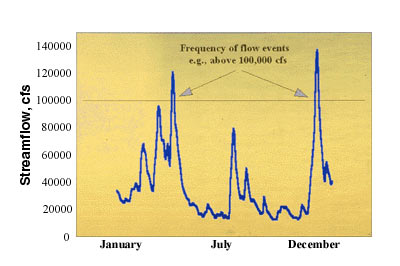
- Frequency describes how often a particular condition, such as a large flood, has occurred.
- Duration refers to the length of time that a specific flow condition lasts, such as the duration of extremely low flow conditions.
- Timing describes the time of year at which particular flow events occur, such as the timing of floods or low flow extremes.
- The rate of change indicates how quickly the flow changes, as flows rise or fall from day-to-day.
Collaborating with river ecologists around the world, The Nature
Conservancy compiled a list of 33 hydrologic parameters that can be used
to assess changes in a river's flow regime over time (see Table 1 at the
end of this document). These parameters provide a means for quantifying
the five attributes listed above, and have proven to be sensitive
indicators of various forms of human-induced flow alteration, such as by
damming, diversions, ground water pumping, and conversion of a watershed
to agricultural uses or urbanization.
The IHA software utilizes daily streamflow information as input. More information about the IHA
method and software can be found on the
IHA Page
 and in the following journal article:
Richter B.D., Baumgartner J.V., Powell J. & Braun D.P. (1996) A method for
assessing hydrologic alteration within ecosystems. Conservation
Biology, 10:1163-1174.
and in the following journal article:
Richter B.D., Baumgartner J.V., Powell J. & Braun D.P. (1996) A method for
assessing hydrologic alteration within ecosystems. Conservation
Biology, 10:1163-1174.