


Grantee Research Project Results
U.S. Environmental Protection Agency
Office of Research and Development
National Center for Environmental Research
Science to Achieve Results (STAR) Program
CLOSED - FOR REFERENCES PURPOSES ONLY
ANTICIPATING THE ENVIRONMENTAL IMPACTS AND BEHAVIORAL DRIVERS OF DEEP DECARBONIZATION
No awards were made under this funding opportunity due to budgetary and programmatic priorities.
This is the initial announcement of this funding opportunity.
Funding Opportunity Numbers:
EPA-G2017-STAR-B2, Early Career: Anticipating the Environmental Impacts and Behavioral Drivers of Deep Decarbonization
Catalog of Federal Domestic Assistance (CFDA) Number: 66.509
Solicitation Opening Date: November 10, 2016
Solicitation Closing Date: February 10, 2017, 11:59:59 pm Eastern Time
Technical Contact: Terry J. Keating (keating.terry@epa.gov); phone: 202-564-1174
Eligibility Contact: Ron Josephson (josephson.ron@epa.gov); phone: 202-564-7823
Electronic Submissions Contact: Debra M. Jones (peterson.todd@epa.gov); phone: 202-564-7839
Access Standard STAR Forms (How to Apply and Required Forms)
View research awarded under previous solicitations (Past Research Funding Opportunities)
SUMMARY OF PROGRAM REQUIREMENTS
The U.S. Environmental Protection Agency (EPA), as part of its Science to Achieve Results (STAR) program, is seeking applications proposing research that will contribute to an improved ability to understand and anticipate the public health and environmental impacts and behavioral drivers of significant changes in energy production and consumption in the United States, particularly those changes associated with advancing toward the deep decarbonization necessary to achieve national and international climate change mitigation objectives and avoid the most significant health, environmental, and economic impacts of climate change. The proposed research is intended to contribute to the development of new insights and predictive tools related to the multimedia, life-cycle impacts of the decarbonization of electricity generation; the electrification of end uses; the adoption of low-carbon emitting, renewable fuels; and the adoption of energy efficiency measures. The proposed research is also intended to contribute to an improved understanding of the drivers of individual, firm (i.e. business), and community decisions that affect energy consumption patterns, including decisions about the adoption of new technologies and energy efficiency measures.
This solicitation provides the opportunity for the submission of applications for projects that may involve human subjects research. Human subjects research supported by the EPA is governed by EPA Regulation 40 CFR Part 26 (Protection of Human Subjects). This includes the Common Rule at subpart A and prohibitions and additional protections for pregnant women and fetuses, nursing women, and children at subparts B, C, and D. Research meeting the regulatory definition of intentional exposure research found in subpart B is prohibited by that subpart in pregnant women, nursing women, and children. Research meeting the regulatory definition of observational research found in subparts C and D is subject to the additional protections found in those subparts for pregnant women and fetuses (subpart C) and children (subpart D). All applications must include a Human Subjects Research Statement (HSRS, as described in Section IV.C.5.c of this solicitation), and if the project involves human subjects research, it will be subject to an additional level of review prior to funding decisions being made as described in Sections V.C and V.D of this solicitation.
Guidance and training for investigators conducting EPA-funded research involving human subjects may be obtained here:
Basic Information about Human Subjects Research
Basic EPA Policy for Protection of Subjects in Human Research Conducted or Supported by EPA
Award Information:
Anticipated Type of Award: Grant or Cooperative Agreement
Estimated Number of Awards: Approximately 5 regular awards and 5 early career awards
Anticipated Funding Amount: Approximately $6 million total for all awards
Potential Funding per Award: Up to a total of $900,000 for regular awards and $300,000 for early career awards, including direct and indirect costs, with a maximum duration of 3 years. Cost-sharing is not required. Proposals with budgets exceeding the total award limits will not be considered.
Eligibility Information:
Public nonprofit institutions/organizations (includes public institutions of higher education and hospitals) and private nonprofit institutions/organizations (includes private institutions of higher education and hospitals) located in the U.S., state and local governments, Federally Recognized Indian Tribal Governments, and U.S. territories or possessions are eligible to apply. Special eligibility criteria apply to the early career award portion of this RFA. See full announcement for more details.
Application Materials:
To apply under this solicitation, use the application package available at Grants.gov (for further submission information see Section IV.F. “Submission Instructions and other Submission Requirements”). Note: With the exception of the current and pending support form (available at https://www.epa.gov/research-grants/research-funding-opportunities-how-apply-and-required-forms), all necessary forms are included in the electronic application package. Make sure to include the current and pending support form in your Grants.gov submission.
If your organization is not currently registered with Grants.gov, you need to allow approximately one month to complete the registration process. Please note that the registration process also requires that your organization have a unique entity identifier (formerly ‘DUNS number’) and a current registration with the System for Award Management (SAM) and the process of obtaining both could take a month or more. Applicants must ensure that all registration requirements are met in order to apply for this opportunity through Grants.gov and should ensure that all such requirements have been met well in advance of the submission deadline. This registration, and electronic submission of your application, must be performed by an authorized representative of your organization.
If you do not have the technical capability to utilize the Grants.gov application submission process for this solicitation, see Section IV.A below for additional guidance and instructions.
Agency Contacts:
Technical Contact: Terry J. Keating (keating.terry@epa.gov); phone: 202-564-1174
Eligibility Contact: Ron Josephson (josephson.ron@epa.gov); phone: 202-564-7823
Electronic Submissions Contact: Debra M. Jones (peterson.todd@epa.gov); phone: 202-564-7839
I. FUNDING OPPORTUNITY DESCRIPTION
A. Introduction
Climate change mitigation and adaptation is a high priority for the United States and the EPA. Meeting U.S. and international long-term climate change mitigation goals will require a substantial change in the production and consumption of energy in the United States and elsewhere in the world. In this solicitation, we adopt the term “deep decarbonization” to refer to the types of changes in the energy system that will be required to meet the carbon emission reduction and related climate policy goals. Various studies (discussed below) have shown that deep decarbonization is possible given technologies and practices that are available currently or expected in the near term. This solicitation seeks research to improve the understanding of the individual, firm (i.e. business), and community decision behaviors that affect the adoption of clean technologies and energy efficiency measures. Better understanding of these behaviors can provide insights into the design of policies and programs to achieve deep decarbonization in the United States. Furthermore, deep decarbonization, along with climate change and other social, economic, technological, demographic and land use trends, will affect patterns of energy production and consumption between now and 2050. As the patterns of energy production and consumption evolve, the magnitude and distribution of sources of all types of environmental emissions, discharges, and waste will also change. This solicitation seeks research to improve the ability to anticipate, at the local, regional, or national level, the positive and negative multimedia, life-cycle health and environmental impacts of strategies designed to move the country toward deep decarbonization, as well as potential barriers to achievement of this goal.
In addition to regular awards, this solicitation includes the opportunity for early career awards. The purpose of the early career award is to fund research projects smaller in scope and budget by early career PIs. Please see Section III of this RFA for details on the early career eligibility criteria.
EPA recognizes that it is important to engage all available minds to address the environmental challenges the nation faces. At the same time, EPA seeks to expand the environmental conversation by including members of communities, which may have not previously participated in such dialogues to participate in EPA programs. For this reason, EPA strongly encourages all eligible applicants identified in Section III, including minority serving institutions (MSIs), to apply under this opportunity.
For purposes of this solicitation, the following are considered MSIs:- Historically Black Colleges and Universities, as defined by the Higher Education Act (20 U.S.C. § 1061). A list of these schools can be found at White House Initiative on Historically Black Colleges and Universities;
- Tribal Colleges and Universities, as defined by the Higher Education Act (20 U.S.C. § 1059(c)). A list of these schools can be found at American Indian Tribally Controlled Colleges and Universities;
- Hispanic-Serving Institutions (HSIs), as defined by the Higher Education Act (20 U.S.C. § 1101a(a)(5). There is no list of HSIs. HSIs are institutions of higher education that, at the time of application submittal, have an enrollment of undergraduate full-time equivalent students that is at least 25% Hispanic students at the end of the award year immediately preceding the date of application for this grant; and
- Asian American and Native American Pacific Islander-Serving Institutions; (AANAPISIs), as defined by the Higher Education Act (20 U.S.C. § 1059g(a)(2)). There is no list of AANAPISIs. AANAPISIs are institutions of higher education that, at the time of application submittal, have an enrollment of undergraduate students that is not less than 10 % students who are Asian American or Native American Pacific Islander.
Climate Goals and Deep Decarbonization
The United States and other nations have committed under the United Nations Framework Convention on Climate Change (UNFCCC) to limit global average temperature rise below 2°C above pre-industrial levels. To meet this goal, very large decreases in greenhouse gas (GHG) emissions will be required. The United States has set a goal of a 26-28% decrease in GHG emissions economy-wide from 2005 levels by 2025 and a longer range target of an 80% decrease in GHG emissions by 2050 (White House, 2015). Various technology and policy pathways may be taken to achieve such “deep decarbonization” of the energy system, however all such pathways require three significant shifts to occur to achieve the magnitude of emissions reductions envisioned:
- Electricity generation must shift almost entirely to zero or near-zero carbon-emitting technologies, including solar, wind, nuclear, or total carbon capture and sequestration (CCS) of fossil fuel or biofuel emissions.
- End-uses must be electrified or shifted to low carbon-emitting, renewable fuels.
- Energy efficiency measures (including technologies, practices, and behaviors) must be employed to decrease the energy intensity of buildings, transportation, and industry (National Research Council, 2010; Williams, et al., 2014).
For purposes of this solicitation, we will refer to these three shifts in energy production and consumption collectively as “deep decarbonization.” A number of studies have been conducted to identify the technology mix necessary to achieve deep decarbonization. Most notably, the Deep Decarbonization Pathways Project identified a set of four distinct scenarios which they named for the principal form of energy used to generate electricity: High Renewables (primarily wind and solar), High Nuclear, Fossil Fuels with CCS, and a Mixed Case (Williams, et al., 2014). The National Renewable Energy Laboratory has studied the feasibility and implications of a range of scenarios for renewable sources for electricity generation, from 30% to 90% penetration of renewables by 2050 (NREL, 2012). Jacobson et al. (2015) have developed energy development roadmaps for all 50 United States that could provide all energy needs for electricity, transportation, buildings, and industry from wind, water, and solar power. As part of the multi-faceted study America’s Climate Choices, the National Research Council has also evaluated the potential for and impediments to the deep penetration of renewable sources for electricity generation (NRC/NAE, 2010) and identified overall energy strategies that would achieve the U.S. climate change policy goals (NRC, 2010). These assessments have drawn upon the cooperative analyses organized by the Stanford Energy Modeling Forum as part of EMF-24 (Huntington and Smith, 2011) and EMF-25 (Fawcett et al, 2014).
Health and Environmental Impacts of Deep Decarbonization
Deep decarbonization will have significant health, environmental, economic, and social benefits through the mitigation of climate change and the avoidance of some of its most severe impacts. The U.S. Global Change Research Program recently summarized the significant risks to human health posed by human-induced climate change, which endangers public health by affecting “our food and water sources, the air we breathe, the weather we experience, and our interactions with the built and natural environments (USGCRP, 2016).” The NRC concluded that the worst effects of climate change could be avoided through significant decreases in GHG emissions (NRC, 2010). Thus, deep decarbonization is expected to decrease overall health and environmental impacts in the United States.
However, deep decarbonization combined with climate change itself and other social, economic, technological, demographic, and land use trends are likely to result in significant changes in the sources of environmental emissions, discharges, or waste streams and the way these sources are arrayed across the landscape. These changes will have implications for air quality; water quality and quantity; land use; ecosystems and biodiversity; acute and chronic toxic exposures; and solid, hazardous, and radioactive waste generation. Although many aspects of environmental quality and public health may improve, some risks to public health and ecosystems may increase, and the distribution of risks across different populations and locations is likely to change. Dramatic shifts in infrastructure and economic activity may lead to unintended consequences. Furthermore, environmental impacts may arise as existing infrastructure is no longer needed and is abandoned or decommissioned.
In their assessment of renewable energy sources for electricity generation, the NRC concluded that renewable technologies have
- “inherently low life-cycle CO2 emissions as compared to fossil-fuel-based electricity production, with most emissions occurring during manufacturing and deployment
- inherently low or zero direct emissions of other regulated atmospheric pollutants, such as sulfur dioxide, nitrogen oxides, and mercury [with the exception of biofuels, which produce NOx emissions levels similar to those associated with fossil fuel combustion]
- significantly less water consumption and have much smaller impacts on water quality than do nuclear, natural gas-, and coal-fired electricity generation technologies [with the exception of biopower, high-temperature concentrated solar power, and some geothermal technologies].(NRC/NAE, 2010)”
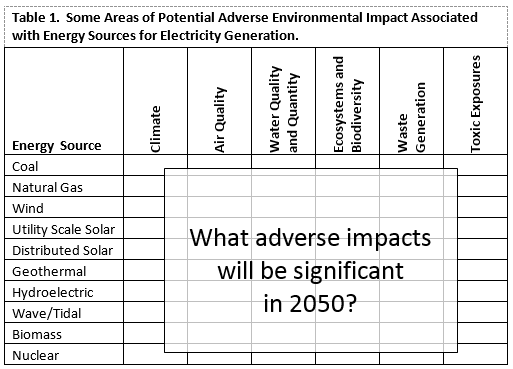
The NRC/NAE noted that utility-scale renewable resources require large land areas for collection of the diffuse energy sources (i.e. wind and solar) and for transmission lines to connect the generated power to the grid. However, given the low level of direct environmental emissions, the adverse environmental impacts tend to remain localized, as opposed to impacting neighboring, downwind, or downstream areas. Furthermore, the land used for utility-scale renewable energy generation may also be used for other purposes, e.g. the deployment of wind turbines on agricultural land. Local opposition to siting of renewable electricity-generating facilities and transmission lines has been a key obstacle to renewable energy development in the past and will continue to be in the future. (NRC/NAE, 2010). Table 1 presents a matrix that could be used to characterize the potential adverse environmental impacts associated with different energy sources for electricity generation. Research is needed to be able to fill in the cells of this matrix with qualitative and quantitative information.
While further reliance on low- or zero-carbon electricity may meet many energy needs, in other cases, alternative forms of low-carbon energy may be necessary or desirable. In the transportation sector, for example, it may be technically necessary or economically desirable to augment electrification of transportation modes with other sources of low-carbon energy, such as low-carbon liquid fuels for aviation or long-haul heavy-duty land and water transportation.
Another approach to decarbonization of energy production involves the use of fossil fuels with carbon capture and sequestration (CCS) or the cultivation and use of biofuels along with CCS. The methods for CCS for emissions from fossil fuel and biofuel combustion are the same (Wilcox, 2012). In 2015, a National Research Council committee concluded that such point source carbon capture methods may have potentially serious negative environmental impacts that may be difficult to mitigate to current environmental protection standards (NRC, 2015). Such impacts may be considered a part of proposed research. Environmental impacts associated with other methods of carbon removal and sequestration not directly tied to energy production—including direct capture from ambient air; removal by forests, crops, and soils; removal via ocean fertilization; or accelerated mineral weathering (NRC, 2015)—are not of interest in this solicitation.
The potential impacts of different modes of energy production have received much more attention than the potential impacts of changes in the patterns of energy consumption. New technologies, such as information and communication technology and autonomous transportation, may dramatically change where people live and work and their daily patterns of energy use. The increasing integration of electronics and associated power supplies into many products used in daily life creates new emissions and waste streams from manufacturing and disposal of electronics and batteries.
Predictive Tools Needed to Anticipate Impacts
To protect public health and environmental quality as energy production and consumption evolve, it is necessary to be able to anticipate the risks and benefits to public health and environmental quality at local, regional, and national scales. A wide range of models, databases, and assessment tools are currently used by environmental managers, industry, and scientists to analyze the environmental impacts associated with changes to our current energy system at different spatial scales. Most current models address impacts in one environmental medium (e.g., air, water, …), impacts from one economic sector (e.g., electricity generation), or one aspect of the overall energy system (e.g., energy demand). These models are used by themselves or in combinations by government agencies, private industries, and the academic community to understand environmental issues. Some examples of such models and tools are listed in Table 2 along with hyperlinks to websites where further information is available. This list is intended to be illustrative, not exhaustive.
Most available environmental modeling tools were designed to address today’s environmental problems. Additional tools and enhancements may be needed to capture and quantify the significant environmental and public health risks and benefits of a very different future energy system that would result from deep decarbonization. Current models may not include all of the linkages between environmental media or the health and ecosystem endpoints that are significantly impacted, making it difficult to understand risk and benefit tradeoffs. Therefore, this solicitation seeks research to help develop, extend, and apply the models, databases, and assessment tools needed to anticipate the risks and benefits of deep decarbonization.
| Table 2. Some examples of current models and tools used to assess public health and environmental risks (not exhaustive). | |
|---|---|
| Energy Models | |
| NEMS: National Energy Modeling System | |
| IPM: Integrated Planning Model | |
| MARKAL: Market Allocation Model | |
| GREET: Greenhouse Gases, Regulated Emissions, and Energy Use in Transportation Model | |
| GCAM: Global Change Assessment Model Exit | |
| Air Quality, Emissions, and Benefits Models | |
| MOVES: Motor Vehicle Emission Simulator | |
| CMAQ: Community Multi-scale Air Quality Model Exit | |
| BenMAP-CE: Environmental Benefits Mapping and Analysis Program – Community Edition | |
| Water Quality Models | |
| SWAT: Soil & Water Assessment Tool Exit | |
| SWMM: Storm Water Management Model | |
To inform choices along the path to deep decarbonization, it is important not only to understand the important relationships that drive public health and ecosystem risks in a future decarbonized world, but it is also necessary to understand how energy production, delivery, and consumption, and the associated environmental risks and benefits, might evolve along the way. The evolution of the energy system will take time, during which the technology mix will shift from the current mix of technologies to the future decarbonized mix. Intermediate technologies may be phased in and subsequently phased out in the course of this evolution, generating a different distribution of impacts along the way.
Furthermore, as the energy system evolves, climate change and other social, economic, demographic, land use, and technological trends (which may or may not be predictable) will continue to alter the important relationships that drive health and ecosystem risk. For example, the evolving nature of transportation including connected/automated vehicles, greater reliance on electricity and other low-carbon fuels, and potentially significant changes in transportation demand can synergistically affect energy system impacts. While much ongoing research has focused on the lifecycle GHG impacts of non-petroleum sources for transportation fuels, comparatively little research has attempted to quantify the ecosystem impacts of these alternative energy sources, such as their impact on water use, water pollution, and biodiversity.
Thus, the models, databases, and assessment tools needed to guide choices along the path to deep carbonization must be able to account for these dynamic and uncertain forces to help maximize benefits and avoid unintended consequences.
The Role of Individual, Firm, and Community Decision Behaviors
To move toward deep decarbonization, we must understand not just technological opportunities but social and behavioral drivers and responses as well. We must understand and be able to anticipate the willingness of individuals, firms (i.e. businesses), and communities to adopt new technologies and to implement energy efficiency measures. Behavioral and social aspects of deep decarbonization must be accounted for in assessments of the potential impacts of new technologies and policies.
A significant amount of research has indicated that energy efficiency measures can potentially drive significant reductions in energy consumption, expenditures, and associated air emissions, including emissions of GHGs (e.g., Choi Granade et al., 2009; NAS/NAE/NRC, 2010; EPRI, 2014). As a result, as noted above, energy efficiency is consistently identified as a critical carbon mitigation strategy in both the near and longer term. However, it has been observed that energy efficiency measures are not adopted to the full extent to which they would appear to be beneficial, i.e. at a less than cost-minimizing rate. This phenomenon has been labeled the “energy efficiency gap” or “energy efficiency paradox.” For example, analyses in support of recent EPA rules to reduce GHG emissions from vehicles have found a number of technologies, such as advanced transmissions, that save fuel with moderate costs and no loss of vehicle functionality have nevertheless not been widely adopted. Other examples of energy efficiency measures that are adopted less than one would expect assuming that consumers attempt to minimize costs include building insulation and energy efficient appliances and heating and cooling equipment. There are a number of factors that may explain this energy efficiency gap, including market failures, such as asymmetry in access to information and capital; decision behaviors, including loss aversion and myopia; and unobserved costs (Gillingham and Palmer, 2014; Gerarden et al., 2015). There is still not agreement on the size and source of this gap (Allcott and Greenstone, 2012). In addition to consideration of the energy efficiency gap, it has also been observed that in some instances, when energy efficiency measures are adopted, individuals or firms may consume more of the energy-consuming good or service. This is known as the rebound effect or Jevon’s Paradox (Gillingham et. al., 2016). As with the energy efficiency gap, there is not agreement on the significance of this phenomenon. Failure to take the rebound effect and energy efficiency gap into consideration in analyzing technologies and designing policies may affect assessments of adoption and implementation.
Under many scenarios for deep decarbonization, new questions about behavioral responses arise as deep decarbonization and ongoing sector transformation lead to the creation of new markets and/or pricing schemes for energy services; new energy consumption patterns; and new ways in which energy consumers interact with energy producers. For example, how does the provision of real-time energy consumption information and dynamic pricing structures change energy consumption? How and in what contexts? Homeowners that install solar photovoltaic panels on their roofs become not only energy consumers but energy producers as well. How does this change their energy consumption patterns and adoption of energy efficiency measures?
Research is needed to better understand human decision processes related to energy consumption and technology adoption, to account for them in the assessment of future energy and technology scenarios, and to help design policies, programs and markets that support clean and efficient energy technologies. In particular, it is important to understand how human decision making differs depending on the nature of the technology or efficiency measure and the decision context, including the socioeconomic status of an individual or community and competitive nature of a firm. This research may include empirical studies that elucidate the underlying drivers of energy use and technology adoption decisions in particular settings and demonstrate how the effect of these drivers can be anticipated in future projections or analyses or accounted for in the design of effective policies or efficient markets. Without an understanding of how human decision processes affect the adoption of new technologies and efficiency measures, it will be difficult to predict the potential for positive or negative environmental impacts or to design effective policies or efficient markets at the local, state, or national scale.
The specific Strategic Goal and Objectives from the EPA’s Strategic Plan that relate to this solicitation are:
Goal 1: Addressing Climate Change and Improving Air Quality, Objective 1.1: Address Climate Change and Objective 1.2: Improve Air Quality
The EPA’s FY 2014-18 Strategic Plan can be found at: EPA Strategic Plan
C. Authority and Regulations
The authority for this RFA and resulting awards is contained in the Clean Air Act, 42 U.S.C. 7403, Section 103(b)(3); Safe Drinking Water Act, 42 U.S.C. 300j-1, Section 1442; the Clean Water Act, 33 U.S.C. 1254, Section 104(b)(3); and the Solid Waste Disposal Act, 42 U.S.C. 6981, Section 8001.
For research with an international aspect, the above statutes are supplemented, as appropriate, by the National Environmental Policy Act, Section 102(2)(F).
Note that a project’s focus is to consist of activities within the statutory terms of EPA’s financial assistance authorities; specifically, the statute(s) listed above. Generally, a project must address the causes, effects, extent, prevention, reduction, and elimination of air pollution, water pollution, solid/hazardous waste pollution, toxic substances control, or pesticide control depending on which statute(s) is listed above. Further note applications dealing with any aspect of or related to hydraulic fracking will not be funded by EPA through this program.
Additional applicable regulations include: 2 CFR Part 200, 2 CFR Part 1500, and 40 CFR Part 40 (Research and Demonstration Grants).
D. Specific Areas of Interest/Expected Outputs and Outcomes
Note to applicant: The term “output” means an environmental activity, effort, and/or associated work products related to an environmental goal or objective, that will be produced or provided over a period of time or by a specified date. The term “outcome” means the result, effect or consequence that will occur from carrying out an environmental program or activity that is related to an environmental or programmatic goal or objective.
For the following research areas, “deep decarbonization” is defined as in Section I.B.
Proposals should address one or more of the following three research areas:
- How might the deep decarbonization of the U.S. economy by 2050 change the geographic, socioeconomic, and demographic distribution of public health and ecosystem risks associated with energy production and consumption?
- What factors drive decisions at the individual, firm, and community levels regarding how much and what types of energy are used in different technological and socioeconomic contexts? How can these insights be applied to the design of efficient markets and effective policies supporting clean technology and efficiency measures?
- What predictive tools are needed to anticipate the risks and responses to deep decarbonization?
Proposals that address more than one of the research areas above will not necessarily be rated more highly than those that address just one of the areas.
Relevant health and environmental risks include, but are not limited to, those associated with climate change; air quality; water quality and quantity; land use change; ecosystems and biodiversity; acute and chronic toxic exposures; and solid, hazardous, and radioactive waste generation. As noted in Section I.B., health and environmental impacts associated with the use of CCS along with fossil fuel or biofuel combustion are relevant for this RFA, but impacts associated with carbon removal and sequestration strategies not directly tied to energy production are not of interest in this RFA.
The research funded by this RFA is expected to lead to the following outcomes:
- improved awareness and understanding of the potential health and environmental risk tradeoffs of different energy development pathways
- more informed private and public investments in clean technology and energy efficiency measures
- more efficient markets and effective policies to support the adoption of clean technology and energy efficiency measures
The expected research outputs that may contribute to these outcomes include:
- quantitative and qualitative assessments of potential health and environmental risk tradeoffs associated with deep decarbonization pathways
- improved models and methodologies to assess the health and environmental risks associated with a range of significantly different patterns of energy production and consumption in the future
- behavioral insights that can be applied to the design of robust policies or efficient markets to support the adoption of clean technology and efficiency measures
Applicants are encouraged to build upon future technological, policy, and economic scenarios that have been described in the academic literature and by other U.S. government agencies, including the U.S. Global Change Research Program. Although the feasibility and likelihood of future scenarios can be addressed in the proposed research, the emphasis should be on the ability to assess the health and environmental impacts and behavioral issues associated with those future scenarios.
In addition to addressing scenarios that achieve deep decarbonization, applicants may choose to consider the risks and the unintended consequences along the various alternative pathways to deep decarbonization, including intermediate scenarios and technologies that may contribute to climate change mitigation but not ultimately achieve deep decarbonization. The analysis of such intermediate scenarios and technologies must be in addition to the consideration of deep decarbonization scenarios.
In addressing each of the research areas, applicants are encouraged to consider the resiliency of future energy systems, communities, and policy frameworks. Resiliency is the capacity of a system to adapt to and to recover from unexpected and changing conditions or a range of shocks and stresses (see Redman 2012). Applicants are encouraged to consider how deep decarbonization affects the resiliency of systems that produce and consume energy and the resiliency of populations and ecosystems with respect to health and environmental risks (i.e., minimizing the vulnerability of populations and ecosystems to adverse impacts). Quantitative or qualitative tools of interest are those that can be used to inform the development of robust or adaptable policies and programs at the local, state, and national level to achieve maximum benefits and avoid unintended consequences associated with energy production and consumption. Applicants are also encouraged to consider how their research can improve the resiliency of the energy system transformation and robustness of environmental decision-making under a range of possible futures.
With respect to the behavioral responses and decision processes addressed by research area 2, applicants are encouraged to consider what factors drive the energy efficiency gap, rebound effects, or other consumer behaviors associated with the ongoing transformations of the power sector (e.g., dynamic pricing, new markets for more fully valuing energy services) and the evolution of the transportation sector. Applicants are encouraged to consider how these behaviors can be accounted for in predictive models and program designs.
Applicants for regular awards are encouraged to approach the research questions from a multi-disciplinary, multi-pollutant, multi-media perspective. However, applicants may choose, but are not required, to bound their investigation by focusing on a specific geographic area (national, regional, state, local), economic or activity sector (power, transportation, industry, …), or category of technology. Applicants for early career awards are expected to propose projects with a narrower scope than projects proposed for regular awards and are not expected to engage multiple investigators.
To the extent practicable, research proposals must embody innovation and sustainability. Innovation for the purposes of this RFA is defined as the process of making changes; a new method, custom or device. Innovative research can take the form of wholly new applications or applications that build on existing knowledge and approaches for new uses. Research proposals must include a discussion on how the proposed research is innovative (see Section IV.C.5.a). The concept of sustainability is based on language in the U.S. National Environmental Policy Act of 1969 (NEPA). This definition is reiterated in Executive Order 13514, Federal Leadership in Environment, Energy, and Economic Performance, stating that the goal of sustainability is to, “create and maintain conditions, under which humans and nature can exist in productive harmony, that permit fulfilling the social, economic, and other requirements of present and future generations.” Research proposals must include a discussion on how the proposed research will seek sustainable solutions that protect the environment and strengthen our communities (see Section IV.C.5.a). ORD will draw from all of the above-mentioned innovation and sustainability definitions in the review/evaluation process of recommending research proposals (see Section V.A).
Allcott, Hunt and Michael Greenstone. Is There an Energy Efficiency Gap. Journal of Economic Perspectives 26(1): 3-28 (2012). Available at: http://dx.doi.org/10.1257/jep.26.1.3 Exit
Choi Granade, Hannah, Jon Creys, Anton Derkach, Philip Farese, Scott Nyquist, and Ken Ostrowski. Unlocking Energy Efficiency in the U.S. Economy. New York: McKinsey & Company, 2009.
Electric Power Research Institute (EPRI). U.S. Energy Efficiency Potential through 2035. Final Report 1025477. Palo Alto: Electric Power Research Institute, 2014. Available at: http://www.epri.com/abstracts/Pages/ProductAbstract.aspx?ProductId=000000000001025477 Exit
Fawcett, Allen A., Leon E. Clarke, and John P. Weyant (eds). The EMF24 Study on U.S. Technology and Climate Policy Strategies. The Energy Journal 35 (Special Issue 1), 2014. Available at: http://dx.doi.org/10.5547/01956574.35.SI1 Exit
Gerarden, Todd, Richard E. Newell, and Robert N. Stavins. Deconstructing the Energy-Efficiency Gap: Conceptual Frameworks and Evidence. American Economic Review: Papers & Proceedings 2015 105(5):183-186 (2015). Available at: http://dx.doi.org/10.1257/aer.p20151012 Exit
Gillingham, Kenneth, and Karen Palmer. Bridging the Energy Efficiency Gap: Policy Insights from Economic Theory and Empirical Evidence. Review of Environmental Economics and Policy 8(1): 18-38 (2014). Available at: http://dx.doi.org/10.1093/reep/ret021 Exit
Gillingham, Kenneth, David Rapson, and Gernot Wagner. The Rebound Effect and Energy Efficiency Policy. Review of Environmental Economics and Policy 10(1): 66-88 (2016). Available at: http://dx.doi.org/10.1093/reep/rev017 Exit
Huntington, Hillard, and Eric Smith (eds). Mitigating Climate Change through Energy Efficiency. The Energy Journal 32 (Special Issue 1), 2011. Available at http://dx.doi.org/10.5547/ISSN0195-6574-EJ-Vol32-SI1 Exit.
Jacobson, Mark Z., Mark A. Delucchi, Guillaume Bazouin, Zack A.F. Bauer, Christa C. Heavey, Emma Fisher, Sean B. Morris, Diniana J.Y. Piekutowski, Taylor A.Vencill, and Tim W. Yeskoo. 100% clean and renewable wind, water, and sunlight (WWS) all-sector energy roadmaps for the 50 United States. Energy & Environmental Science 8(7):2093-2117 (2015). Available at: http://dx.doi.org/10.1039/C5EE01283J Exit
National Academy of Sciences, National Academy of Engineering, and National Research Council (NAS/NAE/NRC). Real Prospects for Energy Efficiency in the United States. Washington, DC: The National Academies Press, 2010. Available at: http://dx.doi.org/10.17226/12621 Exit
National Renewable Energy Laboratory (NREL). Renewable Electricity Futures Study. Hand, M.M.; Baldwin, S.; DeMeo, E.; Reilly, J.M.; Mai, T.; Arent, D.; Porro, G.; Meshek, M.; Sandor, D. eds. 4 vols. NREL/TP-6A20-52409. Golden, CO: National Renewable Energy Laboratory, 2012. Available at: http://www.nrel.gov/analysis/re_futures/ Exit
National Research Council (NRC). Limiting the Magnitude of Future Climate Change. Washington, DC: The National Academies Press, 2010. Available at: http://dx.doi.org/10.17226/12785 Exit
National Research Council (NRC). Climate Intervention: Carbon Dioxide Removal and Reliable Sequestration. Washington, DC: The National Academies Press, 2015. Available at: http://dx.doi.org/10.17226/18805 Exit
National Research Council and National Academy of Engineering (NRC/NAE). Electricity from Renewable Resources: Status, Prospects, and Impediments. Washington, DC: The National Academies Press, 2010. Available at: http://dx.doi.org/10.17226/12619 Exit
National Energy Technology Laboratory (NETL). Risk Analysis and Simulation for Geologic Storage of CO2, June 2013 Revised Edition, DOE/NETL-2013/1603. Morgantown, WV: National Energy Technology Laboratory, U.S. Department of Energy, 2013.
Redman, Charles L. Should sustainability and resilience be combined or remain distinct pursuits? Ecology and Society 19(2):37 (2014). Available at: http://dx.doi.org/10.5751/ES-06390-190237 Exit
United States Global Change Research Program (USGCRP), 2016: The Impacts of Climate Change on Human Health in the United States: A Scientific Assessment. Crimmins, A., J. Balbus, J.L. Gamble, C.B. Beard, J.E. Bell, D. Dodgen, R.J. Eisen, N. Fann, M.D. Hawkins, S.C. Herring, L. Jantarasami, D.M. Mills, S. Saha, M.C. Sarofim, J. Trtanj, and L. Ziska, Eds. U.S. Global Change Research Program, Washington, DC, 312 pp. Available at: http://dx.doi.org/10.7930/J0R49NQX Exit
White House, Office of the Press Secretary. FACT SHEET: U.S. Reports its 2025 Emissions Target to the UNFCCC, Washington DC: Executive Office of the President of the United States, March 31, 2015. Available at: https://www.whitehouse.gov/the-press-office/2015/03/31/fact-sheet-us-reports-its-2025-emissions-target-unfccc Exit
Wilcox, Jennifer. Carbon Capture. New York: Springer, 2012.
Williams, J.H., B. Haley, F. Kahrl, J. Moore, A.D. Jones, M.S. Torn, and H. McJeon. Pathways to deep decarbonization in the United States. The U.S. report of the Deep Decarbonization Pathways Project of the Sustainable Development Solutions Network and the Institute for Sustainable Development and International Relations (2014). Revision with technical supplement, November 16, 2015. Available at: http://usddpp.org/ Exit
Agency policy and ethical considerations prevent EPA technical staff and managers from providing applicants with information that may create an unfair competitive advantage. Consequently, EPA employees will not review, comment, advise, and/or provide technical assistance to applicants preparing applications in response to EPA RFAs. EPA employees cannot endorse any particular application.
Multiple Investigator applications may be submitted as: (1) a single Lead Principal Investigator (PI) application with Co-PI(s) or (2) a Multiple PI application (with a single Contact PI). If you choose to submit a Multiple PI application, you must follow the specific instructions provided in Sections IV. and V. of this RFA. For further information, please see the EPA Implementation Plan for Policy on Multiple Principal Investigators (RBM Toolkit - Research Business Models Working Group).
Please note: Early career awards will not accommodate a Multiple PI application. Early career awards shall be submitted as a single Lead PI application. Special eligibility criteria apply to the early career portion of this RFA. Please see Section III of this RFA for details on the early career eligibility criteria. The application must include an early career verification (see “Early Career Verification” in Section IV.C.5.e).
This solicitation provides the opportunity for the submission of applications for projects that may involve human subjects research. All applications must include a Human Subjects Research Statement (HSRS; described in Section IV.C.5.c of this solicitation). If the project involves human subjects research, it will be subject to an additional level of review prior to funding decisions being made as described in Sections V.C and V.D of this solicitation.
Groups of two or more eligible applicants may choose to form a consortium and submit a single application for this assistance agreement. The application must identify which organization will be the recipient of the assistance agreement and which organizations(s) will be subawardees of the recipient.
The application should include a plan (see “Data Plan” in section IV.C.5.d) to make available to the NCER project officer all data generated (produced under the award) from observations, analyses, or model development used under an agreement awarded from this RFA. The data must be available in a format and with documentation such that they may be used by others in the scientific community.
These awards may involve the collection of “Geospatial Information,” which includes information that identifies the geographic location and characteristics of natural or constructed features or boundaries on the Earth or applications, tools, and hardware associated with the generation, maintenance, or distribution of such information. This information may be derived from, among other things, a Geographic Positioning System (GPS), remote sensing, mapping, charting, and surveying technologies, or statistical data.
It is anticipated that a total of approximately $6 million will be awarded under this announcement, depending on the availability of funds, quality of applications received, and other applicable considerations. The EPA anticipates funding approximately 5 regular awards and 5 early career awards under this RFA. For regular awards, requests for amounts in excess of a total of $900,000, including direct and indirect costs, will not be considered. For early career awards, requests for amounts in excess of a total of $300,000, including direct and indirect costs, will not be considered. The total project period requested in an application submitted for this RFA may not exceed 3 years.
The EPA reserves the right to reject all applications and make no awards, or make fewer awards than anticipated, under this RFA. The EPA reserves the right to make additional awards under this announcement, consistent with Agency policy, if additional funding becomes available after the original selections are made. Any additional selections for awards will be made no later than six months after the original selection decisions.
In appropriate circumstances, EPA reserves the right to partially fund proposals/applications by funding discrete portions or phases of proposed projects. If EPA decides to partially fund a proposal/application, it will do so in a manner that does not prejudice any applicants or affect the basis upon which the proposal/application, or portion thereof, was evaluated and selected for award, and therefore maintains the integrity of the competition and selection process.
EPA may award both grants and cooperative agreements under this announcement.
Under a grant, EPA scientists and engineers are not permitted to be substantially involved in the execution of the research. However, EPA encourages interaction between its own laboratory scientists and grant Principal Investigators after the award of an EPA grant for the sole purpose of exchanging information in research areas of common interest that may add value to their respective research activities. This interaction must be incidental to achieving the goals of the research under a grant. Interaction that is “incidental” does not involve resource commitments.
Where appropriate, based on consideration of the nature of the proposed project relative to the EPA’s intramural research program and available resources, the EPA may award cooperative agreements under this announcement. When addressing a research question/problem of common interest, collaborations between EPA scientists and the institution’s principal investigators are permitted under a cooperative agreement. These collaborations may include data and information exchange, providing technical input to experimental design and theoretical development, coordinating extramural research with in-house activities, the refinement of valuation endpoints, and joint authorship of journal articles on these activities. Proposals may not identify EPA cooperators or interactions; specific interactions between EPA’s investigators and those of the prospective recipient for cooperative agreements will be negotiated at the time of award.
Public nonprofit institutions/organizations (includes public nonprofit institutions of higher education and hospitals) and private nonprofit institutions/organizations (includes private nonprofit institutions of higher education and hospitals) located in the U.S., state and local governments, Federally Recognized Indian Tribal Governments, and U.S. territories or possessions are eligible to apply. Profit-making firms are not eligible to receive assistance agreements from the EPA under this program.
Eligible nonprofit organizations include any organizations that:
1) Are operated primarily for scientific, educational, service, charitable, or similar purposes in the public interest; 2) Are not organized primarily for profit; and 3) Use its net proceeds to maintain, improve, and/or expand its operations. However, nonprofit organizations described in Section 501(c) (4) of the Int
The perspectives, information and conclusions conveyed in research project abstracts, progress reports, final reports, journal abstracts and journal publications convey the viewpoints of the principal investigator and may not represent the views and policies of ORD and EPA. Conclusions drawn by the principal investigators have not been reviewed by the Agency.