U.S. flag

An official website of the United States government

Here’s how you know

Dot gov

Official websites use .gov
A .gov website belongs to an official government organization in the United States.

HTTPS

Secure .gov websites use HTTPS
A lock (LockA locked padlock) or https:// means you have safely connected to the .gov website. Share sensitive information only on official, secure websites.

  • Environmental Topics
  • Laws & Regulations
  • Report a Violation
  • About EPA
Contact Us

Grantee Research Project Results

Final Report: Ultra-Sensitive Detection of Air Toxics Using Incoherent Cavity Ringdown Spectroscopy

EPA Contract Number: EPD12019
Title: Ultra-Sensitive Detection of Air Toxics Using Incoherent Cavity Ringdown Spectroscopy
Investigators: Leen, J. Brian
Small Business: Los Gatos Research Inc.
EPA Contact: Richards, April
Phase: I
Project Period: March 1, 2012 through August 31, 2012
Project Amount: $79,292
RFA: Small Business Innovation Research (SBIR) - Phase I (2012) RFA Text |  Recipients Lists
Research Category: SBIR - Air and Climate

Description:

In this SBIR effort, Los Gatos Research (LGR) proposed to design, build and test a novel Incoherent Cavity Ring Down Spectroscopy (iCRDS) gas analyzer in the mid-infrared region with 500 – 1000x higher sensitivity than long-path, open-path Fourier Transform Infrared (FTIR) and a 1.7 – 10x lower cost of ownership compared to portable Gas Chromatography/Mass Spectroscopy (GC/MS). The analyzer was optimized to provide in situ, autonomous, high sensitivity (ppbv to pptv range), continuous, high speed measurements of multiple EPA designated air toxics. Because of the inherent benefits of iCRDS, the analyzer was highly sensitive, selective, robust and economical compared to the alternatives of GC/MS and FTIR.

Summary/Accomplishments (Outputs/Outcomes):

In Phase I, LGR has demonstrated technical feasibility by fabricating a MIR iCRDS system optimized for the detection of trichloroethylene (TCE) and tetrachloroethylene (PCE) that provides continuous unattended monitoring of these and several other compounds. LGR developed a custom suite of software to collect data automatically from multiple sample sources and two reference sources (zero air and known standard), process the data and fit the resulting spectrum to a basis set library to yield a quantitative measure of volatile organic compound concentrations in the ppb to ppt range. LGR performed advanced modeling on reinjection techniques to optimize the system performance. The instrument was shown to be precise: 5.6 ppb for benzene (1σ over 4 measurements), 1.57 ppb for TCE (1σ in 16 minutes), and 2.8 ppb for PCE (1σ in 16 minutes). When averaged, the precision increased to 500 ppt for TCE (1σ in 800 minutes) and 466 ppt for PCE (1σ in 258 minutes). The instrument was shown to be extremely linear, having a measured vs. actual slope of 0.993 ± 0.017 (R2 = 0.99791) for TCE and 1.015 ± 0.010 (R2 = 0.99791) for PCE. Once calibrated with a known standard, the instrument was found to be accurate to 0.52 ppb for TCE at 88.7 ppb and to 3.56 ppb for PCE at 97.5 ppb. The minimum detectable concentration was found to be 3.57 ppb for TCE and 7.68 ppb for PCE at a SNR ratio of 3σ. The instrument was found to have cross interferences for TCE with water but not PCE with water. It was shown that the TCE interference can be completely eliminated by drying the air with a Nafion drier. It was found that both TCE and PCE are measured accurately when a contaminated wet stream is dried using Nafion. By varying the concentration of a TCE + PCE stream, it was found that there was no cross interference between these species despite an overlap between their absorption lines.
 
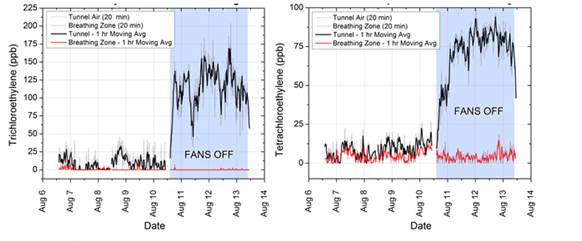
After these laboratory validation studies the instrument was deployed to the Superfund site at Moffett airfield for one week where it measured absorption spectra unattended. Ground water at the site has been contaminated from engine cleaning shops, dry cleaners and semiconductor processing. Building 10 at Moffett airfield is a known vapor intrusion site for cis-1,2-dichloroethylene, TCE and PCE through steam tunnels with ground water intrusion. During the deployment, the instrument measured breathing zone air and steam tunnel air with automatic, periodic measurement of zero air and known concentration of PCE in zero air. The site recently was equipped with ventilation to draw air from the breathing zone, through the tunnel to an external exhaust, and LGR was permitted to turn this ventilation off for the weekend at the end of the deployment. During this period, LGR observed a significant rise in the TCE and PCE concentration in tunnel air that was consistent with previously values measured before ventilation by summa canister collected GC/MS (Figure 1).
 

Figure 1
Figure 1. (left) TCE concentration during the deployment to BUilding 10 of Moffett Field. The bold
lines ahow the 1 hour moving average. (right) PCE concentration during the deployment. Both VOCs
were measured in bo th the breathing zone at head height and in 3 locations in the stream tunnels. 
The ventilation fans were turned off during hte weekend of August 11 and both VOC show a 
significant increase in concentration during this period. 


Conclusions:

With these laboratory data, LGR has shown that the instrument is precise and accurate to the ppb level and has an extremely linear response, with an MDC in the low ppb range for TCE and PCE. Additionally, LGR has shown that interferences with water can be eliminated using Nafion drying for TCE and PCE and that these two compounds do not interfere with each other when present in the same gas sample.
 
The successful deployment, with measurement and quantitative reporting of TCE and PCE concentrations in breathing zone and tunnel air demonstrate the feasibility of the iCRDS technique for autonomous, continuous, in-the-field monitoring of ppb levels of toxic VOCs from vapor intrusion.
 
Commercialization:
Dr. Leen has been invited to present this instrument and the Phase I deployment results at several EPA events, and LGR will present literature for the instrument at the upcoming fall meeting of the American Geophysical Union in San Francisco, CA.

Supplemental Keywords:

air pollution, air pollution monitoring, air pollution control, Incoherent cavity ring down spectroscopy, iCRDS, gas analyzer, gas chromatography, infrared, MIR, portable, external-cavity quantum cascade laser, EC-QCL, air quality monitoring, laser-based analyzer, SBIR, pollutant measurement

Top of Page

The perspectives, information and conclusions conveyed in research project abstracts, progress reports, final reports, journal abstracts and journal publications convey the viewpoints of the principal investigator and may not represent the views and policies of ORD and EPA. Conclusions drawn by the principal investigators have not been reviewed by the Agency.

Site Navigation

  • Grantee Research Project Results Home
  • Grantee Research Project Results Basic Search
  • Grantee Research Project Results Advanced Search
  • Grantee Research Project Results Fielded Search
  • Publication search
  • EPA Regional Search

Related Information

  • Search Help
  • About our data collection
  • Research Grants
  • P3: Student Design Competition
  • Research Fellowships
  • Small Business Innovation Research (SBIR)
Contact Us to ask a question, provide feedback, or report a problem.
Last updated April 28, 2023
United States Environmental Protection Agency

Discover.

  • Accessibility
  • Budget & Performance
  • Contracting
  • EPA www Web Snapshot
  • Grants
  • No FEAR Act Data
  • Plain Writing
  • Privacy
  • Privacy and Security Notice

Connect.

  • Data.gov
  • Inspector General
  • Jobs
  • Newsroom
  • Open Government
  • Regulations.gov
  • Subscribe
  • USA.gov
  • White House

Ask.

  • Contact EPA
  • EPA Disclaimers
  • Hotlines
  • FOIA Requests
  • Frequent Questions

Follow.