U.S. flag

An official website of the United States government

Here’s how you know

Dot gov

Official websites use .gov
A .gov website belongs to an official government organization in the United States.

HTTPS

Secure .gov websites use HTTPS
A lock (LockA locked padlock) or https:// means you have safely connected to the .gov website. Share sensitive information only on official, secure websites.

  • Environmental Topics
  • Laws & Regulations
  • Report a Violation
  • About EPA
Contact Us

Grantee Research Project Results

Final Report: Training and Technical Assistance to Brownfields in EPA Regions 1, 2, and 3

EPA Grant Number: R831575
Title: Training and Technical Assistance to Brownfields in EPA Regions 1, 2, and 3
Investigators: Bouwer, Edward J. , Alavi, Hedy
Institution: The Johns Hopkins University
EPA Project Officer: Aja, Hayley
Project Period: June 1, 2003 through May 31, 2007
Project Amount: $393,264
RFA: HSRC - TTAB Brownfields (2003) RFA Text |  Recipients Lists
Research Category: Hazardous Substance Research Centers , Land and Waste Management

Objective:

A. OVERVIEW
 
1. Background
 
The Center for Hazardous Substances in Urban Environments (CHSUE) (www.jhu.edu/hsrc/) was initiated in October 2001. The Outreach Program has been a collaborative effort between the Johns Hopkins University (lead institution), University of Maryland, Morgan State University (the previous three institutions service EPA Region 3), New Jersey Institute of Technology (services EPA Region 2), and University of Connecticut (services EPA Region 1). All of these institutions have provided technical assistance for Brownfields communities for the past 3 years with this TTAB funding. Examples of outreach assistance our team provided for this award include providing site-specific technical resources for community groups, conducting workshops for new pilots, establishing relationships with state programs, preparation of a Brownfields Resource Manual, participation in roundtables for state and local Brownfields programs, and providing support to Brownfields stakeholders on financing, environmental justice, environmental assessment and cleanup technology, greenway area-wide assessment, inventorying, private property owner concerns, government coordination, and application of the Triad approach.
 
2. Goals and Objectives
 
The Northeast and Mid-Atlantic regions of the U.S. contain a high density of Brownfields sites. This outreach program within the Center for Hazardous Substances in Urban Environments provided training and technical assistance to Brownfields (TTAB) in EPA Regions 1, 2, and 3 according to the guidelines of the National Brownfields Program. Under training, efforts were directed to provide knowledge on Brownfields issues to stakeholders through various methods, including class-room style training, workshops, conferences, roundtables, and internet communications. Under technical assistance, efforts were directed to guide stakeholders through a particular process or help them understand complex Brownfields-related subject matter.
 
3. Strategy
 
The Outreach activities conducted by the Center for Hazardous Substances in Urban Environments (CHSUE) under this TTAB funding were distributed among the partnering institutions to more appropriately respond to the local needs across the large geographical area represented by EPA Regions 1, 2, and 3. Staff at each of the partnering institutions contributed to this proposed Brownfields Outreach program. In EPA Region 1, staff at the University of Connecticut carried out the following TTAB projects: a) Ninigret Park (Charleston, RI), b) Mallory Hat Factory (Danbury, CT), and c) Brownfields Remediation, Reuse, and Outreach Training. In EPA Region 2, staff at the New Jersey Institute of Technology carried out the following TTAB projects: a) Area-wide Assessment (Kingston, NY), b) Task Force Training (Lackawanna, NY), c) Institutional Controls Training (Newark, NJ), d) New Jersey Brownfields Development Areas, e) New Jersey School Construction, and f) New York State Department of Housing and Community Renewal. In EPA Region 3, staff at the University of Maryland and Johns Hopkins University carried out the following TTAB projects: a) Technical Assistance and Technical Document Review and b) Training in the areas of Community Leadership, Community Involvement, Health Care Providers, Risk Communication, and Economics of Brownfields Cleanup and Redevelopment. Staff at Morgan State University provided technical assistance to the Park Heights Reisterstown Road Corridor Coalition Community. The TTAB activities benefited from the guidance of an external Outreach Advisory Committee. The Outreach Advisory Committee was comprised of 12 representatives from the communities, U.S. EPA, industry and States and provided oversight, vision and perspective; assisted in the development, implementation, and evaluation of the outreach activities; and identified outreach funding opportunities. The subsequent sections of this proposal provide a discussion of the participants and a summary of the projects.
 
B. PROJECT DESCRIPTION
 
The Northeast and Mid-Atlantic regions of the United States have a long history of heavy industrial development in steel production, agrochemical production and manufacturing, specialty chemical production, petroleum refining, shipbuilding, warehousing, and transportation. An unfortunate consequence of this industrialization is the presence of industrial waste and pollution at disposal sites, abandoned facilities, and the release of toxic compounds from ongoing activities. This industrial development has caused considerable degradation to the environment. An important subset of sites are designated as Brownfields. Brownfields are abandoned, idled, or underused industrial and commercial facilities where expansion or redevelopment is complicated by real or perceived environmental contamination (http://www.toscprogram.org/tab-overview.html). Relative to the rest of the U.S., the Northeast and Mid-Atlantic regions of the United States have a high population density and a large number of Brownfields sites. The purpose for the training and technical assistance to Brownfields (TTAB) program is to help communities clean and redevelop properties that have been damaged or undervalued by environmental contamination.
 
1. Participants
 
The interdisciplinary and multimedia nature of Brownfields problems demand a diverse array of scientific talent and facilities. An outstanding team of individuals from a number of different institutions was assembled to participate in the TTAB activities. The location and expertise of the TTAB staff are detailed below.
 
Johns Hopkins University, Baltimore, Maryland (Lead Institution) (EPA Region 3)
 
Director: Edward Bouwer (environmental engineering, bioremediation, and engineering microbiology)
Assoc. Director: Hedy Alavi (environmental engineering, hazardous waste and solid waste management)
 
University of Maryland School of Nursing, Baltimore, Maryland (EPA Region 3)
 
Barbara Sattler (environmental health nursing)
Robyn Gilden (environmental health nursing)
 
Morgan State University, Baltimore, Maryland (EPA Region 3)
Gbekeloluwa Oguntimein (chemical engineering, hazardous waste management, bioremediation)
Bheem Kattel (industrial engineer, occupational ergonomics and safety)
 
New Jersey Institute of Technology, Newark, NJ (EPA Region 2)
 
Director: Fred Ellerbush (environmental engineering, hazardous and solid waste management, risk assessment, and outreach)
Director: James Mack (environmental management, site, characterization and remediation)
Executive Director: Daniel Watts (environmental management and chemistry, green manufacturing, and sustainability)
Gerard McKenna (community outreach, characterization methods, technology transfer and training)
 
University of Connecticut, Storrs, CT (EPA Region 1)
 
Christopher Perkins (environmental monitoring and assessment, environmental toxicology and risk, risk communication)
Kevin Hood (public health, facilitation, community outreach)
Amine Dahmani (remediation, site assessment, Brownfields policy)

Approach:

The outreach activities being conducted by the CHSUE are distributed among the partnering institutions to more appropriately respond to the local needs across the large geographical area represented by EPA Regions 1, 2, and 3. Staff at each of the partnering institutions will contribute to this proposed Brownfields Outreach program. In EPA Region 1, staff at the University of Connecticut propose the following TTAB projects: a) Ninigret Park (Charleston, RI); b) Mallory Hat Factory (Danbury, CT); c) Regional Growth Partnership (Bridgeport, CT); d) Redevelopment of Contaminated Land (Stamford, CT); and e) Hartford Police Shooting Range (Rocky Hills, CT). In EPA Region 2, staff at the New Jersey Institute of Technology propose the following TTAB projects: a) Area-wide Assessment (Kingston, NY); b) Task Force Training (Lackawanna, NY); c) Institutional Controls Training (Newark, NJ); d) New Jersey Brownfields Development Areas; e) New Jersey School Construction; and f) New York State Department of Housing and Community Renewal. In EPA Region 3, staff at the University of Maryland and Johns Hopkins University propose the following TTAB projects: a) Community Leadership Training; b) Community Involvement Training; c) Health Care Provider Training; d) Workshops on Risk Communication; e) Workshops on Economics of Brownfields Cleanup and Redevelopment; and f) Technical Assistance and Technical Document Review. Staff at the Morgan State University propose to contribute to TTAB in EPA Region 3 via technical assistance to the Park Heights Reisterstown Road Corridor Coalition Community.

The proposed TTAB activities will benefit from the guidance by an external Outreach Advisory Committee. The Outreach Advisory Committee is comprised of 11 representatives from the communities, U.S. EPA, industry and States and provides oversight, vision and perspective, assists in the development, implementation, and evaluation of the outreach activities, and identifies outreach funding opportunities.

Summary/Accomplishments (Outputs/Outcomes):

2. Summary of Projects
 
EPA Region 1
 
Project Objective: The Regional Growth Partnership (RGP) is a Brownfields Pilot recipient and also lead agency for a smart growth project that involves the Quinnipiac River Conservation and Development Corridor. Additionally, The RGP is leading the team that is developing a master use plan for the Hamden Middle School site, a hazardous waste landfill, which TTAB has been intricately involved with.
 
Progress Summary/Accomplishments: TTAB attended 3 meetings with the RGP and the community regarding the redevelopment of the Hamden Middle School site. The Center provided technical assistance regarding potential risk associated with each redevelopment option allowing the community to make informed decisions.
 
Project Objective: TTAB was asked to advise the town of Plainfield regarding the redevelopment of a Mill site destroyed by fire. RFPs were prepared by the town for potential redevelopers and TTAB assisted the town in the review of the responses.
 
Progress Summary/Accomplishments: TTAB attended 2 meetings regarding the former mill site in Plainfield during this period. An additional RFP was released and TTAB reviewed several proposals received and provided recommendations to the Town.
 
EPA Region 2
 
The NJIT portion of the project carried out activities throughout EPA Region 2, including extensive activities in Puerto Rico and the Virgin Islands. Working closely with EPA Region 2 personnel, significant advances in community involvement and planning for Brownfield redevelopment activity have been made in both Puerto Rico and the Virgin Islands, as well as in other parts of the Region. It can be expected that continued community technical assistance will be important in those areas in the future, based in part on the work carried out as part of this program. The program has had numerous successes. The result of many of the successes is that there are community requests for additional and continuing services.
 
Project Objective: The Brownfields Environmental Solutions for Trenton Advisory Council (BEST) was formalized through a USEPA Pilot grant but originated in the community support work under a previous TOSC project. BEST is focused on the Brownfields opportunities in the city of Trenton, New Jersey ranging from assisted living housing, residential living, to commercial redevelopment.
 
Progress Summary/Accomplishments: Monthly meetings were held with presentations from the city, NJDEP, new developer initiatives, the TAB program and NJIT support resources, as well as city-wide redevelopment initiatives. We drafted a panel proposal for the 2004 Brownfields Conference focused on how Brownfields fits into the overall planning effort for the city. An informative citywide bus tour of major Brownfields properties and redevelopment plans was conducted by the City of Trenton for the BEST. Immediately following the tour a meeting was held to develop concepts and ideas that might aid the city as it moves forward. Subsequent meetings have included opportunities to address property issues in-depth that were identified during the tour and refine the concepts and ideas that BEST developed. Monthly meetings were held during the year that focused on how the group could assist the City of Trenton with redevelopment of its Brownfield sites. The BEST also toured Brownfields in the City to assess progress and continue discussions on redevelopment objectives. Meetings focused on the Magic Marker cleanup, newly identified Brownfields properties and initiatives, funding opportunities, integrating redevelopment plans with State sponsored community schools, storm water investigations, and development of topics for the Brownfield 2005 conference. BEST also reviewed and provided input on updated HUD community development documents which will be the subject of a presentation to the Mayor in the next quarter. NJIT provided BEST with a presentation on the issues of use of re-cycled concrete aggregate in construction, which is becoming of greater concern in New Jersey and other states. More recent activities have included participation in tours and planning for the Brownfields redevelopment in the Roebling Market area.
 
Project Objective: NHSRC was requested to provide technical assistance to a South Waterfront Redevelopment Plan sponsored by the Heart of Camden, a community organization located in South Camden. The area has been plagued by encroachment of industrial uses and abandoned property including sites listed on the NJDEP Known Contaminated Site List, USEPA Superfund program and the target of NJDEP enforcement actions. The area is disadvantaged but with strong grassroots community involvement. Our assistance activities were focused on a technical evaluation of the Environmental Risk Management Framework &Mitigation Strategies Interim Report prepared by Vita Nuova LLC under funding by the Heart of Camden. We provide technical suggestions on land use issues and building design for Brownfields.
 
Progress Summary/Accomplishments: During the period of this project, our involvement with the community leadership, City of Camden, NJDEP, and others continued to be extensive on the redevelopment plans for the Waterfront South area through conference calls and meetings. We commented on an update of the NJDEP Air Toxics study to assess land use impacts on the residential neighborhoods. A multi-stakeholder meeting was held with the NJDEP Commissioner to review neighborhood plans and address concerns. Vita Nuova, Tufts, and NJIT developed a proposal to conduct an independent transportation related study on diesel emissions to determine the impact of mobile sources on air quality. More recent activities have included work with the community group as it has interacted with the NJDEP through the process of an environmental justice assessment for the community area, with a particular emphasis on the Brownfields redevelopment aspects of the environmental justice issues raised.
 
Project Objective: At the request of NJDEP, NHSRC provided technical support to facilitate the Systematic Planning and Work Plan preparation phases of the Triad Approach. The Ford Avenue Redevelopment Project is a former Michelin Tire manufacturing facility located on 20 acres of land in Milltown, NJ. The Ford Avenue Authority was created to provide a mechanism to redevelop this site into senior housing, market rate residential and mixed use commercial. The project involves coordination among key stakeholders including Middlesex County Improvement Authority (MCIA), the NJDEP, the developer, USEPA Region 2 Brownfields, USEPA Region 2 Mobile Laboratory, the MCIA consultant, Argonne Labs and USEPA Technology Innovation Office.
 
Progress Summary/Accomplishments: Provided technical support for preparation of the Triad work plan and for the fieldwork and in preparing draft for NJDEP review. Participated in meetings w/NJDEP to review and discuss comments to WP. Organized a training session with Region 2 EPA ERT to present a data management system. Organized a training session for NJDEP on the Tetra Tech Data Management System and Decision Support Software for Triad programs. Updated key NJDEP officials on EPA data, BDA program and funding. Attended meetings w/ Milltown Ford Avenue Redevelopment Agency to provide technical support to discussion on Triad approach, schedule for investigation and funding requirements. Provided technical assistance to prepare HSDRF grant application.
 
EPA Region 3
 
Project Objective: Carroll County has over 100 cases dealing with leaks of MTBE and other gasoline contaminants. Some groundwater contamination has been detected in drinking water wells. The issues were brought before the Environmental Advisory Council to the County Commissioners and Center Staff was asked to provide information and public education on the contaminants, health effects, monitoring, and cleanup issues.
 
Progress Summary/Accomplishments: Center Staff provided information to the council and community members on the gasoline contaminants, potential health effects, and assessment and cleanup techniques. Staff also attended various community meetings hosted by CC Health Department and MDE and attended the monthly Environmental Advisory Council. Staff collaborated with the EAC and MDE to create a reporting system and assisted the Carroll County Health Department to create and disseminate educational materials for the general public.
 
Project Objective: Bruceville Road Property, Keymar, Carroll County, MD. Several concerned citizens approached the Carroll County Environmental Advisory Council and CHSUE staff for help with an abandoned property on Bruceville Rd. Of concern were a potential oil spill, improper use of agriculturally zoned property as a recycling business, collapsed drainage culverts, trash, and other possible chemical contamination that could be onsite and possibly migrating off to surrounding properties and waterways.
 
Progress Summary/Accomplishments: Center staff assisted the community in contacting the appropriate people in the Carroll County Zoning Office, various divisions at Maryland Department of Environment, and the Carroll County Health Department to further their investigation of the situation and help them be active participants in the assessment and cleanup process.
 
Project Objective: Many environmental health trainings were held for practicing nurses, nursing faculty, and nursing students, along with other health care professionals. Topics included, among others, land use issues like safe assessment and reuse of Brownfields. States included Pennsylvania and Virginia in EPA Region 3 and New York in EPA Region 2. As the nurses at UMSON are sought after nationwide for their expertise in environmental health issues, including health effects and safe reuse related to Brownfields, trainings were also held in Missouri, Oklahoma, Alabama and Alaska.
 
Progress Summary/Accomplishments: Center staff imparted valuable information related to health effects, assessment, and safe reuse of Brownfield sites to many nurses and other health care providers so that they are aware and equipped to go into their own communities throughout their respective states and be valuable members of the assessment and reuse process.
 
C. ADVISORY COMMITTEE FOR THE TTAB PROGRAM
 
The CHSUE activities under the TTAB Award benefited from guidance supplied by an external advisory committee. The Outreach Advisory Committee (OAC) provided guidance on our TOSC and TTAB programs.
 
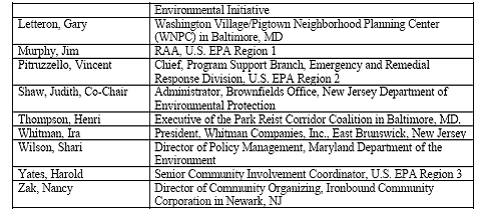
Our Outreach Advisory Committee (OAC) was comprised of 12 representatives from EPA, other government offices, industry, and the community (Table 1). The purpose for the OAC was to assist the CHSUE in the development, implementation, and evaluation of education, knowledge transfer, and outreach activities and to identify outreach funding opportunities. The OAC met annually throughout the duration of the TTAB Grant funding.


Table 1. Members of the Outreach Advisory Committee


Expected Results:

These activities are expected to appreciably enhance the capacity of communities in Regions 1, 2 and 3 to successfully redevelop brownfields properties. The use of regional, university-based technical assistance and training teams ensures credible, independent and knowledgeable staff closely linked to the communities being served.

Supplemental Keywords:

brownfields, community involvement, economic redevelopment, environmental remediation, hazardous waste, revitalization, technical outreach, technology transfer., RFA, Scientific Discipline, Ecosystem Protection/Environmental Exposure & Risk, INTERNATIONAL COOPERATION, Geographic Area, Waste, Ecological Risk Assessment, EPA Region, Ecosystem Protection, Urban and Regional Planning, Ecosystem/Assessment/Indicators, Brownfields, Ecological Effects - Environmental Exposure & Risk, Ecology and Ecosystems, environmental consequences, environmental education, government coordination, environmental risks, risk assessment, technical assistance, hazardous waste, Region 3, Region 1 , environmental assessment, risk assessment , Region 2, outreach and education, brownfield sites

Relevant Websites:

www.jhu.edu/hsrc/

Progress and Final Reports:

Original Abstract
  • 2003
  • 2004
  • 2005
  • Top of Page

    The perspectives, information and conclusions conveyed in research project abstracts, progress reports, final reports, journal abstracts and journal publications convey the viewpoints of the principal investigator and may not represent the views and policies of ORD and EPA. Conclusions drawn by the principal investigators have not been reviewed by the Agency.

    Project Research Results

    • 2005
    • 2004
    • 2003
    • Original Abstract

    Site Navigation

    • Grantee Research Project Results Home
    • Grantee Research Project Results Basic Search
    • Grantee Research Project Results Advanced Search
    • Grantee Research Project Results Fielded Search
    • Publication search
    • EPA Regional Search

    Related Information

    • Search Help
    • About our data collection
    • Research Grants
    • P3: Student Design Competition
    • Research Fellowships
    • Small Business Innovation Research (SBIR)
    Contact Us to ask a question, provide feedback, or report a problem.
    Last updated April 28, 2023
    United States Environmental Protection Agency

    Discover.

    • Accessibility
    • Budget & Performance
    • Contracting
    • EPA www Web Snapshot
    • Grants
    • No FEAR Act Data
    • Plain Writing
    • Privacy
    • Privacy and Security Notice

    Connect.

    • Data.gov
    • Inspector General
    • Jobs
    • Newsroom
    • Open Government
    • Regulations.gov
    • Subscribe
    • USA.gov
    • White House

    Ask.

    • Contact EPA
    • EPA Disclaimers
    • Hotlines
    • FOIA Requests
    • Frequent Questions

    Follow.