


Grantee Research Project Results
2024 Progress Report: 100% Compostable Packaging Film
EPA Grant Number: SU840865Title: 100% Compostable Packaging Film
Investigators: Sun, Luyi , Dabaghian, Marina , Bodin, Josh , Miel, Samantha , Domingo, Alex , Lee, Claire , Norquist, Alexa , Lin, Andy , Horvath, Katelynn , Choi, Joseph , Miel, Alyssa , Colwell, Annaliese , Kim, Grace
Institution: University of Connecticut
EPA Project Officer: Brooks, Donald
Phase: I
Project Period: January 1, 2024 through April 23, 2025
Project Period Covered by this Report: January 1, 2024 through December 31,2024
Project Amount: $75,000
RFA: 20th Annual P3 Awards: A National Student Design Competition Focusing on People, Prosperity and the Planet Request for Applications (RFA) (2023) RFA Text | Recipients Lists
Research Category: Land and Waste Management , P3 Awards , Environment
Objective:
Plastic films have become ubiquitous in modern consumer goods, primarily used for single-use food packaging material around the world. However, despite modern advances in recycling technology, most thin plastic films cannot be recycled in the current recycling infrastructure because they tangle processing equipment and are typically made form materials that are difficult to break down and reuse. Additionally, returning to biodegradable alternatives such as paper has become increasingly difficult since modern-day food packaging has several strict requirements, including flexibility, transparency, and high gas barrier properties, etc. Therefore, in comparison to conventional food packaging, we aim to achieve the following goals: (1) similar or higher oxygen and water vapor barrier performance to meet food protection requirements; (2) a thin-film production process that is easily retrofittable into existing infrastructure; (3) 100% compostable packaging film without toxic or hazardous chemicals; (4) similar or lower cost to existing packaging technology. The development of this technology will contribute to the EPA's goal of reducing waste and preventing environmental contamination (EPA-G2023-P3-Q3 Goal 6.2). By developing these technologies, we aim to fundamentally change plastic packaging and waste management conventions.
The research plan includes the following key components (Milestones):
1. Selection of Inorganic Nanosheets:
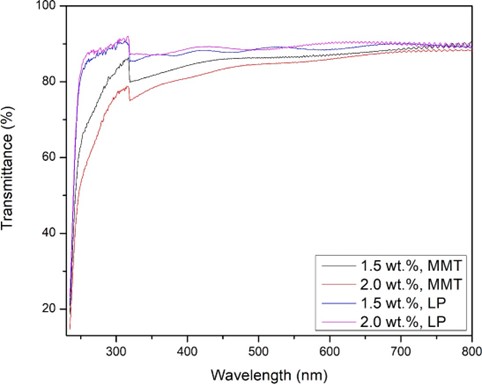
- In addition to MMT nanosheets that were employed during our preliminary investigation and exhibited outstanding performance, we plan to investigate another promising nanosheet, laponite (LP). Like MMT, LP can be exfoliated into single layer nanosheets spontaneously in water. However, while MMT exhibits a slight light green/yellow color, LP is truly colorless, and can thus be an ideal candidate for applications requiring both high barrier properties and high transparency.
2. Selection of Polymer Binder:
- In our preliminary investigation, degradable PVA was selected as the binder for MMT nanosheets due to its excellent film formability. We aim to focus on both coating formability and barrier function for this project. As such, chitosan, a naturally occurring polymer, will be selected as an alternative. Chitosan has a high affinity for negatively charged nanosheets (i.e., MMT and LP) due to the amine groups present. It is also degradable and non-toxic, and its excellent performance with other polymer composites suggests that it could exhibit similar properties when used in our coassembled nanocoatings with inorganic nanosheets.
3. Selection of Active Components
- Iron-based oxygen scavenging systems, usually found in oxygen-permeable sachets inside packaging, are among the most common in the food packaging industry. It has been reported that iron nanoparticles (FeNP's) can be dispersed in PVA aqueous solution; therefore, in this research, FeNP's will be suspended in nanocoating dispersions at different concentrations. The mixture will then be applied to form an active protection layer and its oxygen scavenging property will be investigated, thus identifying the best loading. A promising natural scavenger system utilizes the oxidation of ascorbic acid, a vitamer of vitamin C. Ascorbic acid is soluble in water, so it can be incorporated into the nanocoating dispersions, and similarly applied as one of the layers inside the packaging system.
- Control of the moisture inside the packaging is also crucial to preventing food spoilage. A common moisture control method is to introduce desiccants, such as silica gels, clays, etc. Thus, silica nanoparticles will be incorporated into the interlayer galleries to create a silica/MMT layered hybrid; various ratios of silica/MMT will be mixed with PVA and applied as a moisture scavenger layer in the packaging material.
4. Selection of Crosslinking Agent
- The interfacial bonding between the nanosheets and the binder is critical because they affect the properties of the resulting nanocoatings. We aim to achieve three types of crosslinking: (1) between polymer chains; (2) co-crosslinking between MMT nanosheets and polymer chains; (3) co-crosslinking between nanocoating and substrate to avoid delamination and preserve material integrity. Considering MMT, PVA, and most polymer substrates contain hydroxyl groups, citric acid (CA) and trisodium trimetaphosphate (TSMP) can be great candidates.
Progress Summary:
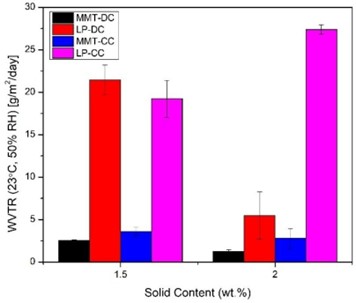
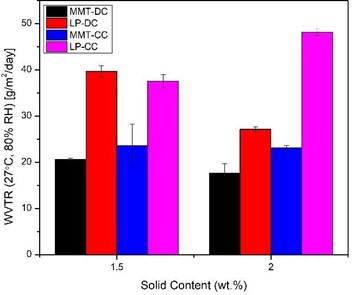
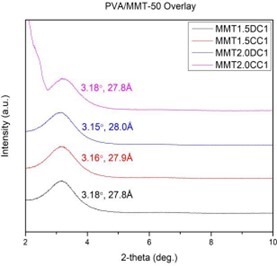
The following preliminary results have been collected for Milestone 1. Overall, MMT is emerging as the higher-performing nanosheet compared to LP when used in the nanocoating formulation. Wherever noted, DC and CC refers to dip-coating and continuous-coating deposition methods, respectively.
1. Oxygen Transmission Rate (OTR) and O2 Permeability:
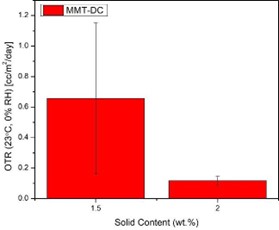
| Table: Permeability results for Milestone 1 samples that have been tested for OTR so far. | ||||||||
| Coating Name | Thickness (nm) | OTR testing [cm3/m2 day atm] | OTR * thickness cm3cm/m2 day atm | Normalized O2 Permeability of coating [10-16cm3(STP)cm/cm2 s Pa] | O2 Permeability of total (substrate + coating) [10-16cm3(STP)cm/cm2 s Pa] | O2 Permeability of coating [10-16cm3(STP)cm/cm2 s Pa] | O2 Permeability of coating [cm3mm/m2 day atm] | Oxygen Permeability BIF |
| PLA (substrate) | 25400 | 899.75 | 2.28537 | 261.05148 | 261.050 | 261.05000 | 22.86216 | 1.0 |
| M1-P12-151-A (DC) | 192.1 | 0.6575 | 0.00001 | 0.00114 | 0.190 | 0.00143 | 0.00013 | 1373.9 |
| M1-P12-151-B (DC) | 211.3 | 0.11715 | 0.00000 | 0.00000 | 0.030 | 0.00025 | 0.00002 | 8701.7 |
2. Water Vapor Transmission Rate (WVTR):
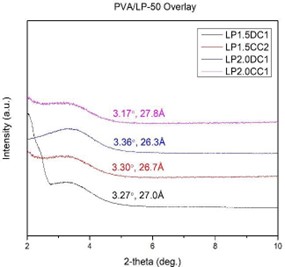
3. X-Ray Diffraction (XRD):
4. UV-Vis Spectrometry (UV-Vis):
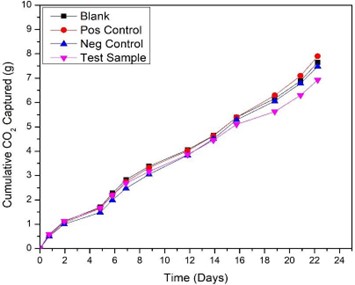
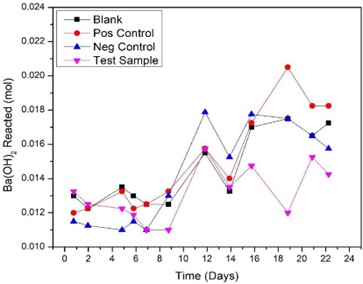
5. Aerobic Biodegradation Capability (Milestone 1, 2.0 wt.% solids PVA/LP-50 sample only):
Future Activities:
Completion of Milestones 2-4, including the following characterizations for each:
1. Barrier properties: oxygen transmission rate (OTR), water vapor transmission rate (WVTR)
2. X-Ray Diffraction (XRD)
3. Transmission Electron Microscopy (TEM)
4. Scanning Electron Microscopy (SEM)
5. UV-Vis Spectrometry (UV-Vis)
6. Thermogravimetric Analysis (TGA)
7. Total Antioxidant Activity (ABTS radical scavenging assay; Milestone 3 only)
8. Aerobic Biodegradation Capability
9. Plant Germination (Phytotoxicity)
Supplemental Keywords:
Environmentally-friendly, green chemistry, nanotechnology, system design, global considerationsProgress and Final Reports:
Original AbstractThe perspectives, information and conclusions conveyed in research project abstracts, progress reports, final reports, journal abstracts and journal publications convey the viewpoints of the principal investigator and may not represent the views and policies of ORD and EPA. Conclusions drawn by the principal investigators have not been reviewed by the Agency.