


Grantee Research Project Results
2023 Progress Report: Innovative approach to assess the effect of metal mixtures from infant meconium associated with adverse infant outcomes by identifying methylation loci in mothers and infants
EPA Grant Number: R840454Title: Innovative approach to assess the effect of metal mixtures from infant meconium associated with adverse infant outcomes by identifying methylation loci in mothers and infants
Investigators: Pavilonis, Brian , McDermott, Suzanne , Kavouras, Ilias , Cai, Bo , Cai, Guoshuai , Shin, Jin , Maroko, Andrew
Institution: Research Foundation of CUNY , Medgar Evers College , University of South Carolina at Columbia
EPA Project Officer: Aja, Hayley
Project Period: October 1, 2022 through May 12, 2025
Project Period Covered by this Report: October 1, 2022 through September 30,2023
Project Amount: $746,154
RFA: Development of Innovative Approaches to Assess the Toxicity of Chemical Mixtures Request for Applications (RFA) (2022) RFA Text | Recipients Lists
Research Category: Children's Health , Health Effects , Genetics/Susceptibility/Metabolics , Urban Air Toxics , Endocrine Disruptors , Heavy Metal Contamination of Soil/Water , Human Health , Safer Chemicals , Mixtures , Chemical Safety for Sustainability , CSS
Objective:
This research is designed to establish a platform to quantify intrauterine exposure to metal mixtures and determine their effect on epigenetic loci changes in newborns. This is of great importance since the standards for metal mixture exposure thresholds in pregnancy are not established. We will achieve this goal by 1) developing a standardized methodology for assessing intrauterine exposure using meconium as a biomarker and quantify metal mixtures among an urban population and 2) explore and quantify the effect of metal mixture exposure on methylated genes for three adverse birth outcomes: small for gestational age (SGA), intellectual disability (ID), and autism spectrum disorders (ASD).
Progress Summary:
We have quantified metal concentrations in 151 meconium samples and expect to analyze an additional 200 samples in quarter 1 of 2024. Below in Table 1, we summarize results from 5 of 10 toxic metals measured in the study and show an excellent detection limit.
Table 1: Selected Metal Concentrations (ppm) in Meconium
| Metal | Mean | Std Dev | Minimum | Maximum |
| Cr | 0.1438 | 0.1778 | 0.0006 | 0.9985 |
| Ni | 0.4017 | 0.9666 | 0.0013 | 11.8948 |
| Mo | 0.2219 | 0.1665 | 0.0006 | 1.6477 |
| Cd | 0.0037 | 0.0027 | 0.0001 | 0.0193 |
| Pb | 0.0193 | 0.0215 | 0.0000 | 0.1825 |
Levels varied across the five different metals with mean concentrations of chromium (Cr), nickel (Ni), molybdenum (Mo) being 1 to 2 orders of magnitude larger than lead (Pb) and cadmium (Cd). Levels found in our EPA funded study were in line with a previous pilot study our investigative team conducted in 2021 of a similar cohort. We anticipate analyzing the entire 300 meconium samples by quarter 2 of 2024.
Figure 1: Maternal and Child DNA Methylation Patterns
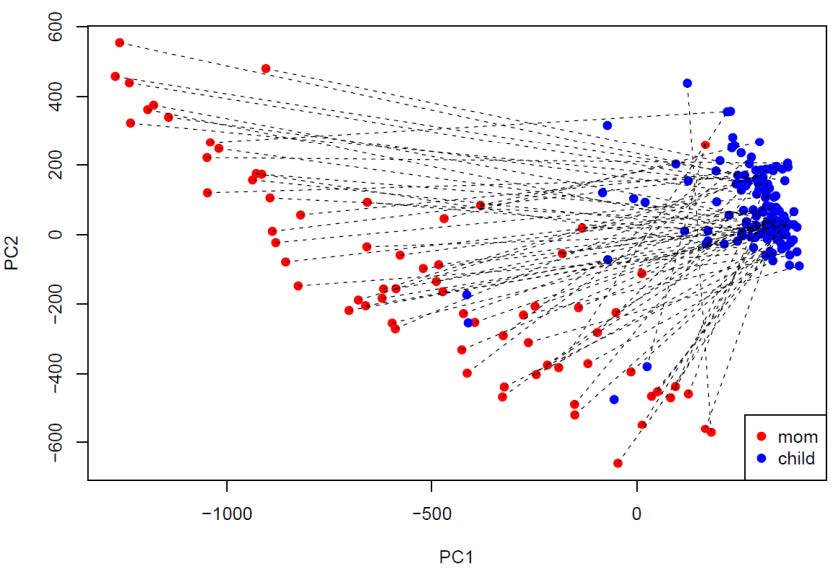
Results from the principal component analyses of genome wide methylation patterns show distinct differences between mother-child dyads (Figure 1). There is a substantial spread in the pattern with mothers’ methylation having much lower values on PC1 and higher on PC2, compared to the newborns which were tightly clustered close to the zero value for PC1 and PC2. Across all participants, mothers have substantially greater and more varied DNA methylation than their child, which we believe is likely due to age. Initial results also indicate we are collecting usable and distinctly different DNA samples from the mother-child pairs.
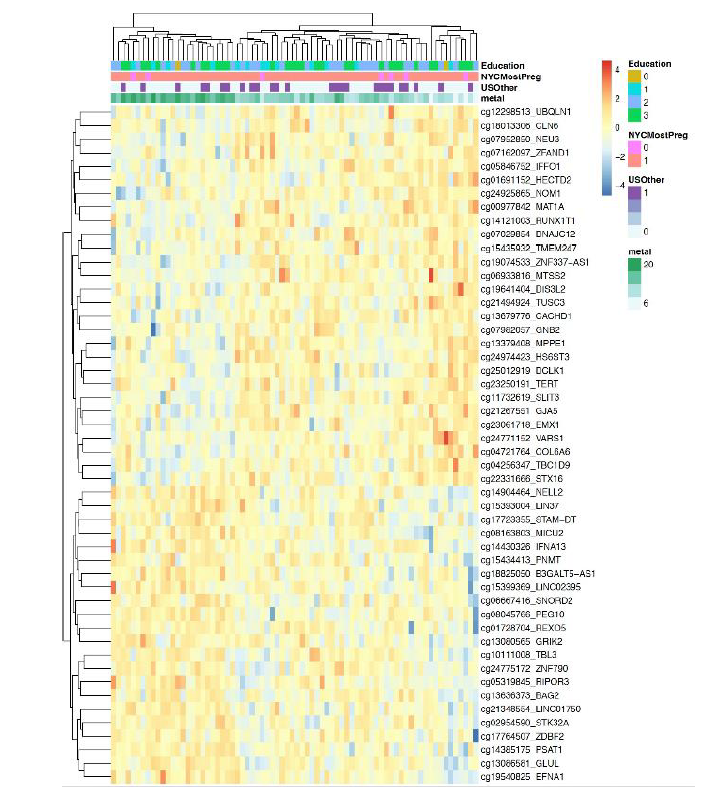
Figure 2: Correlation Between Selected Methylated Genes, Metals Concentrations, and Demographic Variables in Children
A simple additive index of five toxic metals was created to identify the correlation between selected methylated genes, demographic variables, and metals concentrations in children (Figure 2). The top of the figure shows the data were analyzed to detect patterns for education, whether the mother spent the majority of her pregnancy in NYC, whether the mother was US born, and finally by the metal concentration. This preliminary heatmap shows a different pattern of impacted genes based on metal concentrations. This is evident by observing the top part of the map where the blue areas on the left side of the map represent higher concentration of metals compared to the orange areas on the right side of the map with the lower concentrations for the metals. The pattern changes on the lower area of the heatmap. As the project progresses, we intend to use more advanced statistical techniques, including Bayesian kernel machine regression (BKMR) modelling, to investigate the effect of maternal metal mixture exposure on DNA methylation. The heatmap above shows the top 50 differentially methylated loci in the newborn population. As more data becomes available, we will focus on the three outcomes of interest (ID, ASD, SGA) and have begun to search various genetic databases to identify relevant gene loci.
Future Activities:
Since we have completed more than 90% of data collection, we will focus our interest focus on data analysis in year 2 of the project. Our team’s biostatistician (B. Cai) and bioinformatics (G. Cai) leads are currently analyzing our preliminary data to determine the best methodology for carrying out the DNA methylation and metals mixture analysis.
Supplemental Keywords:
Meconium, metal mixture, epigenetics, small for gestational age, intellectual disability, autism, urban pollution, fetal exposure, New York City, EPA Region 2Progress and Final Reports:
Original AbstractThe perspectives, information and conclusions conveyed in research project abstracts, progress reports, final reports, journal abstracts and journal publications convey the viewpoints of the principal investigator and may not represent the views and policies of ORD and EPA. Conclusions drawn by the principal investigators have not been reviewed by the Agency.