


Grantee Research Project Results
Final Report: Plasma-Enhancement of Absorbers for Improved Removal of PFOS and PFOA from Water
EPA Contract Number: 68HERC20C0009Title: Plasma-Enhancement of Absorbers for Improved Removal of PFOS and PFOA from Water
Investigators: Bailey, Charles
Small Business: AAPlasma, LLC
EPA Contact: Richards, April
Phase: II
Project Period: November 1, 2019 through October 31, 2021 (Extended to October 31, 2022)
RFA: Small Business Innovation Research (SBIR) - Phase II (2019) Recipients Lists
Research Category: SBIR - Drinking Water Treatment and Monitoring , Small Business Innovation Research (SBIR)
Description:
This research project performed by AAPlasma, LLC was created in response to the emergent fluorocarbon contaminants, specifically perfluorooctanoic acid (PFOA) and perfluorooctanesulfonic acid (PFOS), and the aim to remove these chemicals from drinking water. The currently available methods to remove these contaminants are either cost intensive, or ineffective at destroying PFOS/PFOA. Granular Activated Carbon (GAC) can remove over 99% of PFOA/PFOS from water and is relatively inexpensive. Once saturated, with contaminants however, GAC is either disposed of improperly (landfill leachate contains high concentrations of chemical contaminants where PFOS/PFOA can reenter the environment), incinerated or thermally regenerated (both of which are highly energy inefficient and therefore expensive).
Our Phase I efforts culminated in favorable results for all three objectives with (1) plasma-regenerated GAC removing PFOS/PFOA from water as well or better than unsaturated (virgin) GAC, (2) successful amination of GAC and its improved contaminant removal from water, and (3) favorable operation cost estimates when compared to existing and emerging water filtration technologies. These results support the ability for plasma-regenerated GAC to offer an effective technology for removal of PFOS and PFOA with possible longer-term re-use.
Summary/Accomplishments (Outputs/Outcomes):
Dielectric barrier discharges using air as the gas medium yielded the most effective GAC desorption results out of all other studied carrier gasses (shown in Figure 2 of the Final Report). These results suggest that NO is the main chemical reagent produced in plasma that reacts with the hydroxyl groups contained in perfluoro-carbons (PFCs). If this is the case, then O2 and CO2 are not involved with the reaction between plasma and PFCs.
Conclusions:
Phase II of this project furthered the development of plasma-reactivated GAC with the creation of 2 prototypes and the creation of a spin-off company, focused on the commercialization, production, and sales of these systems.
| Table 1. Phase II Project Schedule
| |||||||||||||||||||||||||||||||||||||||||||||||||||||||||||||||||||||||||||||||||||||||||||||||||||
By the conclusion of Phase II of this SBIR project, AAPlasma was able to achieve the following milestones:
1. Completed development and construction of a conveyor-driven GAC reactivation system (research system available for purchase on the website)
2. Completed the design and construction of 10 commercial power supplies (these power supplies are available on the website)
3. Created a commercial-facing company that plans to take over future efforts (continuing discussions with Mr. Thomas Giroux)
By the conclusion of this Phase II SBIR project, AAPlasma scaled up our production capabilities to manufacture 10 initial robust power supply systems, based on the model which currently drives our Conveyor-driven GAC Treatment Plasma System. These Design for Manufacture Power Supply Systems will be used both internally at AAPlasma to drive a variety of plasma systems and, separately, sold within our product line available on our company's website at aaplasma.com. As detailed in Figure 17 of the Final Report, we have successfully repeated the manufacturing process to create 10 of these power supply systems with laser-engraved labels and internal components.
In addition to the batch GAC reactivation prototype, AAPlasma developed a prototype capable of continuous GAC treatment via flat electrodes and conveyor-fed process utilizing a conductive copper conveyor belt as the ground electrode and a DBD roller as the high-voltage electrode. The system has variable speed, direction, and plasma parameters driven by the purple power supply shown next to the conveyor system in Figure 1. This system development aimed to evolve our technology away from batch-treatment of GAC to a continuous flow-through treatment that is more relevant to industry operations.
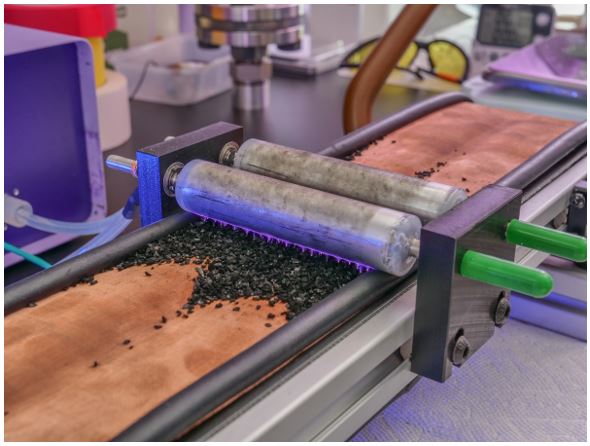
Figure 1. Plasma GAC Regeneration Conveyor System Prototype treating sample GAC
AAPlasma's spin-off startup company, PFC-X, will directly focus on removal of PFAS and other emerging contaminants from water, air, and soils. PFC-X (Perfluoural compound extermination) aims to regenerate adsorbents, destroys contaminants (not just removing them), and use less energy than existing approaches. The conveyor-driven prototype shown in Figures 3 and 4 ARE undergoing licensing agreements to PFC-X, who will then go on to manufacture, sell, and distribute these systems.
Figure 2 shows the relationship between AAPlasma and PFC-X. Within this structure, PFC-X will exclusively license technologies from AAPlasma for PFAS destruction while providing technology improvement IP to AAPlasma in return. In addition, and once profitable, a percentage of sales revenue will be paid to AAPlasma, per the licensing agreement.
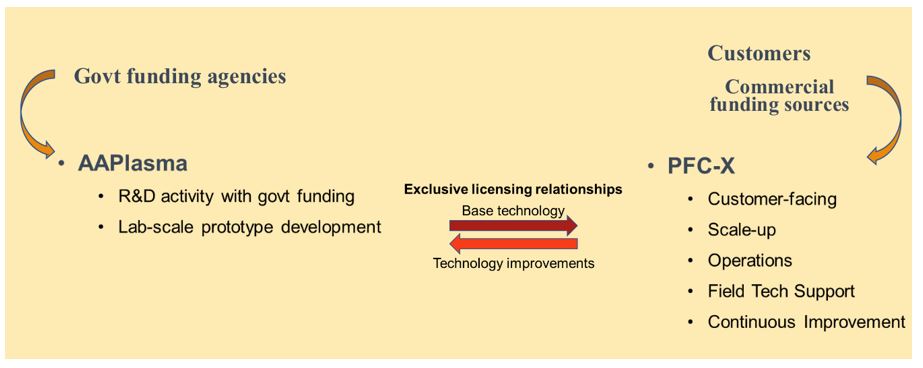
Figure 2. PFC-X relationship structure with AAPlasma, LLC
PFC-X has four "thrusts", as shown in Figure 2. With one of our promising connection, Mr. Thomas Giroux, we have formulated a business strategy to sell service to small water consumers (breweries, Ag growers, etc) who use GAC. Mr. Giroux has also shown interest in becoming the CEO for PFC-X.
Table 2. Applications and PFC-X Advantage
| Application | Customer Characteristic | Unique Challenge | PFC-X Advantage |
|---|---|---|---|
| PFAS Destruction | Early market development Sexy mission-driven target | Dedicated line- MOC, corrosion, F-emission handling | Low energy destruction as unique offering |
| GAC Oil/Gas Air | Huge existing market with profitable customers | Shared line- emission handling | Lower cost Small volume orders |
| GAC Wastewater | Huge existing market with moderately profitable customers | Shared line- emission handling | Lower cost Small volume orders |
| GAC Food | Huge existing market with modestly profitable customers | Dedicated line- food safety | Lower cost Small volume orders |
SBIR Phase I:
Plasma-Enhancement of Absorbers for Improved Removal of PFOS and PFOA from Water | Final ReportThe perspectives, information and conclusions conveyed in research project abstracts, progress reports, final reports, journal abstracts and journal publications convey the viewpoints of the principal investigator and may not represent the views and policies of ORD and EPA. Conclusions drawn by the principal investigators have not been reviewed by the Agency.