


Grantee Research Project Results
Final Report: Portable Desalination Using Ocean and Solar Energy
EPA Grant Number: SU839910Title: Portable Desalination Using Ocean and Solar Energy
Investigators: Zuo, Lei , Mi, Jia , Capper, Joseph , Chen, Shuo , Jones, Erin , Lane, Jimmy , Vencill, Ethan , O'Donnel, Dana
Institution: Virginia Tech
EPA Project Officer: Page, Angela
Phase: I
Project Period: October 1, 2019 through September 30, 2020 (Extended to August 31, 2021)
Project Amount: $25,000
RFA: P3 Awards: A National Student Design Competition Focusing on People, Prosperity and the Planet (2019) RFA Text | Recipients Lists
Research Category: P3 Awards , P3 Challenge Area - Safe and Sustainable Water Resources
Objective:
The purpose of project is to develop a portable desalination system using marine renewable energy, shown in Figure. 1. The
proposed consists of two modules: wave energy converter module and RO desalination module. In order to fit the portable design
concept, a two-body selfreactive point-absorber wave energy converter will be developed to capture the waveenergy and drive the high- pressure pump. There is one floating buoy and one submerged heave plate which can achieve self-reactive between the two bodies. A RO module will be adapted with an accumulator to stabilize the system pressure under fluctuated wave conditions. The proposed system can fill a market void of portable desalination system, which can be used for isolated coastal or salt-lake communities and also disaster relieve scenarios. In phase I of this project, different renewable energy resources have been evaluated to determine the best energy source for powering the desalination system. A prototype of self-reactive two-body point absorber wave energy converter has been built and tested in the wave tank. A reverse osmosis (RO) desalination system has been demonstrated driven by a double-acting high-pressure piston pump.
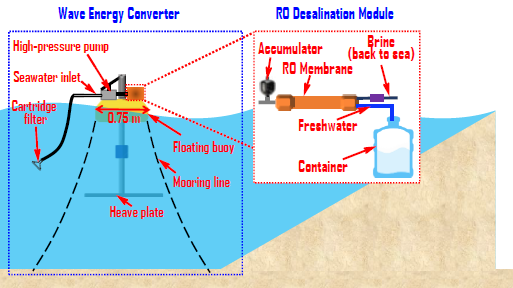
Figure 1. Portable desalination using ocean wave energy
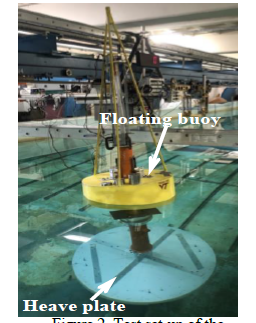
Figure 2. Test set-up of the
wave energy converter
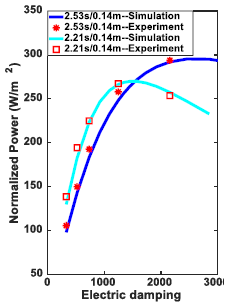
Figure 3. Performance under different conditions
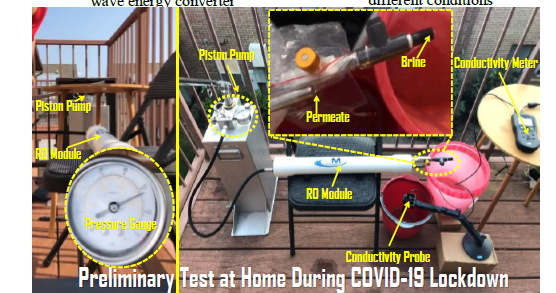
Figure 4. Preliminary test of the RO system
Summary/Accomplishments (Outputs/Outcomes):
During the Phase I of this project, a portable desalination system driven by ocean waves has been proposed and evaluated. A two-body self-reactive point-absorber wave energy converter has been fabricated, tested and characterized, as shown in Figure 2 and Figure 3. A RO desalination system driven by high-pressure piston pump has been demonstrated and tested with off-the-shelf components, as shown in Figure 4. The system pressure can reach to about 50 bar and the concentration of the produced freshwater is lower than 500 mg/L. It should be noted that, only preliminary test driven by hand at home was tested because of pandemic lockdown. The preliminary test results show the proposed RO desalination system driven by high-pressure piston pump without electricity could be realized in the real condition. All the components used in the preliminary test are commercially available off-the-shelf components, which is good for future commercialization and mass production. Summary of the Phase I includes:
1). Considering the energy efficiency and small-scale operation, RO is the best desalination technology;
2). Regarding the energy density, ocean wave energy (1-40kW/m) is much larger than solar energy (0.1-1kW/ m2) which is much more applicable to realize the initial portable desalination system concept;
3). A portable two-body self-reactive point-absorber wave energy converter (diameter 0.75m) has been fabricated, tested and characterized in the wave tank;
4). A RO desalination system driven by a double-acting high-pressure piston pump has been demonstrated and tested with off-the-shelf components.
Journal Articles:
No journal articles submitted with this report: View all 3 publications for this projectSupplemental Keywords:
Renewable energy, portable desalination, point-absorber, reverse osmosis, energy-water nexusProgress and Final Reports:
Original AbstractThe perspectives, information and conclusions conveyed in research project abstracts, progress reports, final reports, journal abstracts and journal publications convey the viewpoints of the principal investigator and may not represent the views and policies of ORD and EPA. Conclusions drawn by the principal investigators have not been reviewed by the Agency.