


Grantee Research Project Results
Final Report: Beneficial reuse of PCBs (poly-chlorinated biphenyls) as new materials through a low cost process
EPA Grant Number: SV839354Title: Beneficial reuse of PCBs (poly-chlorinated biphenyls) as new materials through a low cost process
Investigators: Lu, Mingming
Institution: University of Cincinnati
EPA Project Officer: Page, Angela
Phase: II
Project Period: March 1, 2018 through February 29, 2020 (Extended to February 28, 2021)
Project Amount: $74,958
RFA: P3 Awards: A National Student Design Competition for Sustainability Focusing on People, Prosperity and the Planet - Phase 2 (2017) Recipients Lists
Research Category: P3 Awards , P3 Challenge Area - Chemical Safety , Sustainable and Healthy Communities
Objective:
Polychlorinated biphenyls (PCBs) are persistent organic pollutants (POPs) due to their high toxicity and bioaccumulation in humans, animals, and the ecosystem. Although the production of PCBs has been prohibited in many regions around the world, PCBs can still be found in air, water, solid waste and sediments, etc. Affordable and effective cleanup technologies are still in high demand as existing treatments are rather costly. Dechlorination under mild conditions can potentially lower remediation cost. The goal of this project is to study the effectiveness of catalytic hydrode-coloration (HDC) at low temperatures (room temperature, 50C and approximately 80C) and atmospheric pressure under hydrogen environment. More complex PCB compounds were selected and experimentally studied based on Phase I results on 3 chlorobinpenyl and 2,3, dichlorobiphenyl. Pure compounds of 2,4,4’trichlorobiphenyl (PCB- 28 based on the congener list), PCB-44 (2,2’,3 5’ tetrachlorobiphenyl), PCB-52 (2,2’,5 5’ tetrachlorobiphenyl) and 2-chlorobiphenyl (PCB-1) were studied and also Aroclor 1232, a mixture. The catalyst responsible for dechlorination is palladium on carbon (Pd/C). Triethylamine (Et3N) is used to as an electron donor to enhance the reaction. The carrier gas is hydrogen in nitrogen. PCB-28 and PCB-52 are as among the six indicator congeners by the World Health Organization (WHO). Since PCB-1 is a major by product for PCB-28 dechlorination and also an ortho-PCB found in many natural systems, we studied also its HDC reactions to better understand the HDC of ortho PCBs. Studies on Aroclor 1232 has been very limited unlike some other aroclors, and its reported composition is close to the individual PCB compounds already studied in this project.
Summary/Accomplishments (Outputs/Outcomes):
We run HDC reactions with this compound under room temperature (20-22.5 °C), 50°C and 77°C conditions We further investigated the role of Et3N (triethylamine) on HDC reactions by varying its loads. At room temperature, it takes 6 hours for the HDC of 2-chlorobiphenyl and 2,4,4’-trichlorobiphenyl to reach nearly 100%, while the time is shortened when temperature increases to 50℃ and 76℃ (Fig. 1). The same impact of temperature is observed forall PCB compounds tested. all PCB compounds tested.
At Et3N to chlorine ratio of 1:1 , the 1 hour dechlorination rates of 2-chlorobiphenyl are 51%±3.5% and 84.8%±2.8%, and 76.5%±6.1% respectively, at room temperature (22.5℃), 50℃ and 76℃. When the Et3N to chlorine ratio increased to 3:1, the same 1hr dechlorination rates of 2-chlorobiphenyl are 63%±14.8%, 87%±7.2% and 99%±0.7% from room temperature to 76℃. Similar impacts of increasing Et3N to chlorine ratio has also been observed for PCB-28 and Aroclor 1232. Based on experimental results, reaction pathways of PCB-28 are proposed as shown in Figure 2.
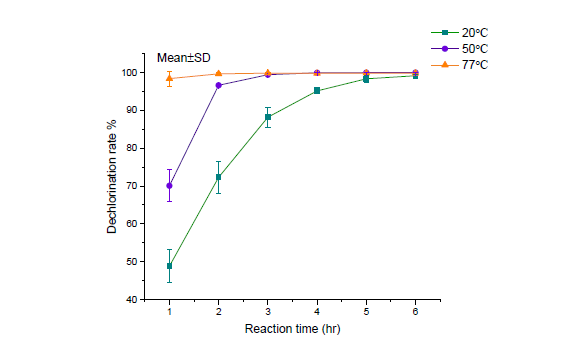
Figure 1. Effect of temperature control on the dechlorination of PCB28 (Et3N/Cl in PCB = 4:1 by mole)
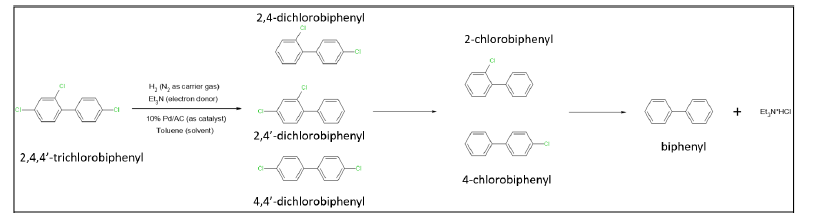
Figure 2. Dechlorination pathway of 2,4,4'-trichlorobiphenyl
We carefully studied the instrumentation results to find reaction by products for the time series. As an example, the GC-MS composition of Aroclor 1232 is shown in Figure 3.
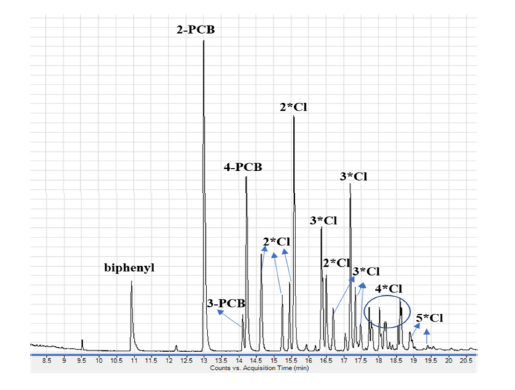
Figure 3. GC spectrum of Aroclor 1232 before HDC reaction at room temperature (22℃)
The study indicated that both reaction temperature and Et3N loading can significantly affect the yield of the HDC reaction. With temperature increase, the dechlorination rate increased for all the PCBs tested. This research can be one of the just in time solutions of the PCB problem, since the Stockholm Convention of Persistent Organic Pollutants (POPs) recommended concerted efforts toward “environmentally sound PCB management by 2028” among its member nations, and ceasing the use of PCBs by 2025.
Conclusions:
Output: Project outputs include detailed documentation on how to run the reaction and perform data analysis. Annual progress reports/summaries, conference presentations and journal publications, and Master’ thesis have all been generated. These documents will be useful in results dissemination and outreach.
Outcome: The catalytic hydro-dechlorination technology has been tested successful with PCB congeners containing 1, 2, 3 and 4 chlorines at various positions, and a mixture. The mild temperatures and atmospheric reaction conditions can potentially lower the cost of PCB treatment. It can potentially be more affordable for PCB treatment to the end users around the world. Another significant outcome lies in student training through research participation and other courses using this research as an example. The PI actively recruited students for this project through various UC programs. A total of 9 students, 2 graduate and 7 undergraduate, have worked on this project, out of which 6 are female and 2 are minority. The team developed a training kit to quickly get new students started, which include the Phase II proposal, Phase I poster, how-to documents developed in this project, and select papers and documents.This research experience has been presented in “EnvE 7005, Environmental Engineering Safety Seminar” taken by graduate students in Chemical and Environmental Engineering. It has been used as student term projects for “ENVE 6022C, Atmospheric Chemistry and Monitoring”,
“ENVE 6071C, Aerosol Science Engineering and Control”, taken by graduate students and undergraduate students in advanced standing.
Journal Articles:
No journal articles submitted with this report: View all 4 publications for this projectProgress and Final Reports:
Original AbstractP3 Phase I:
Beneficial Reuse of PCBs | 2017 Progress Report | Final ReportThe perspectives, information and conclusions conveyed in research project abstracts, progress reports, final reports, journal abstracts and journal publications convey the viewpoints of the principal investigator and may not represent the views and policies of ORD and EPA. Conclusions drawn by the principal investigators have not been reviewed by the Agency.