


Grantee Research Project Results
2018 Progress Report: Climate & Community Friendly Wastewater Treatment
EPA Grant Number: SU839268Title: Climate & Community Friendly Wastewater Treatment
Investigators: Weber-Shirk, Monroe
Institution: Cornell University
EPA Project Officer: Page, Angela
Phase: I
Project Period: January 1, 2018 through December 31, 2018 (Extended to December 31, 2019)
Project Period Covered by this Report: January 1, 2018 through December 31,2018
Project Amount: $15,000
RFA: P3 Awards: A National Student Design Competition for Sustainability Focusing on People, Prosperity and the Planet (2017) RFA Text | Recipients Lists
Research Category: P3 Awards , P3 Challenge Area - Safe and Sustainable Water Resources , Sustainable and Healthy Communities
Objective:
AguaClara Cornell researched a variety of bioreactor types and selected the Upflow Anaerobic Sludge Blanket (UASB) bioreactor as the most promising core technology for a distributed wastewater treatment system for small communities. The UASB was chosen because of its: (1) efficiency for organics removal, (2) low cost, (3) simplicity of design, and (4) the fact that there is a value added product (biogas for cooking, lighting, heating) that could motivate adoption of the technology. UASB reactors treat wastewater biologically, using anaerobic bacteria to break down organic matter and converting the majority of it to biogas. Methane comprises 60-70% of the resulting biogas content, and can be used as fuel for heating, lighting, or cooking. However, getting UASB designs to work robustly without electricity and at very small scales (a few households to dozens of households) is a challenge not yet well addressed by existing designs. Though large scale UASB systems, such as those installed in Brazil and India, often include pumping and electronic controls, they can be designed as gravity powered systems which are much more attractive to small communities with unreliable electricity access. In Phase I of this EPA P3 project the team designed a distributed scale (UASB) reactor capable of handling ~14 people’s worth of mixed wastewater a day and would provide up to 110 L of biogas daily.
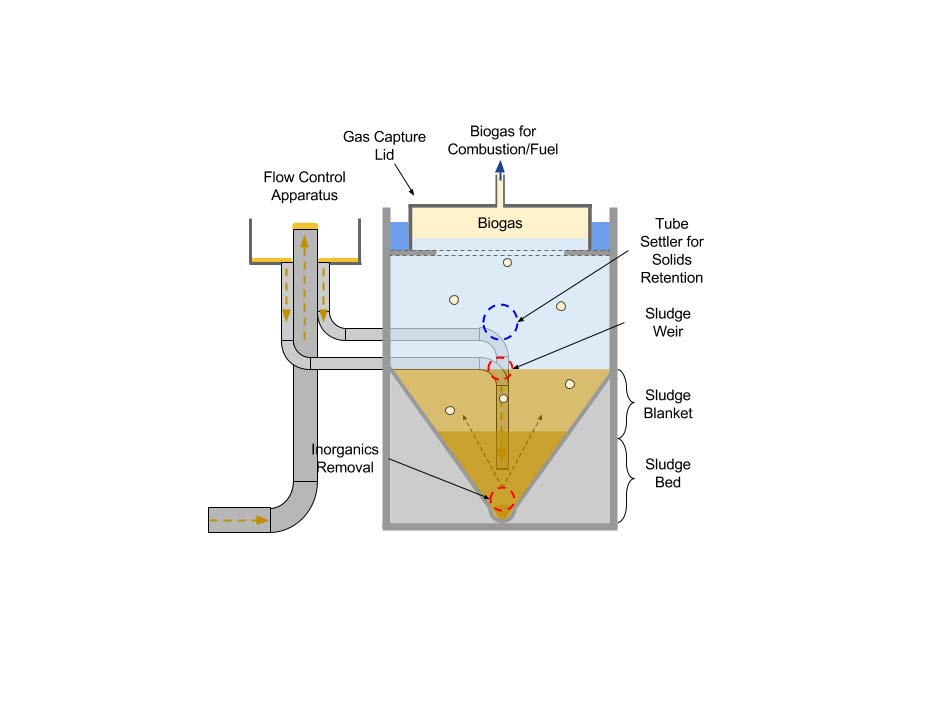
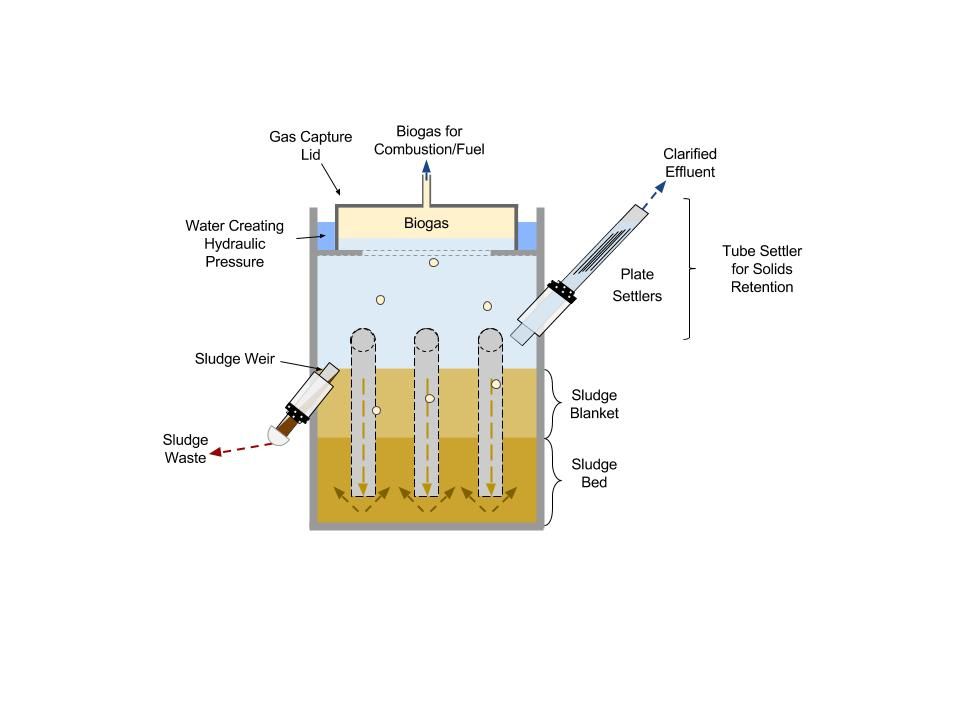
Figure 1: Schematics of the small scale, distributed UASB 1.0 design (left: side view; right: front view). The design has a residence time of 4 hours and a reactor size of 1400 L.
Progress Summary:
Phase I work resulted in a design for a UASB reactor (Figure 1) that treats 14 persons-worth of domestic mixed wastewater (or ~50 persons worth of separated blackwater from toilets). Our final design, which does not require electricity to operate, incorporates innovations for:
- Wastewater dosing that can handle variable flows such as those in small systems
- Biogas capture and storage
- Removal of granular UASB sludge buildup within the reactor
- Enhanced solids capture from the effluent
- (Possible with Phase II funding) Floatables removal (Fats, Oils, Greases)
- Simplified fabrication
In addition to designing a specific UASB, the team has created a Python-based online UASB Design Tool, which is available through GitHub (https://github.com/AguaClara/UASB). Conclusions: An open source UASB Design Tool (https://github.com/AguaClara/UASB) and a modular, pilot scale UASB reactor was designed and is being constructed. To operate the UASB without electricity-reliance, our team has devised several innovations including a gravity powered wastewater dosing system. We will be collecting data on pollutant removal efficiency (suspended solids, organic carbon, nitrogen/phosphorus, fecal bacteria), biogas production, and overall reactor startup and stability. Testing of this design will allow future informed decisions on system components, including post-treatment options for the UASB effluent.
Future Activities:
Proposed Phase II Objectives and Strategies: Phase II work will include construction and pilot testing of two UASB reactors with alternate intermittent influent feed system and methods to remove fats, oils and greases that accumulate at the biogas-water interface. We will monitor performance of both UASB designs and compare the two influent intermittent systems for robustness. We will characterize the treated wastewater for solids, nutrients, and pathogens which will help inform choices for the best post treatment technologies, eg. trickling filters, constructed wetlands, algal ponds. Reactors will be tested for 6-9 months in Ithaca. After the design and testing work is completed the selected UASB system will be sent to Honduras for testing in the field. In partnership with Agua Para el Pueblo (APP), a non-governmental organization working in Honduras on water and sanitation, and AguaClara Reach, a not-for-profit working towards globalization of AguaClara Cornell technologies, these systems will be implemented in small communities in Honduras for field testing. Data collected will provide crucial insight into how these systems work in community settings, and will inform final design decisions before implementation of these reactors in communities on a larger scale.
Journal Articles:
No journal articles submitted with this report: View all 3 publications for this projectSupplemental Keywords:
Wastewater, Anaerobic Digestion, Biogas, Upflow Anaerobic Sludge, Blanket (UASB)Relevant Websites:
Progress and Final Reports:
Original AbstractP3 Phase II:
Environment and Community-Friendly Wastewater Treatment | 2019 Progress Report | 2020 Progress Report | 2021 Progress Report | Final ReportThe perspectives, information and conclusions conveyed in research project abstracts, progress reports, final reports, journal abstracts and journal publications convey the viewpoints of the principal investigator and may not represent the views and policies of ORD and EPA. Conclusions drawn by the principal investigators have not been reviewed by the Agency.