


Grantee Research Project Results
Final Report: Low-cost Household Biochar Water Filter for Lead Removal
EPA Grant Number: SU839266Title: Low-cost Household Biochar Water Filter for Lead Removal
Investigators: Kumar, Sandeep , Kumkum, Pushpita , Wilson, Kaija , Hillman, Jarius , Lee, Marcus , Fulcher, Jason , Auza, Marilyn , Drew, Benjamin , Sawyer, Catherine , Rajan, John C
Institution: Old Dominion University
EPA Project Officer: Page, Angela
Phase: I
Project Period: January 1, 2018 through December 31, 2018
Project Amount: $14,999
RFA: P3 Awards: A National Student Design Competition for Sustainability Focusing on People, Prosperity and the Planet (2017) RFA Text | Recipients Lists
Research Category: P3 Awards , P3 Challenge Area - Safe and Sustainable Water Resources , Sustainable and Healthy Communities
Objective:
With a view to combating the prevailed issue of lead contamination in drinking water, the introduction of an inexpensive, easy-to-use filter is an utmost necessity. The following sections discusses the proposed goals of EPA/P3 phase I award and the progress made in last four months towards achieving these goals:
Goal 1: Theoretical investigation for biochar’s breakthrough point calculation, filter materials selection, and efficiency evaluation
Goal 2: Building a prototype filter
Goal 3: Demonstration the efficiency of the prototype in removing lead
Summary/Accomplishments (Outputs/Outcomes):
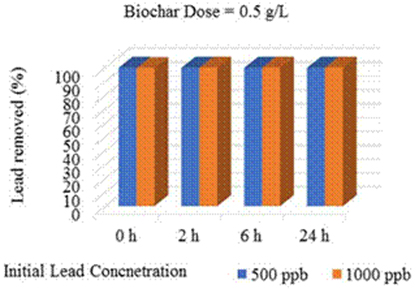
Results of Goal 1: Batch adsorption studies were conducted using biochar as an adsorbent material. Two reactors with varying lead concentration i.e., 0.5 ppm (500 ppb) and 1 ppm (1000 ppb) were treated with 0.5 g/L of biochar in water at natural condition (pH ~ 7). Samples were collected at 0h (start), 2h, 6h and 24h and analyzed using ICP-MS (model Agilent 720). The kinetic experiments (Figure 1) indicated almost 99% of initial Pb adsorption within first few minutes (0h) and no trace level of lead was found even after 24 h. This demonstrates that lead adsorption to biochar was a rapid phenomenon and there was no desorption of lead even after 24 h. Low pressure column testing has been conducted by setting up a column as control packed with only sand media and two other columns as duplicates packed with biochar sandwiched with sand media. Lead solution of 0.5 ppm was passed through the filters. The optimization of experimental condition of column study is still in progress.
A small scale biochar unit was designed and constructed using the household materials. Backyard twigs were used as a feedstock and were produced using the biochar-maker under slow pyrolysis conditions. Five gallon bag of commercially produced biochar was procured through Amazon.com sold by New Hampshire Biochar-Charcola group. This stock of biochar was used to conduct adsorption experiments with the same material under different adsorption conditions. The lead removing potential of the commercial biochar is still in progress.
Figure 1. Kinetics of Pb Adsorption in a Batch Study.
Results of Goal 2: The team has proposed a preliminary design of the prototype filter. The aim is to assemble a protoype filter using easily available household materials and keep the cost of making a filter as minimum possible. As a preliminary data, plastic cups or similar materials are being used to build a prototype. To help the flow of water disspated over the surface and to keep the inside material intact- a permeable medium or screen will be introduced. Cheese cloth/coffee filter paper etc. are some of the suggested solutions.
Results of Goal 3: After building the prototype, it will be tested to evaluate its efficiency in removing lead. Different kind of filter casing materials will be tested to select the best for the filter. Thorough investigation of the performance of the prototype will be continues to pinpoint the limitations and based upon the limiting factors the design will be revised and modified.
Conclusions:
The team has successfully built a prototype biochar maker using recyclable household items and demonstrated that biochar could be produced in small batches from waste biomass (yard waste) for removing lead contamination in drinking water. The data from batch adsorption studies has identified challenges of using biochar is its granulation such that it can be loaded in a filter and no fine biochar particles leach out in downstream flow. Different methods of biochar granulation is being studied by the team.
Proposed Phase II Objectives and Strategies: Following goals are being proposed for Phase II:
1. Determination of design parameters of the final product
2. Packing of biochar in the filter
4. Partnership development and entrepreneurship
Journal Articles:
No journal articles submitted with this report: View all 1 publications for this projectSupplemental Keywords:
neurotoxic, lead, biochar, drinking water treatment technologiesThe perspectives, information and conclusions conveyed in research project abstracts, progress reports, final reports, journal abstracts and journal publications convey the viewpoints of the principal investigator and may not represent the views and policies of ORD and EPA. Conclusions drawn by the principal investigators have not been reviewed by the Agency.