


Grantee Research Project Results
2015 Progress Report: Develop a Concentrated Solar Power-based Thermal Cooling System via Simulation and Experimental Studies
EPA Grant Number: SU835728Title: Develop a Concentrated Solar Power-based Thermal Cooling System via Simulation and Experimental Studies
Investigators: Tang, Yan , Compere, Marc , Boetcher, Sandra , Engblom, William , Rosenthal, Andrew , Faden, Shadi , Atticks, Kendra , Judson, Zachary , Goncalves, Bruna , Gulati, Rohit , Beckwith, Jenna
Institution: Embry - Riddle Aeronautical University
EPA Project Officer: Hahn, Intaek
Phase: II
Project Period: August 15, 2014 through August 14, 2016
Project Period Covered by this Report: August 15, 2014 through August 14,2015
Project Amount: $89,996
RFA: P3 Awards: A National Student Design Competition for Sustainability Focusing on People, Prosperity and the Planet - Phase 2 (2014) Recipients Lists
Research Category: P3 Challenge Area - Air Quality , Sustainable and Healthy Communities
Objective:
The EPA P3 project was to design and test a 300W solar cooling system using parabolic solar troughs. The system captures the sun�s heat with a line-focus, high-temperature parabolic trough collector. The concentrated solar power from the collector drives an absorption cooling cycle of a small refrigeration unit. The circulating collector-loop fluid stores the heat in a storage unit for use during periods solar applications are not practical such as poor weather and night-time. A simulation tool has been developed to mimic the time-dependent thermal and hydraulic performance of the parabolic trough based on classic empirical and analytical models. The simulation results are used to guide and support the selection of system components to meet design goals. The primary focus is solar thermal energy storage and heat exchanger design for the absorption cooling cycle.
With the further investigation, we have found that solar thermal cooling will not find much market value due to the cost and space requirement of the system. So we continued to investigate an alternative solution of solar cooling: using photovoltaic panels to power solar split air conditioning system which is commercially available. Our focus is to improve the efficiency of the photovoltaic panels because the efficiency will drop when the temperature increases. The team has found that the phase change material (PCM) could regulate and remove the heat from the solar panels, so the major design task has shifted to build a testing rig to validate and quantify the improvement of the solar panels with the PCM.
The preliminary nature of the investigation required a simplification of the experimental set-up. The experimental set-up was made to approximate a one-dimensional heat flow from the PV panel to the PCM. An aluminum plate was used to simulate a PV panel to simplify the construction of the experiment. Several experimental container construction variations have been tested. A successful experimental container has been built, and has had five successful tests run with it. The experimental container was made of an aluminum lid and high-density polyethylene (HDPE) body. The aluminum lid is simulating a PV panel and acting as a heat spreader for the constant flux heater. The HDPE body was made to accommodate one layer of the 18 mm PCM pellets currently in the lab. HDPE was used to deter heat transfer through the walls of the container to more accurately simulate 1-D heat flow.
The experimental container was instrumented with 20 Type E thermocouples (TC). Thermocouples 1 through 15 were used to measure the temperature of the aluminum lid (PV panel) and the PCM. Thermocouples 16 through 19 were used to measure the temperature of the HDPE body. Thermocouple 20 was used to measure ambient air temperature. Thermocouples 1 through 15 were distributed thorough out the experimental container in the pattern shown in Figure 1.

Figure 1. TC Tower Configuration
Each specific grouping is termed a Thermocouple Tower (TC Tower). Each tower has 3 thermocouples grouped at that point. One thermocouple is embedded into the aluminum lid 3/8 inch. This TC is used to evaluate the aluminum lid temperature, or the PV panel temperature. This TC is held in place using a small machine screw. The second TC is located at 0.375 inches from the aluminum lid, this is in the center of the depth of the container. The third TC is placed just above HDPE body while not being in contact with the HDPE body. This configuration is shown in Figure 2.

Figure 2. Placement of TCs in Tower
To alleviate any sealing issues, all thermocouples were run through a 1 inch gap in the o-ring seal at the top of the container. The entire experimental container is enveloped in 6 inches of insulation to ensure minimal heat transfer with surroundings. A simulation was used to determine the optimal thickness of the insulation. The entire experimental set-up is shown in Figure 3.
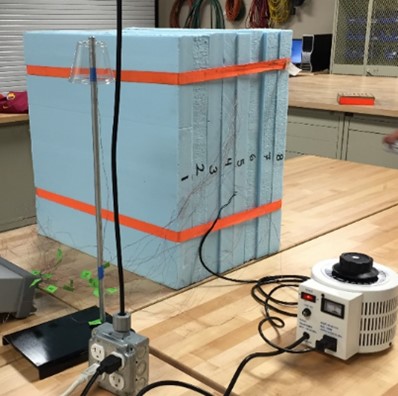
Figure 3. Experimental Set-Up
Progress Summary:
The preliminary results indicate that each experiment be repeated with increased instrumentation to increase the resolution of the data. It is recommended that each experimental container be instrumented with 9 towers with 4 thermocouples each to measure lid and PCM temperature, 3 thermocouples to measure HDPE Body temperature, and 1 ambient thermocouple. This would be a total of 40 thermocouples per experimental container. With the current amount of Multiplexers (3 multiplexers), only one experiment could be run at a time. Therefore, it is also recommended that an additional Multiplexer be purchased in order to run two experiments at once.

Figure 4. Temperature Profile
It is also recommended that PCMs with various melting temperature ranges be tested to determine which PCM has the optimal thermal regulating properties.
Future Activities:
PCMs will could enhance the efficiency of PV panels. We will further develop a test rig so we can collect the data of PV panels at working conditions to investigate how the increased effiicency will improve the performance of solar cooling system.
Journal Articles:
No journal articles submitted with this report: View all 2 publications for this projectSupplemental Keywords:
Solar cooling, photovoltaic, phase-change materialProgress and Final Reports:
Original AbstractP3 Phase I:
Develop a Concentrated Solar Power-based Thermal Cooling System via Simulation and Experimental Studies | Final ReportThe perspectives, information and conclusions conveyed in research project abstracts, progress reports, final reports, journal abstracts and journal publications convey the viewpoints of the principal investigator and may not represent the views and policies of ORD and EPA. Conclusions drawn by the principal investigators have not been reviewed by the Agency.