


Grantee Research Project Results
2016 Progress Report: Assessment, Monitoring and Adaptation To Food and Water Security Threats to the Sustainability of Arctic Remote Alaska Native Villages
EPA Grant Number: R835597Title: Assessment, Monitoring and Adaptation To Food and Water Security Threats to the Sustainability of Arctic Remote Alaska Native Villages
Investigators: Berner, James E. , Brubaker, Michael
Institution: Alaska Native Tribal Health Consortium
EPA Project Officer: Hahn, Intaek
Project Period: July 1, 2014 through June 30, 2018 (Extended to June 30, 2019)
Project Period Covered by this Report: July 1, 2015 through June 30,2016
Project Amount: $888,282
RFA: Science for Sustainable and Healthy Tribes (2013) RFA Text | Recipients Lists
Research Category: Tribal Environmental Health Research , Human Health
Objective:
Establish a community-based, resident-operated, environmental monitoring program, the Rural Alaska Monitoring Program (RAMP), in the communities of the Bering Strait region of northwest Alaska. The goal of the RAMP is to monitor and track trends in established threats, to detect emerging threats, and to provide data to communities for development of risk-reduction adaptation strategies to enable community sustainability in the presence of the climate-mediated environmental health threats.Progress Summary:
The RAMP is designed to monitor the distribution and current prevalence of several climate-influenced traditional food and water threats. These threats include infectious diseases of animals capable of infecting exposed humans (zoonotic diseases), harmful algal bloom (HAB) toxins in marine and fresh water, and the presence of mercury in sea mammals and fresh water sources.
Resident hunters have gathered a variety of specimens from subsistence animals, including blood on filter paper sampling kits (from both land mammals and sea mammals), stomach contents (from sea mammals, water from tundra ponds near villages, mosquitos from near villages, and clams, which will be tested for harmful algal bloom toxins. Each of these sources will be separately described.
Zoonotic disease exposure in sea mammals:
A number of blood samples from walrus, and four species of seals, were tested, and the results are shown in Table 1, below.
Table 1: Zoonotic Disease in Sea Mammals

Zoonotic disease exposure in caribou:
Over 100 caribou blood samples are in a reference laboratory, undergoing testing for exposure to zoonotic pathogens, and the results are pending.
HAB toxin content in sea mammal stomach contents:
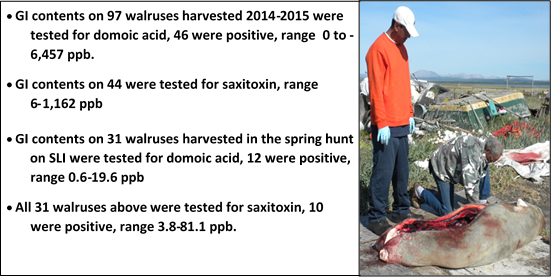
Sea mammal stomach contents tested for presence of two HAB toxins, Saxitoxin associated with paralytic shellfish poisoning (PSP) and domoic acid, associated with amnesic shellfish poisoning. The results are shown in Table 2A and 2B.
Table 2A: Bering and Chukchi Sea HAB Studies
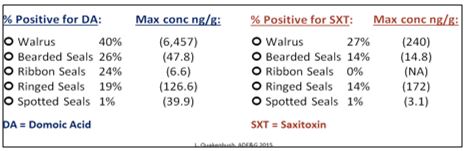
Table 2B: Harmful Algal Blooms; HAB Toxin Levels in Walruses from St. Lawrence Island (SLI)
Mosquito tests:
Mosquitos are tested in pooled samples, gathered from traps in three village sites. They are tested for presence of DNA from the bacterial organism, Franciscella tularensis (FT), that causes the human disease, tularemia, which has moved north as the tree-line in Alaska has moved north with the warming Arctic climate. The beaver and muskrat population has followed the tree line north, and they are the reservoir in the wildlife population for FT, which can be spread by contaminated water, ticks, and, in Europe it has been shown to be carried and spread by mosquitos. See the early results from polymerase chain reaction (PCR) testing and the summary of the QA/QC testing to determine the optimal PCR primer, in Table 3. A large number of sample mosquitos remain to be tested from this summer’s sampling, and should be complete before the spring sampling season starts.
Table 3: Mosquito Sampling Results

Clam tests for HAB toxins:
The clam sampling done on clams is done on two sets of clams, one, summarized above, is clams (and small fish) from walrus and seal stomach contents, summarized above, in Table 2A. The other set is comprised of clams gathered from the bottom of the Bering Strait region, by dredge, and those samples are being analyzed at the present time.
Tundra pond water testing:
Fresh water from three coastal regions of the Bering Strait region was tested for cyanobacterial toxins, microcystin and nodularin, and both total mercury and methyl mercury. These tests were carried out to investigate the effect of the longer frost-free season in northwest Alaska, to look for cyanobacterial blooms and to get baseline data on the amount of bacterial methylation of the mercury resulting from the warmer and longer summer season The samples from the summer testing are in reference laboratories, and not yet available. The results are expected by the end of calendar 2016. These concerns are potentially significant due to the steady increase in coal-fired power plants being built in Asia, and melting permafrost.
Future Activities:
The major additions to the testing described above will be increased tundra pond water testing, and more sites above the Arctic Circle for mosquito sampling. In addition, a possibility of testing clams of various species, for anthropogenic contaminants and cyanobacterial toxins may be added to the HAB studies on dredged clams, at no cost to the RAMP budget. Those results will be reported to the involved communities and regions if that becomes possible.Journal Articles:
No journal articles submitted with this report: View all 20 publications for this projectProgress and Final Reports:
Original AbstractThe perspectives, information and conclusions conveyed in research project abstracts, progress reports, final reports, journal abstracts and journal publications convey the viewpoints of the principal investigator and may not represent the views and policies of ORD and EPA. Conclusions drawn by the principal investigators have not been reviewed by the Agency.