U.S. flag

An official website of the United States government

Here’s how you know

Dot gov

Official websites use .gov
A .gov website belongs to an official government organization in the United States.

HTTPS

Secure .gov websites use HTTPS
A lock (LockA locked padlock) or https:// means you have safely connected to the .gov website. Share sensitive information only on official, secure websites.

  • Environmental Topics
  • Laws & Regulations
  • Report a Violation
  • About EPA
Contact Us

Grantee Research Project Results

Final Report: Preconcentration Technology for Infrared Analysis of Organophosphates in Water

EPA Contract Number: EPD12011
Title: Preconcentration Technology for Infrared Analysis of Organophosphates in Water
Investigators: Roy, Eric
Small Business: Orono Spectral Solutions Inc
EPA Contact: Richards, April
Phase: I
Project Period: March 1, 2012 through August 31, 2012
Project Amount: $80,000
RFA: Small Business Innovation Research (SBIR) - Phase I (2012) RFA Text |  Recipients Lists
Research Category: SBIR - Homeland Security , Small Business Innovation Research (SBIR)

Description:

In the field, drinking water cannot be quickly and reliably analyzed for the presence of highly toxic organophosphate pesticides due to insufficient sensitivity of current portable detection systems. The objective of this SBIR effort is to develop a sampling device that uses reactive nanomaterials to preconcentrate trace levels of organophosphates into a solid film, which can then be analyzed using commercially available Attenuated Total Reflectance (ATR) Infrared (IR)-based detection systems. The preconcentration technology will enable highly trusted, field portable detection systems to detect and positively identify trace concentrations of organophosphate pesticides in water to ensure the safety of human health and the environment.

Summary/Accomplishments (Outputs/Outcomes):
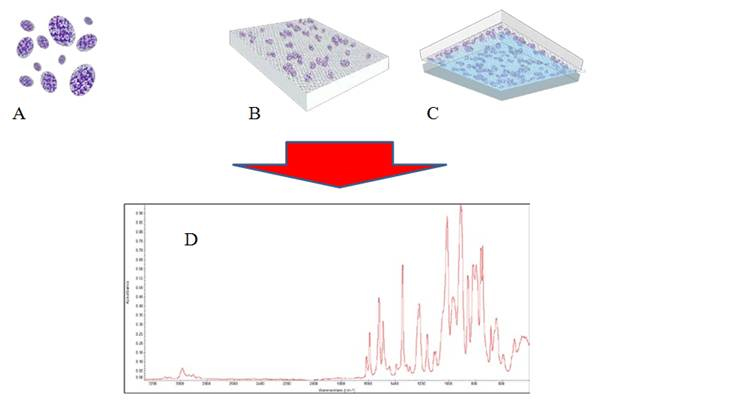
During Phase I, a blend of highly reactive materials was developed and used to successfully preconcentrate part per million (ppm) concentrations of four organophosphate pesticides onto reactive nanoparticles (Figure 1A). These nanoparticles were then collected onto a membrane via syringe filtration, thus forming a solid film of now concentrated pesticides/nanoparticles on the membrane surface (Figure 1B) and analyzed using ATR IR spectroscopy (Figure 1C), where the spectroscopic can be used to identify the organophosphate (Figure 1D).
 
 
Figure 1
Figure 1. Schematic showing how organiphosphate pestcides are A) Concentrated onto reactive nanoparticles
 B) Collected onto a membrane C) Analyzed using ATR IR spectroscopy and D) Identified using the unique IR
signature for each chemical compound. 


Conclusions:
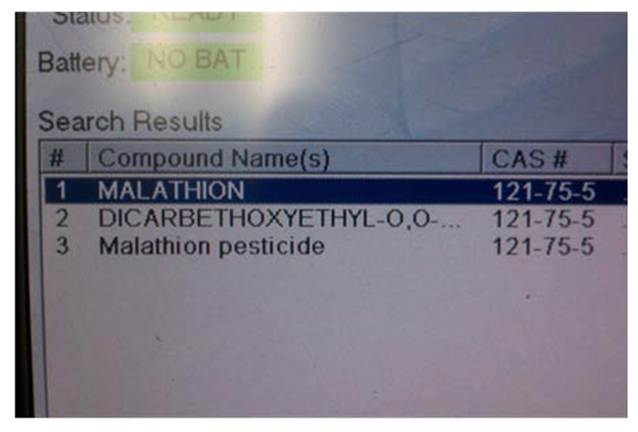
The most exciting finding of Phase I is that the spectroscopic signatures of the organophosphate pesticides that had been concentrated onto the nanoparticles were nearly identical to the corresponding spectrum of the pure material. This allows the concentrated film of pesticides to be positively identified using detection algorithms and spectral libraries already found onboard ATR IR-based detection systems currently in use by military personnel and first responders. Figure 2 shows an instrument screenshot when a dilute solution of Malathion was preconcentrated using the newly developed preconcentration system and was analyzed as an unknown sample using a Hazmat ID 360 detection system on loan from Smiths Detection. It is important to note that all three hits in the search results are different names for the same chemical (as evidenced by identical CAS#’s).
 
Figure 2
Figure 2. Output from Hazmat ID 360 when ZnO/Malathion was run as an unknown sample. All 3 hits are for the 
same chemical, as evidenced by the same CAS #.

Supplemental Keywords:

organophosphates, water supply, detection, attenuated total reflectance infrared spectroscopy, hazmat response, homeland security, toxic chemicals, chemical warfare agents

Top of Page

The perspectives, information and conclusions conveyed in research project abstracts, progress reports, final reports, journal abstracts and journal publications convey the viewpoints of the principal investigator and may not represent the views and policies of ORD and EPA. Conclusions drawn by the principal investigators have not been reviewed by the Agency.

Site Navigation

  • Grantee Research Project Results Home
  • Grantee Research Project Results Basic Search
  • Grantee Research Project Results Advanced Search
  • Grantee Research Project Results Fielded Search
  • Publication search
  • EPA Regional Search

Related Information

  • Search Help
  • About our data collection
  • Research Grants
  • P3: Student Design Competition
  • Research Fellowships
  • Small Business Innovation Research (SBIR)
Contact Us to ask a question, provide feedback, or report a problem.
Last updated April 28, 2023
United States Environmental Protection Agency

Discover.

  • Accessibility
  • Budget & Performance
  • Contracting
  • EPA www Web Snapshot
  • Grants
  • No FEAR Act Data
  • Plain Writing
  • Privacy
  • Privacy and Security Notice

Connect.

  • Data.gov
  • Inspector General
  • Jobs
  • Newsroom
  • Open Government
  • Regulations.gov
  • Subscribe
  • USA.gov
  • White House

Ask.

  • Contact EPA
  • EPA Disclaimers
  • Hotlines
  • FOIA Requests
  • Frequent Questions

Follow.