


Grantee Research Project Results
Final Report: Enhanced detection of lead ions in drinking water using bismuth nanoparticles
EPA Grant Number: SU840576Title: Enhanced detection of lead ions in drinking water using bismuth nanoparticles
Investigators: Dong, Lifeng , LiaBraaten, Lucas , Wagner, McKenzie , Luna-Gutierrez, Diego , Phillips, Shelby , Griebel, Zach , Christianson, Kiera , Anderson, Tommy , Mettler, Shane
Institution: Hamline University
EPA Project Officer: Spatz, Kyle
Phase: I
Project Period: August 1, 2023 through July 31, 2024
Project Amount: $24,975
RFA: 19th Annual P3 Awards: A National Student Design Competition Focusing on People, Prosperity and the Planet Request for Applications (RFA) (2022) RFA Text | Recipients Lists
Research Category: P3 Awards , P3 Challenge Area - Safe and Sustainable Water Resources
Objective:
The objective of this project was to explore the potential of bismuth (Bi) nanostructures for lead detection in drinking water using surface-enhanced Raman spectroscopy (SERS). Specifically, the project aimed to develop a cost-effective method for synthesizing Bi nanostructures through electrodeposition, investigate their ability to enhance Raman signals, and evaluate their effectiveness as an alternative to traditional gold and silver nanostructures for detecting lead ions. For instance, as reported by the U.S. Geological Survey in 2023, gold costs approximately $57.90 per gram, compared to bismuth's $0.0085 per gram. The ultimate goal was to provide a sustainable and economically feasible solution for monitoring lead contamination in drinking water, a critical public health issue.
Summary/Accomplishments (Outputs/Outcomes):
I. Development of a Green Synthesis Method for Bismuth Nanoparticles (BiNPs):
We successfully developed a reproducible green synthesis method for producing bismuth nanoparticles (BiNPs) using a lemon juice-based approach inspired by Mahiuddin and Ochiai. This environmentally friendly method consistently yielded BiNPs with diameters averaging approximately 50 nm. Key findings and accomplishments of this project include:
1) Optimization of Synthesis Parameters
- The synthesis process was systematically studied to identify and optimize key parameters influencing nanoparticle formation, such as growth conditions (temperature, reaction time, and solution pH) and post-synthesis washing conditions (centrifugation speed, duration, and washing solution composition).
2) Establishment of a Quality-Assured Synthesis Procedure
- A standardized, reproducible procedure was established, ensuring consistent quality in BiNP production.
Preparation of Lemon Juice Extract: Freshly squeezed lemon juice was centrifuged, vacuum-filtered, and stored under refrigeration to maintain quality.
Preparation of Reaction Mixtures: A solution of filtered lemon juice mixed with bismuth nitrate pentahydrate was combined with a 4 M sodium hydroxide solution to adjust the pH to ~12.3 - 12.4.
Reaction Process: The reaction mixture was sonicated, stirred, and maintained at 85 °C for 2 hours in a thermostat bath to facilitate nanoparticle formation.
Post-Synthesis Washing and Isolation: Repeated centrifugation and washing steps ensured the removal of impurities, producing a stable BiNP suspension for characterization.
3) Characterization of Synthesized BiNPs
- Scanning electron microscopy (SEM) images confirmed the successful synthesis of BiNPs, showcasing uniform nanoparticle dimensions (Figure 1a). Transmission electron microscopy (TEM) provided further validation, revealing well-dispersed nanoparticles with an average size of ~50 nm (Figure 1b).
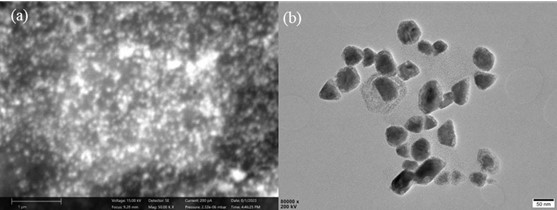
Figure 1. (a) SEM images of lemon juice-capped bismuth nanoparticles at varying magnifications. While some particle clusters are observed, the majority of nanoparticles appear well-dispersed. (b) TEM image of bismuth nanoparticles, showcasing their uniform morphology and size distribution.
Significance of Findings: The development of this green, solution-based synthesis method aligns with sustainable chemical practices by minimizing environmental impact and reducing the use of hazardous materials. The standardized procedure enhances reproducibility, supporting broader adoption in research and industrial applications.
These results lay the foundation for further exploration of BiNP applications in areas such as catalysis, environmental sensing, and sustainable material development. The outcomes of this project demonstrate the feasibility of leveraging natural materials and processes to achieve highquality nanoparticle synthesis while promoting environmental stewardship.
II. Development of a Simple Electrodeposition Method for Synthesizing Bi Thin Films:
This project resulted in the successful development of a simple and effective electrodeposition method for synthesizing Bi thin films on copper and aluminum substrates. These films have significant potential for applications such as lead ion detection. Key findings and accomplishments include:
1) Optimization of Electrodeposition Parameters
- Initial trials using a slightly modified acetate buffer and chronoamperometry at 1.4 V for 300 seconds produced Bi thin films with nanoparticle-like structures.
- Challenges with precursor solubility were identified, and solubility tests confirmed that bismuth nitrate pentahydrate (Bi(NO₃)₃·5H₂O) dissolves up to 150.6 mg/100 mL in deionized water, corresponding to 1.3 mmol/L Bi³⁺ ions.
2) Improved Electrolyte Preparation
- Reducing precursor concentrations (1 mM to 0.15 mM) allowed for controlled deposition of thinner films, minimizing detachment during rinsing. o A buffer solution with a pH of ~5, prepared with sodium acetate and acetic acid, supported stable deposition and better film morphology.
3) Characterization of Bi Thin Films
- Electrochemical deposition yielded diverse morphologies, including clusters, nanowires, and speckled deposits. Speckled deposits were the most effective, reducing overgrowth and ensuring stable films.
- SEM confirmed the formation of nanoparticles and other structures with varying deposition conditions, providing insight into the role of buffer solutions in achieving desirable morphologies (Figure 2).

Figure 2. SEM images of two different Bi deposits using different electrolyte solutions. (a) 1.51 mM Bi electrolyte in acetate buffer at -1.4 V for 300 s. (b) 0.75 mM Bi electrolyte at -1.4 V for 30 s.
4) Establishment of a Reproducible Deposition Procedure
- A quality-assured electrodeposition process was developed using an acetatebuffered electrolyte. Deposition was conducted at -1.4 V for 60 - 300 seconds, followed by gentle rinsing and air-drying to preserve deposits.
5) Comparative Analysis of Deposition Solutions
- Depositions using a simple water solution of Bi(NO₃)₃·5H₂O produced thicker films more rapidly but resulted in shard-like structures. o The acetate-buffered solution provided better control over deposition, yielding uniform nanoparticle clusters.
Significance of Findings: This research demonstrated a scalable and reproducible electrodeposition method for Bi thin films, with significant control over film thickness and morphology. The method leverages accessible materials and simple processes, making it viable for broader applications in environmental sensing and lead ion detection.
These findings contribute to the advancement of green and cost-effective solutions in materials science, aligning with sustainability goals and supporting further research into electrochemical deposition techniques.
III. Exploration of Bi Nanostructures for Lead Detection in Drinking Water Using Surface-Enhanced Raman Spectroscopy (SERS):
This project successfully demonstrated the potential of Bi nanostructures as a cost-effective alternative to gold and silver nanostructures for lead ion detection in drinking water using SERS. Key findings and accomplishments include:
1) Successful Synthesis of Bi Nanostructures
- Two distinct Bi nanostructures were deposited onto aluminum substrates via electrodeposition using a 10 mM Bi³⁺ solution in 1 M HNO₃ at -0.5 V. o Deposition times of 10 and 50 seconds produced nanostructures with varying dimensions, with longer times yielding thicker films and larger whisker-like features (Figure 3a-b).

Figure 3. SEM images of two different Bi deposits on aluminum substrates using 10 mM Bi3+ in 1 M HNO3 solution at -0.5 V for different deposition times. (a) Deposition for 50 s and (b) for 10 s. As deposition time increases, the dimensions of the Bi whiskers become larger. (c) Raman spectra of 10 mM 4-ATP solution on the two Bi deposits on aluminum substrates compared to the same 4ATP solution on a pure aluminum substrate.
2) Raman Signal Enhancement with Bi Nanostructures
- Raman analysis was conducted using 4-aminothiophenol (4-ATP) as a probe molecule for lead ion detection. o Pure aluminum substrates showed no detectable Raman signals, while Bi-coated substrates produced significant Raman signals, demonstrating their effectiveness in enhancing the Raman signal (Figure 3c). o Notably, shorter deposition times resulted in stronger Raman signal enhancement, highlighting the impact of nanostructure dimensions on SERS performance.
3) Potential for Cost-Effective Lead Detection
- This study confirmed that Bi nanostructures can efficiently enhance Raman signals, supporting their application in SERS for lead ion detection in drinking water.
- Bi offers a promising alternative to gold and silver nanostructures, providing a more affordable solution without compromising performance.
Conclusions:
Implications and Future Directions: These findings establish a foundation for further research into the use of Bi nanostructures in environmental sensing applications. Key areas for future exploration include:
- Optimizing deposition parameters, such as deposition time, electrical potential, and precursor concentration.
- Evaluating the performance of Bi nanostructures on alternative substrates.
- Investigating the reproducibility and sensitivity of the system under real-world conditions.
By demonstrating the feasibility of using Bi nanostructures for lead detection in drinking water, this project contributes to advancing sustainable and cost-effective technologies for environmental monitoring and public health protection.
Journal Articles:
No journal articles submitted with this report: View all 3 publications for this projectSupplemental Keywords:
Bismuth nanoparticles, electrodeposition, surface enhanced Raman spectroscopy, lead detection, drinking water, heavy metal sensing, green synthesisThe perspectives, information and conclusions conveyed in research project abstracts, progress reports, final reports, journal abstracts and journal publications convey the viewpoints of the principal investigator and may not represent the views and policies of ORD and EPA. Conclusions drawn by the principal investigators have not been reviewed by the Agency.