


Grantee Research Project Results
Final Report: Prototyping a Process to Reuse Wasted Glass in High Performance Low Carbon Concrete
EPA Contract Number: 68HERC22C0027Title: Prototyping a Process to Reuse Wasted Glass in High Performance Low Carbon Concrete
Investigators: Kumpon, Jacob
Small Business: KLAW Industries LLC
EPA Contact: Richards, April
Phase: I
Project Period: December 13, 2021 through June 12, 2022
Project Amount: $99,966
RFA: Small Business Innovation Research (SBIR) Phase I (2022) RFA Text | Recipients Lists
Research Category: Small Business Innovation Research (SBIR)
Description:
The process to produce cement has remained unchanged since the industrial revolution. Concrete producers need a new high-performing cement alternative to lower their concrete products' cost and embodied carbon.
Otherwise, we will be building our future communities using a process with the embodied carbon and financial costs of 1820s technology.
This project developed a scalable production process for a high-performance concrete raw material to drastically lower carbon emissions, increase strength, and lower the cost of our infrastructure. Derived from the waste glass we landfill across the country, KLAW Industries has developed and deployed the largest material innovation in the concrete industry since the 1940s.
Our new material is a supplementary cementitious material (SCM), created from post-consumer glass that solves not only a major infrastructure problem, but helps recyclers find valuable end markets for their materials. This dual commercialization opportunity has led to early traction and support from industry leaders.
Summary/Accomplishments (Outputs/Outcomes):
Our technical research aimed to answer two questions.
1. Can the proposed scalable process constantly remove impurities from different, highly variable sources of waste glass?
2. Can the resulting glass be successfully used as an SCM in concrete?
We answered these questions by completing the following milestones.
Milestone 1: Construct the designed scalable process to the specified tolerances.
A scalable process to remove contamination from waste glass was built at KLAW Industries' facility in Binghamton, NY. The new system is efficient and scalable.
Milestone 2: Test the prototype process with three sources of waste glass. Adjust the process to successfully remove 99.5% of impurities by mass from each waste glass source.
We tested this new process using waste glass from three recyclers in New York. These highly contaminated glass sources were processed to below 0.5% contamination, the ASTM limit for glass SCMs.
| Waste Glass Source | Contamination Remaining After Processing |
|---|---|
| Source 1 - Delaware County, NY | 0.0548% |
| Source 2 - Broome County, NY | 0.397% |
| Source 3 - Ontario County, NY | 0.342% |
Milestone 3: Adjust the scalable prototype process to ensure the 3 critical costs, energy usage, disposal, and labor are below $60/ton in total.
Innovations in the high-volume concrete and recycling industry must lead to financial savings. We adjusted this process to ensure our innovation's costs are below $60/ton to meet the industry's economic threshold.
Milestone 4: Pass ASTM C1866, the industry standard performance metric for glass SCMs.
Effective March 1, 2020, ASTM C1866 is the existing standard for using glass as an SCM, and we continue to adjust our process to keep our loss on ignition within the limits of this standard.
Milestone 5: Use the resulting glass SCM in a pilot project and evaluate performance in accordance with ASTM C39 and ASTM C143.
The core of our research was to partner with a local concrete plant to complete a project containing 6-yards of concrete and perform standard field and compression testing. A garage floor was poured using our glass SCM, which passed all field testing and increased the compressive strength of the concrete to 5353 on a 4000 PSI concrete mix. This high performance, coupled with field testing success, has validated the technical benefits of glass SCMs in the field.
| 4000 PSI Mix Cure Day | Compression Test Results |
|---|---|
| 7-Day | 3472 PSI |
| 14-Day | 4492 PSI |
| 28-Day | 5353 PSI |
Conclusions:
Utilizing glass as an SCM provides concrete producers with technical, environmental, and cost benefits. The superior performance of a glass SCM demonstrated in our pilot project shows the potential of this innovative technology. By partnering with local concrete producers, KLAW Industries has tested our results in the field and proven concrete industry leaders' willingness to adopt the next generation of sustainable materials.
The technical success of our glass SCM and the economic benefit of deriving this innovative material from waste glass has led to a major commercial opportunity. Concrete producers have used fly ash from coal power plants and slag from steel foundries as SCMs since the 1940's. However, as these industries decline in the US, concrete producers face shortages and price increases on their critical materials.
The technical research performed in conjunction with a pilot project in Binghamton provides a solution to this industry wide problem that is hitting small, ready-mix concrete producers the hardest. With this EPA funded research and a production facility in Binghamton, KLAW Industries is well positioned to bring the next wave of sustainable materials to market.
We are now scaling our process to meet the increased demand from the northeast concrete market for new materials developed in partnership with academia, the EPA, and industry.
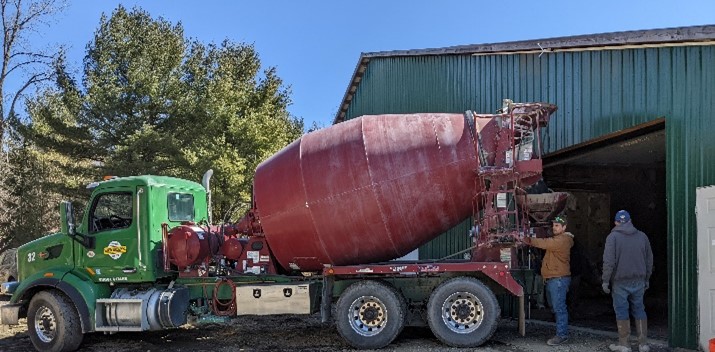
An image from KLAW Industries' EPA SBIR project.
SBIR Phase II:
Prototyping a Process to Reuse Wasted Glass in High Performance Low Carbon ConcreteThe perspectives, information and conclusions conveyed in research project abstracts, progress reports, final reports, journal abstracts and journal publications convey the viewpoints of the principal investigator and may not represent the views and policies of ORD and EPA. Conclusions drawn by the principal investigators have not been reviewed by the Agency.