


Grantee Research Project Results
2018 Progress Report: Ammonia Removal During Solid Waste Anaerobic Digestion Increasing Energy Generation and Reactive Nitrogen Recovery
EPA Grant Number: SV839352Title: Ammonia Removal During Solid Waste Anaerobic Digestion Increasing Energy Generation and Reactive Nitrogen Recovery
Investigators: Grimberg, Stefan J. , Powers, Susan E. , Meyerson, Gabrielle , Roberts, Alexander , Atkinson, Brooke , Rhodes, Steven , Neu, Patrick , Protas, Michael , Quispe Cardenas, Luz Estefanny , Hunt, Jacob
Current Investigators: Grimberg, Stefan J. , Holsen, Tom M , Powers, Susan E. , Ajayi, Olutooni , Fleming, Abigail , Guo, Jennifer , Hunt, Jacob , Knapp, Michael , Meyerson, Gabrielle , Roberts, Alexander , Atkinson, Brooke , Rhodes, Steven , Neu, Patrick , Protas, Michael , Quispe Cardenas, Luz Estefanny , Randall, Andrew A. , Dwyer, Bryan , Hartle, Cody , Melgar, Daniel , Jaworski, Ellen , Sweeter, Gavin , Glasgow, Heath , Davis, Justin , Fudo, Lucas , Bredehoeft, Madison , Kitts, Mathew , Goetze, Rhiannon , Pawlowski, Sarah , Gallimore-Repole, Sasha
Institution: Clarkson University
EPA Project Officer: Page, Angela
Phase: II
Project Period: March 1, 2018 through February 29, 2020 (Extended to February 28, 2021)
Project Period Covered by this Report: March 1, 2018 through February 28,2019
Project Amount: $75,000
RFA: P3 Awards: A National Student Design Competition for Sustainability Focusing on People, Prosperity and the Planet - Phase 2 (2017) Recipients Lists
Research Category: P3 Awards , P3 Challenge Area - Safe and Sustainable Water Resources , Sustainable and Healthy Communities
Objective:
Anaerobic digestion is an effective method for reducing the amount of food waste sent to landfills, while facilitating useful biogas production, which can offset natural gas usage. However, the high levels of nitrogen present in Clarkson's food waste inhibits the microbes, in the existing campus anaerobic digester, from producing the maximum amount of usable biogas, severely limiting the efficiency of the overall system. This project aims to double the biogas production in the anaerobic digester by reducing the total ammonia nitrogen (TAN) concentration in the digestate tanks by 50%. The removed nitrogen will then be incorporated into the digestate for use as fertilizer.
Progress Summary:
The primary result thus far is that a process model has been developed that allowed us to complete the final process engineering of the system.
Ammonium will be removed from the digestate, at pH 8, using a cationic membrane, into a cationic-rich solution, at pH 11.25. Ammonium will then be converted into ammonia at a high pH. The cationic membrane will be a 25 m2 Ultrex™ CMI-7000. The membrane unit will be 4 feet long by 4 feet tall by 2 feet wide, and will consist of several sheets of membrane stacked between alternating channels of digestate and draw solution. There will be 9 channels for the digestate to flow through alternating with 10 channels for the draw solution. The draw solution will be a mix of 0.65 M potassium hydroxide and 0.20 M potassium carbonate at a temperature of 35 oC. In order to remove 50% of TAN from the food waste per day, 43 liters of draw solution will have to be treated in the bubbling column per day. To save space, the draw solution tank will be shared with the bubbling column. A 40 gallon bubbling column containing the potassium-rich draw solution will volatize the ammonia using a 9” diffuser with a dry air volume of 8.46 m3 per stripping event. Each event will be 6 hours so the flow will be around 1 ft3/min. This flow once it has passed through the bubbling tower will have removed around 99% of the ammonia from the liquid to the gas phase. The gas will then proceed to 2 sulfuric acid scrubbers using two 3” diffusers to to bubble the ammonia rich gas through the sulfuric acid resulting in a high concentration of the ammonia in the acid columns. A water column is added on the end as there is a need for a safety factor to be in place for and fugitive ammonia. These processes are outlined in Figure 1.
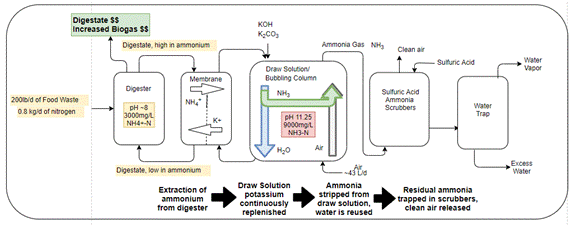
Figure 1: Proposed Design Processes for Ammonia Removal and Recovery
The proposed ammonia removal and recovery components’ layout and connections were designed. To accommodate the proposed system, the existing engine and piping obstructions in the trailer will be removed prior to fabrication. The entire proposed system will be located in place of the existing engine, with the bubbling column and scrubbers on a platform, to maximize space. This system with ammonium removal will add $35.35 per day in increased net benefit over the old system without ammonium removal. Based off of the time value of money this system will be paid off after approximately 2.6 years.
Using actual operation data we will update the economic nand LCA analyses once the data will be available.
Future Activities:
Over the remainder of the project period (we do not anticipate a no-cost extension) we will operate Clarkson’s foodwaste digester throughout the summer and winter period generating important data using during the process evaluation period.
Journal Articles:
No journal articles submitted with this report: View all 11 publications for this projectSupplemental Keywords:
Anaerobic Digestion, Nutrient Recovery, Ammonia InhibitionProgress and Final Reports:
Original AbstractP3 Phase I:
NH4 Removal and Reactive Nitrogen Recovery | Final ReportThe perspectives, information and conclusions conveyed in research project abstracts, progress reports, final reports, journal abstracts and journal publications convey the viewpoints of the principal investigator and may not represent the views and policies of ORD and EPA. Conclusions drawn by the principal investigators have not been reviewed by the Agency.